Clear Sky Science · en
Broadband multi-beam lens-assisted mmID enabling multi-gigabit backscatter data rates for next-generation wireless networks
Why Faster Tags Matter for Everyday Life
As our homes, cities, and factories fill with connected gadgets, the invisible job of simply recognizing and talking to each object becomes a serious bottleneck. Today’s identification tags—like the technology behind many key cards and warehouse trackers—either send data slowly, eat up power, or only work when you point a reader almost exactly at them. This paper introduces a new kind of ultra-fast, ultra‑efficient wireless tag that can stream data at fiber‑like speeds, sip tiny amounts of energy, and still be seen from a wide range of angles, making it well suited for dense smart‑city and industrial networks.
Turning Airwaves into a Data Highway
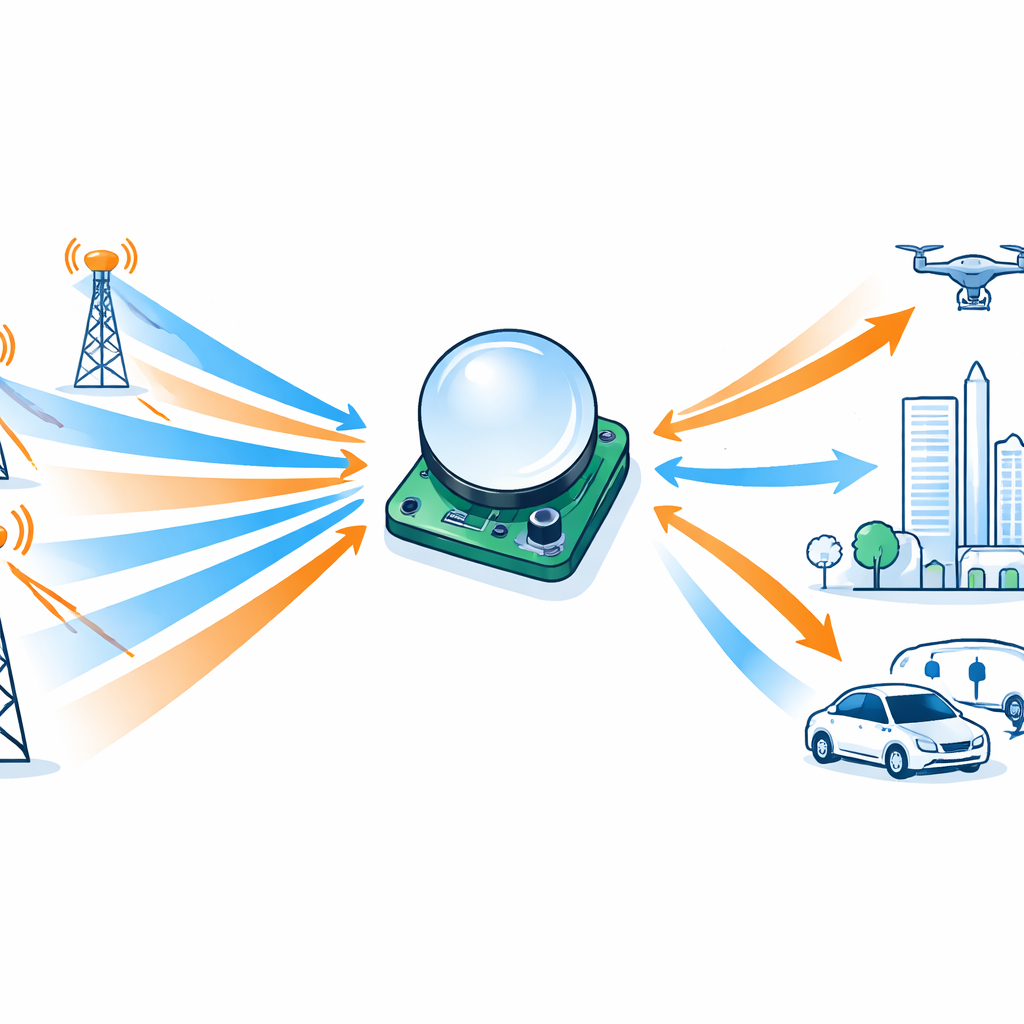
The work builds on a technique called backscatter, where a tag does not generate its own radio signal but instead “wiggles” the reflection of an incoming beam to encode data. That trick saves enormous energy but has traditionally been slow and short‑ranged. The authors move this idea into the millimeter‑wave bands used by 5G, where there is far more available spectrum and where base stations are already designed to send strong, tightly focused beams. By operating between 26 and 29 gigahertz, their tag can ride on the same bands that future networks will use for high‑speed connections, opening a path to tags that keep up with video streams and rich sensor data rather than just ID numbers.
A Tiny Pixel That Reflects Smarter
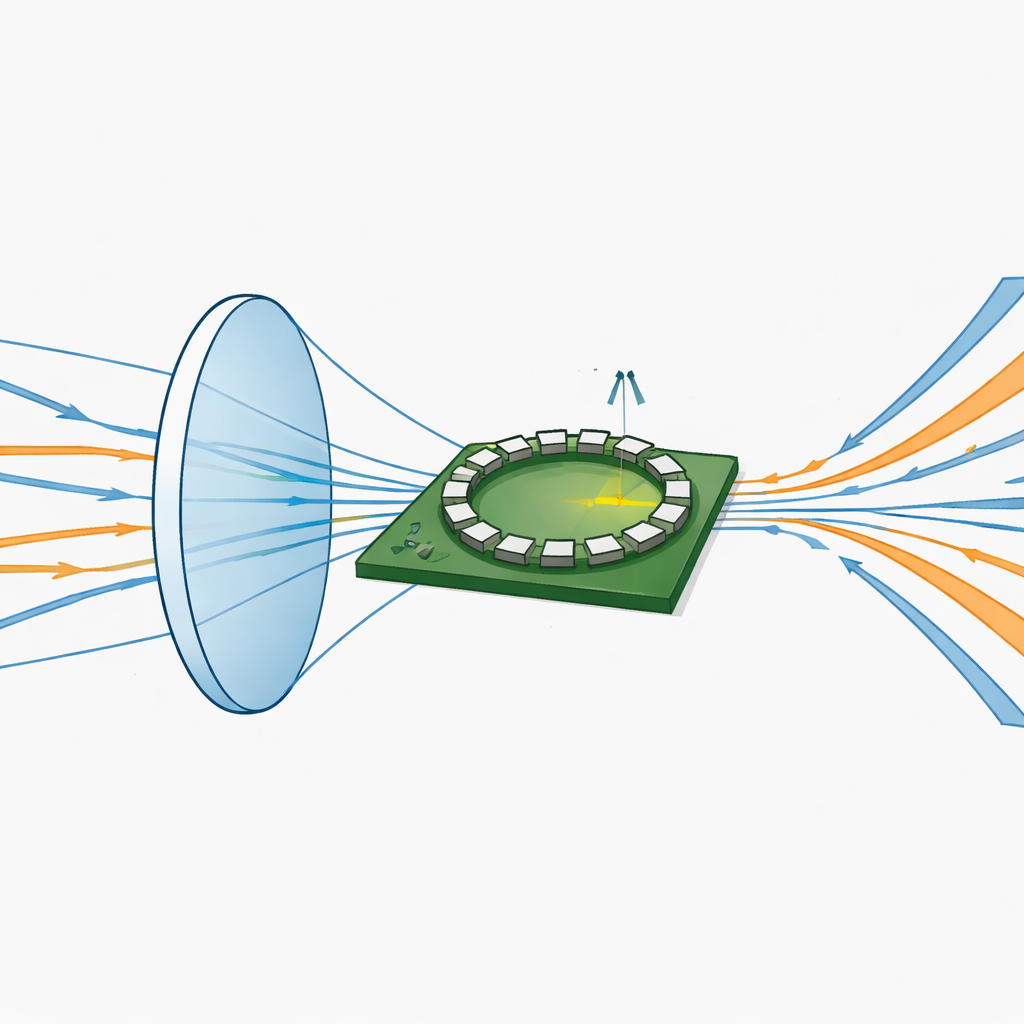
At the heart of the system is a “pixel” that combines a small antenna and an almost power‑free electronic switch. The antenna is designed to listen in one polarization of the radio wave and talk back in the perpendicular one, so the returning signal stands out clearly from the strong carrier sent by the reader. A field‑effect transistor gently changes the electrical load seen by this antenna, flipping the tag between a strong‑reflection and weak‑reflection state. By driving this switch with high‑speed patterns, the tag can imprint complex modulation formats—like those used in modern Wi‑Fi and fiber systems—onto the reflected beam, reaching data rates up to 4 gigabits per second while spending only a fraction of a picojoule of energy per bit.
A Radio “Magnifying Glass” for Wide Coverage
To make the tag visible from many directions without using moving parts or active beam steering, the team adds a clear plastic lens in front of a board holding 25 of these pixels. Much like an optical lens that focuses light, this curved piece of low‑loss PTFE plastic bends incoming millimeter‑wave beams from a broad field of view onto the pixel array. By carefully choosing the lens shape and size, they achieve high gain—effectively concentrating power—while still covering more than 110 degrees across the scene. The pixels are arranged in concentric rings, and each ring can be controlled independently. That means different angular sectors around the tag can carry different modulation schemes, letting it adapt to readers placed at various positions or even support multiple readers without interference.
Proving Speed, Range, and Efficiency
The authors put their prototype through detailed lab tests. Within an anechoic chamber, they measured how strongly the tag reflects when it is switched between states and how that performance holds up across angles and frequencies. The lens‑assisted design maintains strong contrast across ±55 degrees, confirming that readers do not need to be precisely aligned. In communication trials, the tag sustained 4 gigabits per second over 5 meters using a high‑order modulation format and maintained 1 gigabit per second over 20 meters, both head‑on and at a steep angle. Calculations based on the measured reflectivity suggest that, under the transmit power levels allowed for 5G base stations, such tags could be read at gigabit speeds from hundreds of meters to a few kilometers away, all while consuming drastically less energy than conventional radios.
What This Means for Future Connected Worlds
From a layperson’s perspective, this work shows how a simple combination of a smart reflector and a radio “magnifying glass” can turn tiny, nearly powerless tags into high‑speed communication devices. Instead of every sensor or asset in a smart city carrying a full radio with its own power‑hungry transmitter, they could rely on nearby infrastructure to shine millimeter‑wave beams and let the tags answer by subtly changing their reflections. The demonstrated system reaches fiber‑class data rates, works over meaningful distances, and covers a wide swath of angles, all at energy costs low enough to fit battery‑free or energy‑harvesting designs. That balance of speed, reach, and frugality could make it practical to track and monitor billions of objects in real time without wiring them or constantly changing batteries.
Citation: Joshi, M., Lynch III, C.A., Hu, K. et al. Broadband multi-beam lens-assisted mmID enabling multi-gigabit backscatter data rates for next-generation wireless networks. Nat Commun 17, 3765 (2026). https://doi.org/10.1038/s41467-026-70454-8
Keywords: millimeter wave backscatter, wireless identification, smart city IoT, dielectric lens antenna, ultra low power communication