Clear Sky Science · en
Multi-modal characterization of nitrate reduction nano-catalysts with periodic strain distribution
Turning Waste into a Valuable Fuel
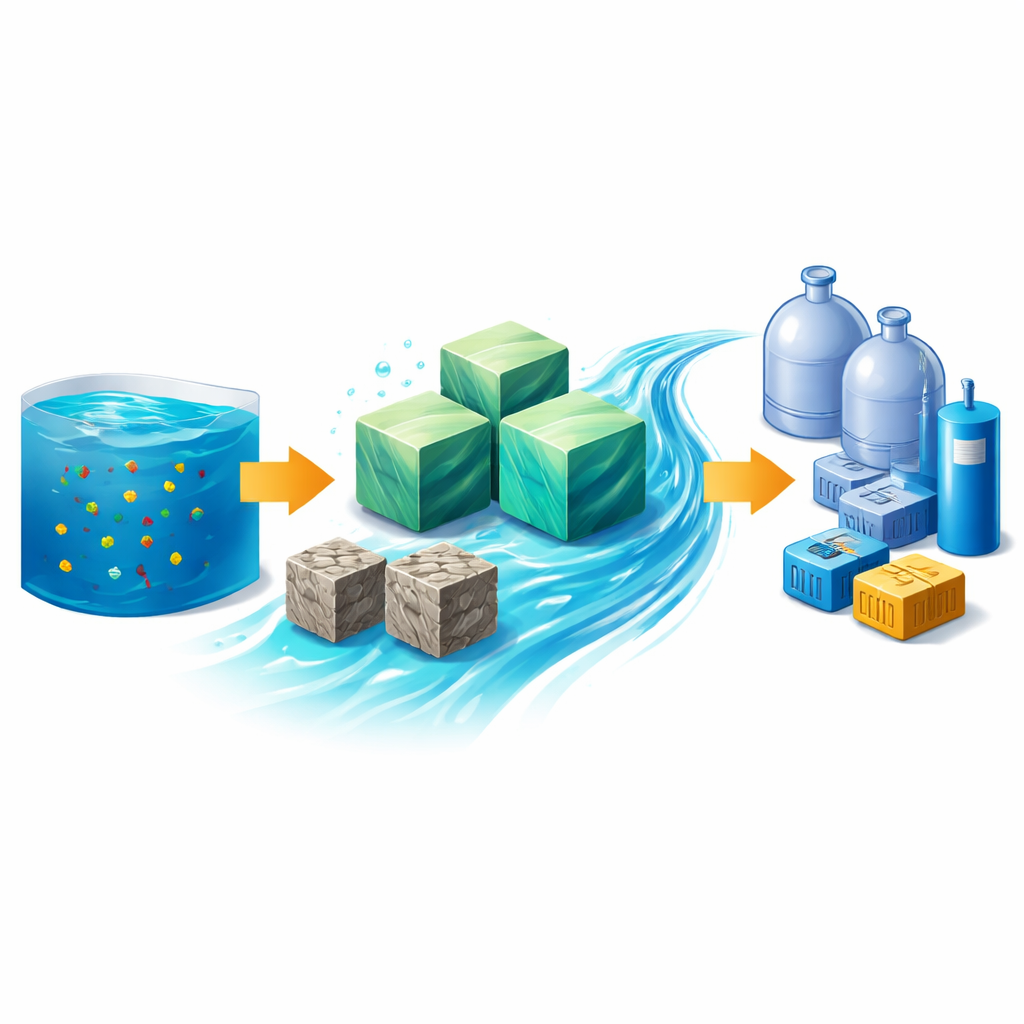
Ammonia is a cornerstone of modern agriculture and industry, but making it today usually demands high temperatures, high pressures, and large carbon emissions. At the same time, nitrate pollution in water threatens ecosystems and drinking supplies around the world. This study explores how to turn that problem into a solution: using electricity and carefully engineered tiny crystals to convert nitrate in water into ammonia efficiently, cleanly, and at scales relevant to industry.
Shaping Tiny Crystals to Control Their Power
The heart of this work lies in the idea that gently stretching or compressing the atomic lattice inside a catalyst can dramatically change how well it drives a chemical reaction. These crystals are made of metals such as copper, cobalt, and tin combined with hydroxide groups, arranged into neat nanometer-sized cubes. The researchers focused on two materials: a simpler cobalt–tin hydroxide and a copper-doped version, CuCoSn(OH)₆. By swapping some cobalt for copper, they intentionally disturbed the atomic arrangement to tune the internal “strain” of the lattice — a bit like putting a controlled ripple into a tightly woven fabric.
Seeing Ripples Inside a Single Nanocube
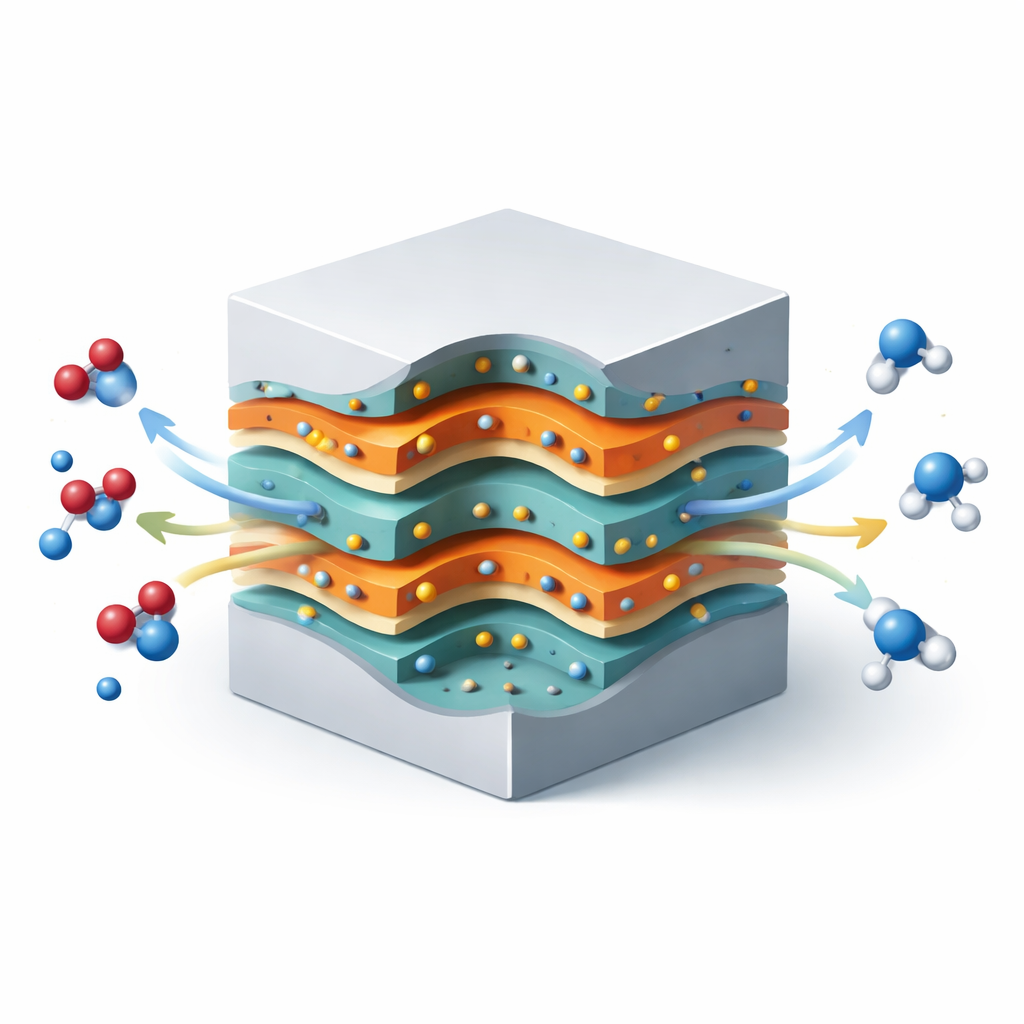
To understand how these ripples of strain are arranged, the team used an advanced electron microscopy method known as four-dimensional scanning transmission electron microscopy (4D-STEM). This approach records a tiny diffraction pattern at every point across a particle, allowing the researchers to construct a detailed strain map with sub-nanometer resolution over entire cubes up to 500 nanometers in size. They discovered that both kinds of nanocubes show periodic, ripple-like patterns of strain running through their interiors and across their surfaces. However, when copper is introduced, these ripples become more uniform and gentler, indicating a smoother distribution of stress inside the crystal.
Linking Atomic Ripples to Chemical Performance
Strain is not just a structural curiosity; it shifts how electrons are arranged in the metal atoms and how strongly the surface grabs onto reacting molecules. By combining their strain maps with quantum-mechanical calculations, the authors built a direct bridge from local strain to how tightly nitrate and its reaction intermediates bind to the surface. They showed that more uniform strain in the copper-doped cubes moves key electronic states closer to the energies needed to interact favorably with nitrate. As a result, nitrate sticks just strongly enough to be transformed step-by-step toward ammonia, while competing reactions such as hydrogen evolution are suppressed.
From Lab-Scale Cubes to Industry-Like Conditions
Armed with this structure–performance link, the researchers tested their copper-containing nanocubes in two types of electrochemical cells: small H-type cells common in labs, and larger membrane electrode assemblies (MEAs) that mimic industrial operation. In the MEA setup, the CuCoSn(OH)₆ catalyst achieved a Faradaic efficiency of about 93% for turning electrical charge into ammonia, along with very high ammonia production rates. Even at large currents and in long-term tests lasting over 1000 hours, the catalyst maintained strong performance and structural stability. The projected energy cost of the process suggests it could compete with, or even undercut, traditional ammonia production if powered by low-cost electricity.
Why This Matters for Clean Chemistry
This work shows that carefully controlling strain and composition inside real-world, relatively large catalyst particles can be the key to both high activity and durability. By visualizing periodic strain patterns and matching them to how nitrate binds and reacts, the authors provide a general recipe for designing better electrocatalysts: tune the internal ripples until the surface sites favor the desired reaction pathway. In practical terms, that means we may be able to convert nitrate pollution into valuable ammonia more efficiently, using electricity and robust catalysts engineered from the inside out.
Citation: Tao, Y., Zheng, X., Huang, S. et al. Multi-modal characterization of nitrate reduction nano-catalysts with periodic strain distribution. Nat Commun 17, 3778 (2026). https://doi.org/10.1038/s41467-026-70447-7
Keywords: electrocatalytic nitrate reduction, ammonia synthesis, strain-engineered catalysts, 4D-STEM characterization, CuCoSn hydroxide nanocubes