Clear Sky Science · en
Elucidating activity-stability trade-offs in nano-fingerprint carbon anchoring single atoms and clusters in oxygen reduction reaction
Why This New Battery Material Matters
As the world looks for cleaner ways to power cars, gadgets, and the grid, scientists are racing to replace costly platinum in fuel cells and metal–air batteries. This study reports a new catalyst made from cheap elements like iron, zinc, nitrogen, and carbon that can rival or beat platinum in certain battery setups while staying stable for thousands of hours. Understanding how this material works could help unlock longer‑lasting, more affordable clean‑energy technologies.
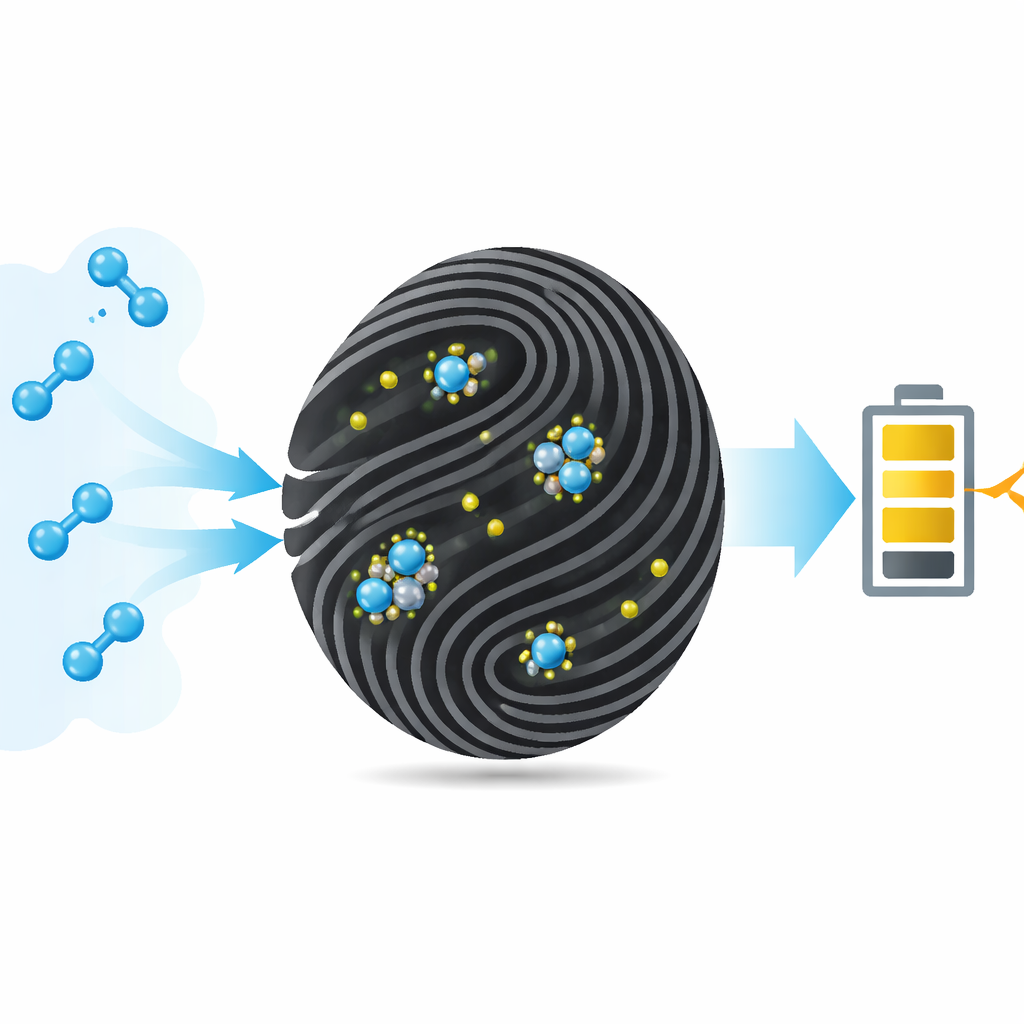
Slow Air Reactions Hold Back Clean Power
Fuel cells and metal–air batteries turn oxygen from the air into electricity through a process called the oxygen reduction reaction. This reaction is surprisingly sluggish because it involves several tightly linked electron and proton steps. Today, the best performers are platinum‑based catalysts, but platinum is expensive, scarce, and not very stable in the alkaline liquids used in many next‑generation devices. That has pushed researchers toward iron‑ and nitrogen‑doped carbons, which scatter single metal atoms on a carbon support. These single‑atom sites can be very active, but they can bind reaction intermediates too strongly and tend to clump together over time, reducing both performance and lifetime.
A Hybrid Surface Built from Atoms and Tiny Clusters
The team designed a composite catalyst that deliberately combines different types of iron and zinc sites on a specially shaped carbon surface. Using a porous crystal called ZIF‑8 as a starting template, they overloaded it with an iron precursor and then heated it to 1000 °C. Under these conditions, the material reorganizes into a nitrogen‑doped carbon skeleton that carries isolated iron and zinc atoms, plus ultra‑small iron clusters, all wrapped in curled, multi‑layer “nano‑fingerprint” carbon shells. Electron microscopy shows fingerprint‑like carbon rings about 8 nanometers wide, with bright single dots representing isolated atoms and slightly larger speckled regions marking iron clusters nestled within the curved layers.
Untangling Which Part Does What
To work out the role of each ingredient, the researchers prepared a family of related samples: with or without clusters, and with or without the fingerprint carbon layers. By comparing their performance, they found that the single iron and zinc atom sites mainly start the reaction, while the iron clusters act as electronic helpers that boost the intrinsic activity of these atomic sites. Meanwhile, the curled carbon layers serve as a physical and electronic cage: they confine the atoms and clusters close together and help prevent them from migrating and clumping under operation. In alkaline solution, the full hybrid catalyst reaches a half‑wave potential of 0.93 V, exceeding commercial platinum on carbon and all of the simpler comparison materials. After 50 hours of continuous testing and 10,000 voltage cycles, the loss in activity is minimal, especially when the fingerprint layers are present.
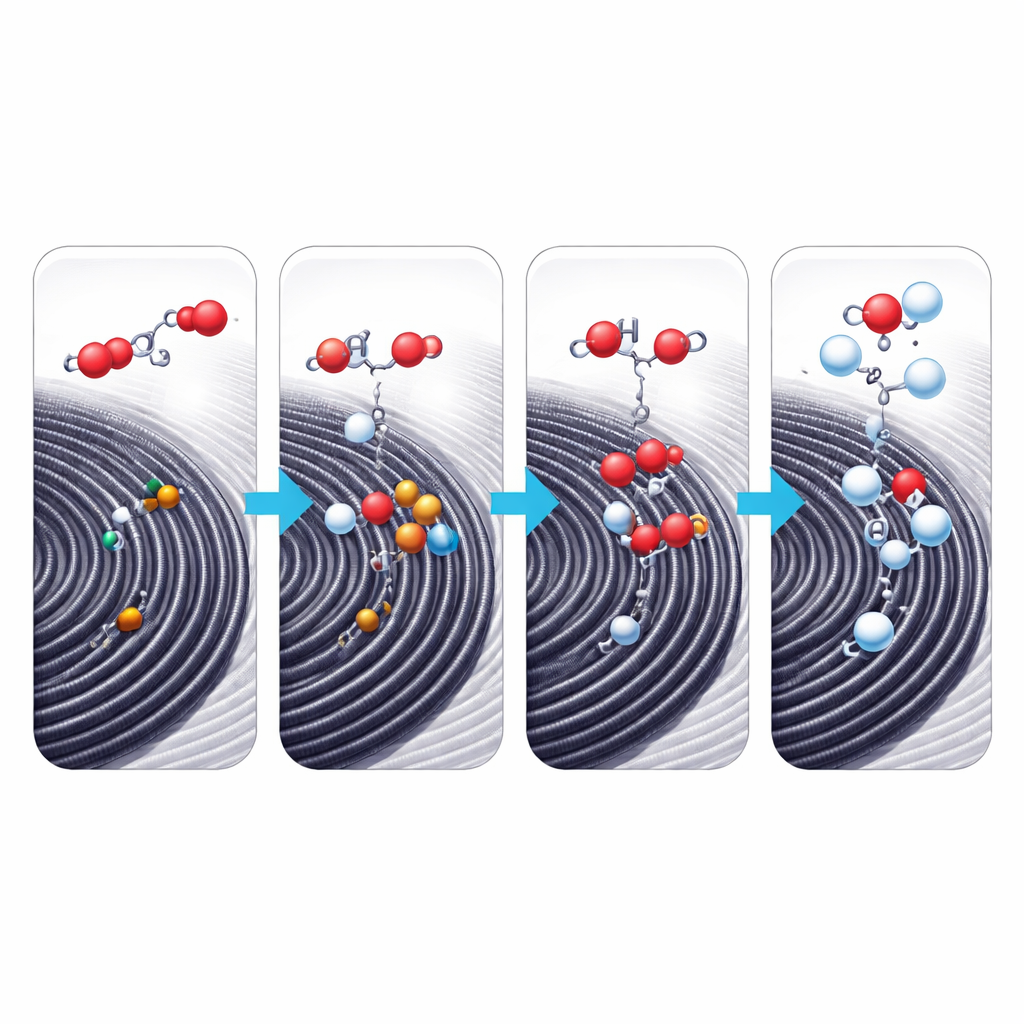
How Curved Carbon and Nearby Metals Tune the Reaction
Computer simulations provided a closer look at why this combination works so well. The authors modeled a single iron–nitrogen site on flat carbon, curved carbon (similar to nanotubes or fullerene‑like cages), and with or without neighboring zinc atoms and iron clusters. They focused on how strongly a key reaction intermediate, an OH fragment, sticks to the iron center. On flat carbon, OH binds too tightly, slowing the last step where it should detach. As the carbon is bent, built‑in strain and an uneven electron distribution weaken the iron–oxygen bond and make OH release easier. Adding neighboring zinc atoms and iron clusters further adjusts the local electronic structure, subtly shifting the energy levels of iron’s d‑orbitals so that adsorption is neither too strong nor too weak. Together, curvature and co‑catalyst sites push the system closer to the “just right” balance that theory predicts for a fast oxygen reduction reaction.
From Lab Catalyst to Long‑Lived Zinc–Air Batteries
The real test of any new catalyst is how it behaves in a working device. When used as the air electrode in a zinc–air battery, the hybrid material delivers a peak power density of about 264 mW per square centimeter, far higher than platinum‑based cells assembled under the same conditions. Even more striking, the rechargeable zinc–air batteries using this catalyst run stably at a set current for more than 2200 hours, with only a tiny change in operating voltage. Microscopy after cycling confirms that the fingerprint carbon shells and most single‑atom sites remain intact, with only slight aggregation at a few spots. The authors note that, going forward, improvements in the liquid electrolyte will be just as important as better catalysts for truly commercial devices.
What This Means for Future Clean Energy
In simple terms, this study shows that carefully mixing single atoms, ultra‑small clusters, and curved carbon shells can break the usual trade‑off between activity and durability in air‑breathing energy devices. By using inexpensive elements and engineering the local environment at the atomic scale, the researchers produced a catalyst that competes with or outperforms platinum in alkaline media and enables zinc–air batteries with record‑long lifetimes. This multicomponent “nano‑fingerprint” design offers a roadmap for building the next generation of robust, efficient catalysts for fuel cells, metal–air batteries, and other clean‑energy technologies.
Citation: Li, F., Wu, Q., Zhou, Y. et al. Elucidating activity-stability trade-offs in nano-fingerprint carbon anchoring single atoms and clusters in oxygen reduction reaction. Nat Commun 17, 3598 (2026). https://doi.org/10.1038/s41467-026-70446-8
Keywords: zinc-air batteries, oxygen reduction reaction, single-atom catalysts, nano-structured carbon, non-precious metal electrocatalysts