Clear Sky Science · en
Elucidating the rate-limiting step of CO2 electroreduction on metal phthalocyanines
Turning Carbon Pollution into Useful Fuel
Carbon dioxide from power plants and factories is a major driver of climate change, but it is also a plentiful raw material. Scientists are working on ways to use electricity from renewable sources to turn this waste gas into useful chemicals and fuels. This study asks a deceptively simple question about one promising class of catalysts for this job: at what exact step do they start to struggle? The answer helps explain why some catalyst designs work better than others and suggests new ways to speed up the process.
Why These Tiny Molecules Matter
Most current devices that turn carbon dioxide into chemicals rely on metal surfaces such as gold, silver, or copper. These metals can work well, but their surfaces have many different kinds of atomic sites, which makes the chemistry hard to control and understand. In contrast, molecular catalysts built around metal atoms inside ring-shaped organic frameworks—such as metal phthalocyanines—offer a more orderly playground. Each metal center sits in nearly the same environment, like identical seats in a stadium. When these molecules are anchored onto conductive supports, they can convert carbon dioxide to carbon monoxide with very high efficiency while producing little unwanted hydrogen gas. Yet despite years of work, researchers still disagreed on which microscopic step in the overall reaction slows everything down.
Pinpointing the Slow Step
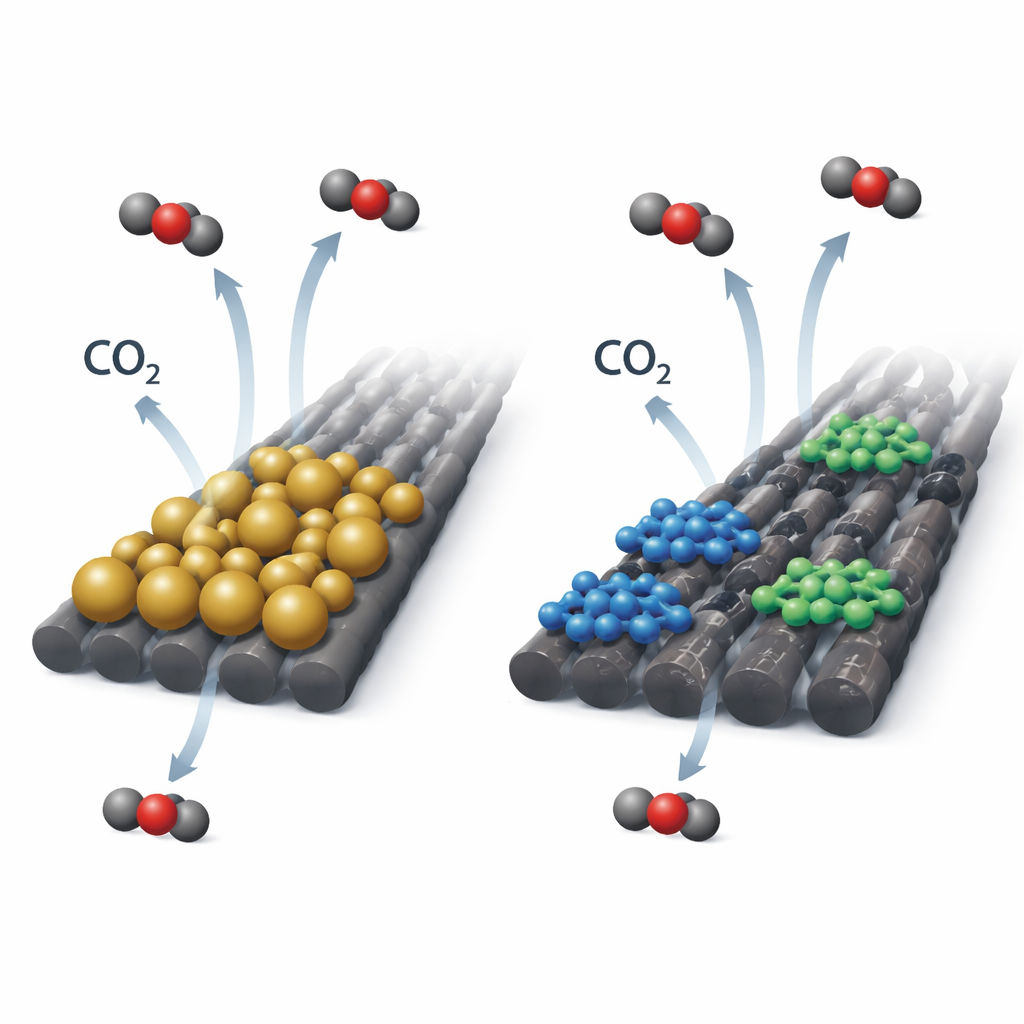
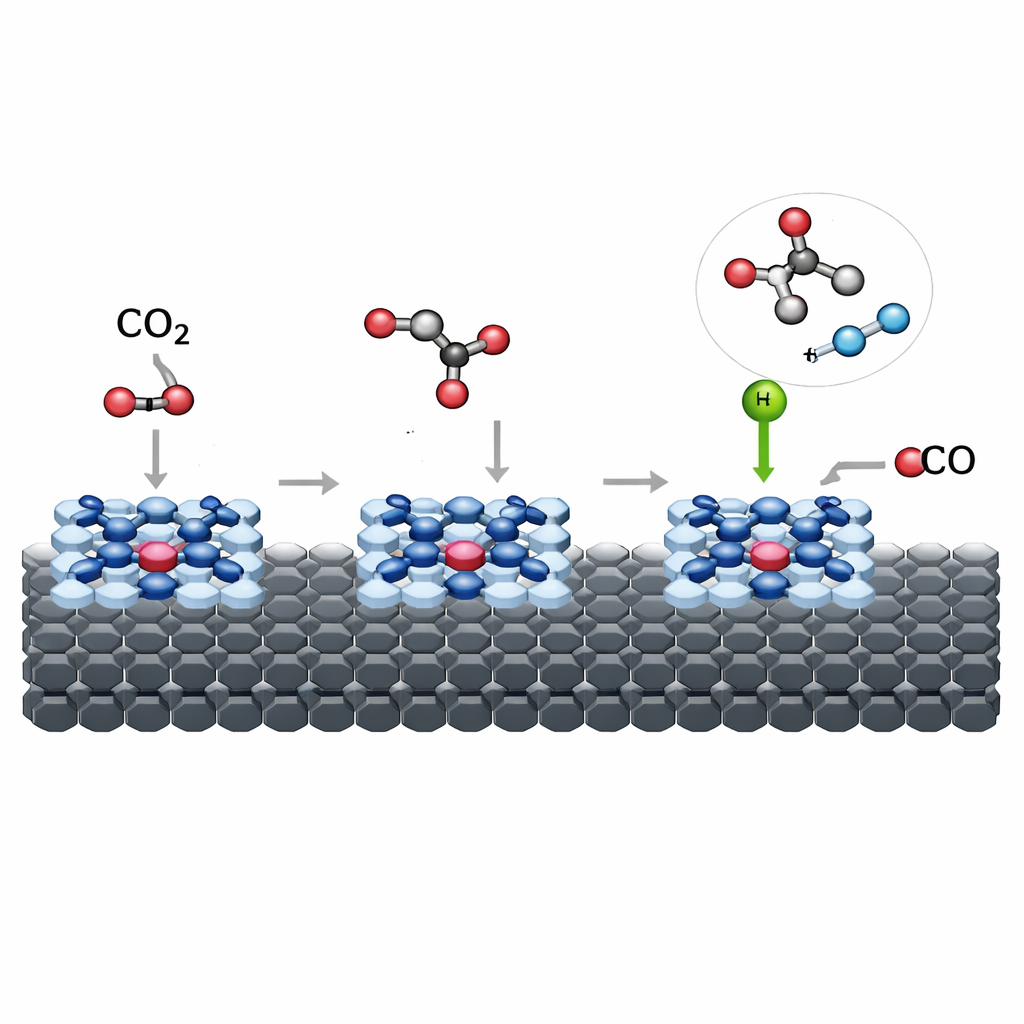
To locate the bottleneck, the team compared three types of catalysts: gold nanoparticles, cobalt phthalocyanine, and nickel phthalocyanine, with the two molecular catalysts finely dispersed on carbon nanotubes. They used a classic trick from physical chemistry called the kinetic isotope effect. By running the reaction in normal water and in heavy water—where hydrogen is replaced by the heavier isotope deuterium—they could tell whether a key step involves moving a proton (a hydrogen nucleus). If the rate changes between the two liquids, proton movement is implicated. For gold, the reaction rate hardly changed, confirming that the tricky step is simply getting carbon dioxide to stick to the surface. For the molecular catalysts, however, the reaction clearly slowed in heavy water, revealing that the critical hurdle is not adsorption but the subsequent proton delivery to a bound carbon dioxide intermediate.
How Packing and Electric Fields Change the Game
Intriguingly, cobalt phthalocyanine did not always behave the same way. When the molecules were well separated along carbon nanotubes, proton delivery limited the rate. But when they were deposited in thicker clumps on a flat carbon sheet, the slow step shifted back to carbon dioxide adsorption, and the overall performance dropped. The authors traced this switch to how the electric field from the applied voltage penetrates the catalyst layer. Bulk piles of the organic cobalt compound act somewhat like an insulating film, so the electric field felt by metal centers buried inside is much weaker. That weaker field makes it harder for incoming carbon dioxide to be activated and attached in the first place. The researchers mimicked this effect in the well-dispersed system by adding a crown ether that holds positively charged sodium ions farther from the surface, softening the local electric field. Under those conditions, even the dispersed catalyst reverted to being limited by carbon dioxide adsorption, reinforcing the electric-field explanation.
The Hidden Help from the Surrounding Liquid
The work also revisits the often-ignored role of negatively charged species in the liquid, known as anions. On gold and similar metals, bicarbonate ions mostly watch from the sidelines while positively charged metal ions near the surface help pull in and stabilize carbon dioxide. On the cobalt phthalocyanine nanotube catalyst, the situation flips. Because the slow step is now proton delivery to a bound carbon dioxide species, species that can donate protons become powerful helpers. The team varied the amounts of sodium ions and bicarbonate independently and found that increasing bicarbonate boosted the reaction more strongly than increasing sodium. Swapping in other anions with different abilities to give up protons confirmed the pattern: liquids whose anions were better proton donors generally drove higher reaction rates for carbon monoxide formation, even after accounting for shifts in local acidity near the surface.
Design Rules for Better Carbon Conversion
Taken together, these findings turn a messy mechanistic debate into a clear design map. For molecular catalysts like metal phthalocyanines that work best when they are individually anchored and electronically connected, the slowest step is delivering a proton to an already attached carbon dioxide molecule. That means engineers should focus on keeping these molecules well dispersed to preserve a strong electric field at each reactive metal center and on choosing electrolytes whose anions can easily donate protons without overly encouraging competing hydrogen formation. In contrast, when the catalyst is packed into thicker aggregates, or when the local electric field is weakened, simply getting carbon dioxide to bind becomes the main obstacle. Recognizing which regime a given system operates in allows researchers to tailor both the catalyst structure and the surrounding solution, bringing efficient electrochemical recycling of carbon dioxide a step closer to large-scale reality.
Citation: Ren, Z., Shi, K., Meng, Z. et al. Elucidating the rate-limiting step of CO2 electroreduction on metal phthalocyanines. Nat Commun 17, 3720 (2026). https://doi.org/10.1038/s41467-026-70445-9
Keywords: CO2 electroreduction, metal phthalocyanine catalysts, catalyst dispersion, electrochemical carbon conversion, bicarbonate electrolyte