Clear Sky Science · en
High-efficiency electrochemical air capture enabled by thiadiazole redox carrier with tunable gas-selective channels
Why catching carbon from thin air matters
Burning coal, oil, and gas has filled the atmosphere with carbon dioxide (CO2), driving climate change. Even if we clean up power plants and cars, we still need ways to actually pull CO2 back out of the air. This article reports a new kind of “electrochemical sponge” that can grab CO2 directly from normal air using electricity, then release it on demand, while wasting very little energy and withstanding the harsh presence of oxygen and moisture.
A new kind of electrical carbon sponge
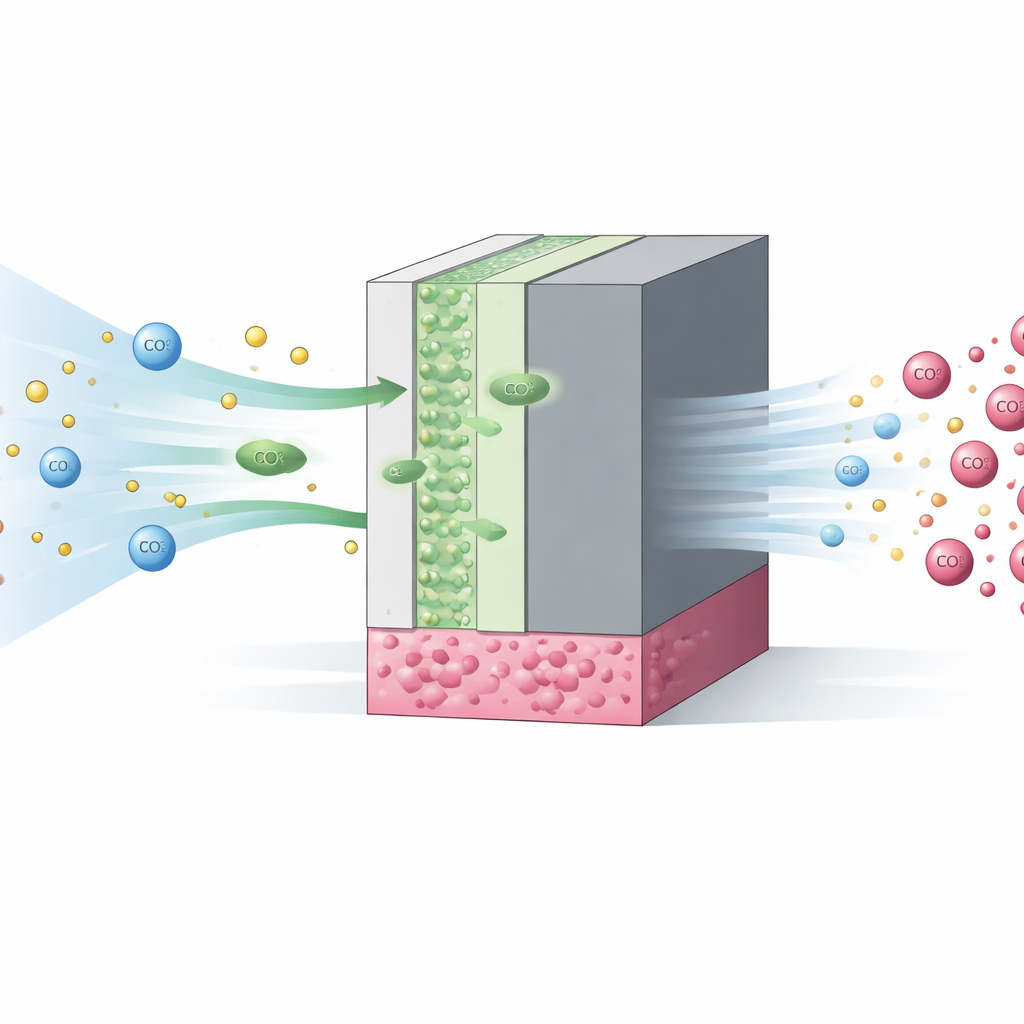
The researchers focus on a strategy called electrochemical direct air capture, where special molecules near an electrode change their behavior when a small voltage is applied. In their neutral state these molecules barely interact with CO2. But when the electrode feeds them electrons, they become strong binders that latch onto CO2 from the surrounding air. Reversing the voltage makes them let go, producing a stream of concentrated CO2 that can be stored or turned into useful chemicals. The team designed a new capture molecule, based on a ring structure called BPT, that spreads incoming electrons across an extended framework. This tuning makes it bind CO2 strongly enough to work at very low concentrations, yet weakly enough that it can let go of the gas again without demanding excessive energy.
Keeping oxygen from ruining the process
Real air is not just CO2 and nitrogen—it also contains a lot of oxygen and some water vapor, both of which can damage the capture molecules or steal electrons that should go toward CO2. Many earlier systems needed carefully purified gas streams or suffered fast degradation. The BPT design already helps by spreading out electron density, which makes the reduced form less vulnerable to attack by oxygen. But the key advance is pairing BPT with an engineered gas permeation layer, or GPL, made from a polymer rich in ether oxygen groups. This thin coating sits between the air and the BPT layer and acts as a selective gate: CO2 passes through relatively easily, while oxygen’s path is slowed and constrained.
Channels that prefer carbon dioxide
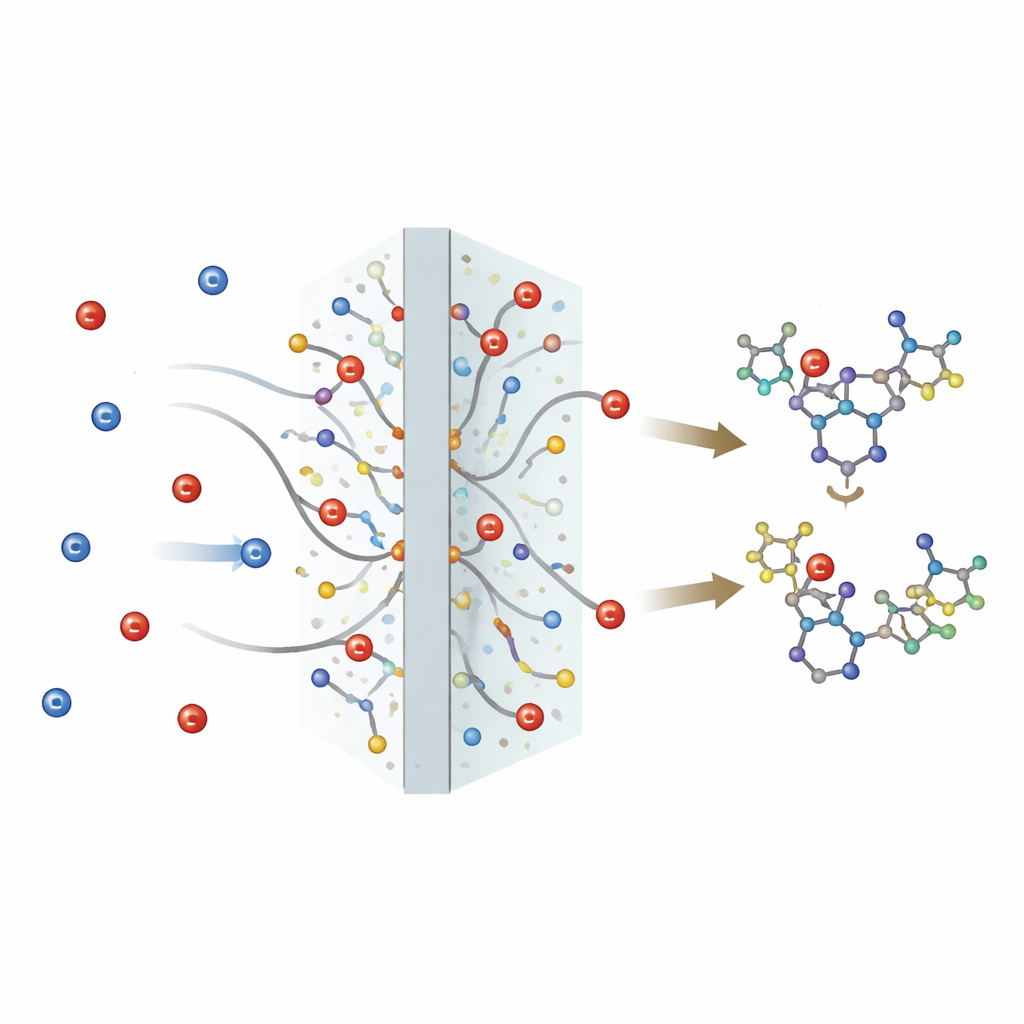
To understand why the gate favors CO2, the authors used gas-permeation measurements and molecular simulations. The polymer’s chemical groups have a stronger attraction to the slightly polarizable CO2 molecules than to nonpolar oxygen. Simulations show that CO2 interacts more often and more strongly with these groups, giving it higher solubility and faster travel through the layer. Size also plays a role: CO2 is marginally smaller than O2, making it easier to thread through the polymer’s nanoscale gaps. Together, these effects create gas-selective channels that enrich CO2 right where the BPT molecules sit, while maintaining a low-oxygen microenvironment that suppresses unwanted side reactions.
Performance under real-world air
In flow-cell tests meant to mimic operating devices, the combined BPT–GPL electrode repeatedly captured CO2 from air with roughly 400 parts per million CO2 and 21% oxygen—the composition of the atmosphere. Over 48 charge–discharge cycles, it maintained a high capture capacity of about 3.3 millimoles of CO2 per gram of BPT with little sign of molecular breakdown. The electrical efficiency stayed near 80%, and the system continued to perform well even when humid air was used, although very high humidity eventually began to nudge the efficiency downward. Compared with an otherwise similar electrode lacking the protective GPL layer, the BPT–GPL version suffered much less loss in capacity over time, confirming that the gas-selective coating shields the active molecules from oxygen damage.
What this means for future carbon removal
This work demonstrates that carefully pairing a tailor-made capture molecule with a smart gas-filtering layer can transform how we pull CO2 from ordinary air. The BPT–GPL system shows that it is possible to build an electrically driven air-capture device that is efficient, repeatedly reversible, and robust in the presence of oxygen and moisture. With further engineering and scaling, similar architectures could be linked directly to renewable electricity and downstream CO2 conversion units, turning excess atmospheric carbon into fuels or chemicals and helping move society toward genuine net-zero emissions.
Citation: Hou, J., Cheng, Y., Yan, T. et al. High-efficiency electrochemical air capture enabled by thiadiazole redox carrier with tunable gas-selective channels. Nat Commun 17, 3629 (2026). https://doi.org/10.1038/s41467-026-70444-w
Keywords: direct air capture, electrochemical CO2 capture, gas-selective membranes, redox carriers, carbon removal