Clear Sky Science · en
Functional diversification of WRINKLED3 integrates fatty acid metabolism with insecticidal acylsugar production in Solanaceae species
How tomato hairs help fight insect pests
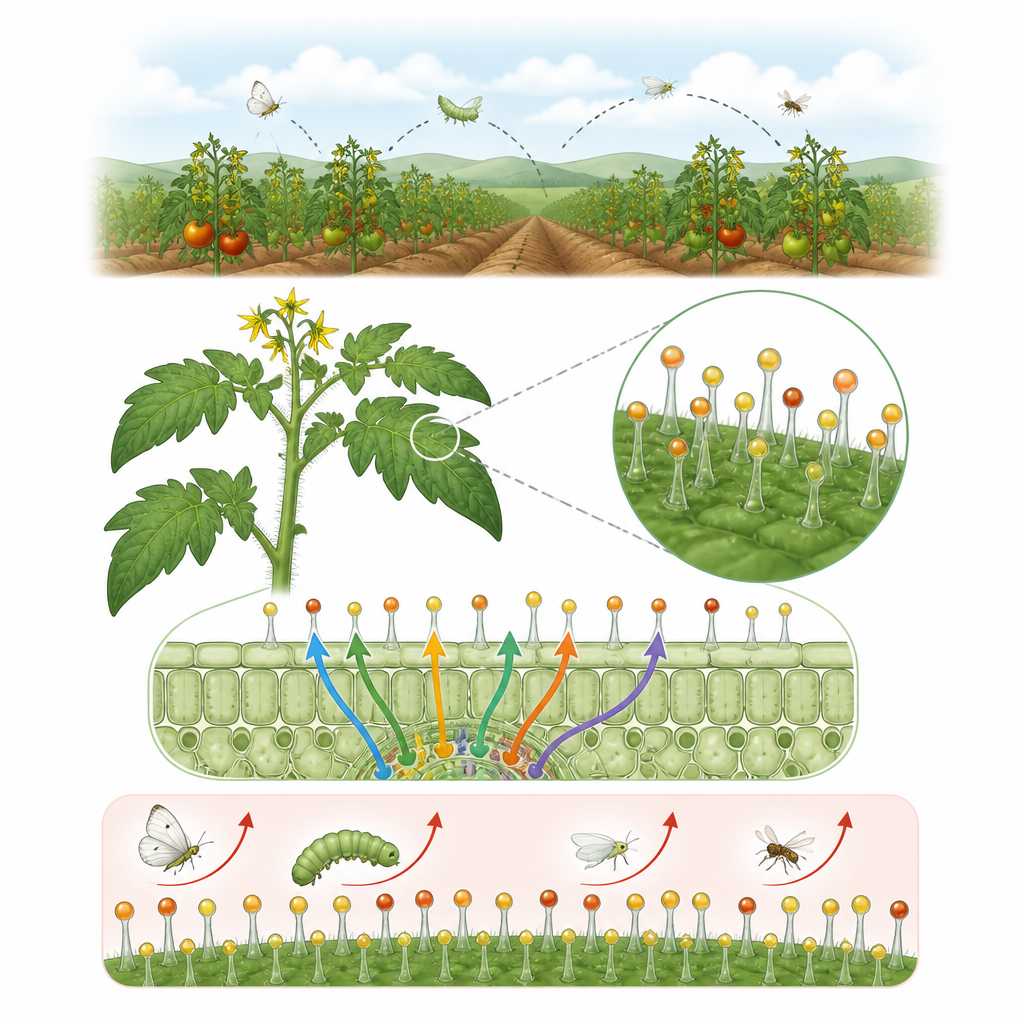
Tomato plants and their nightshade relatives defend themselves with tiny hairs that ooze sticky, bug‑repelling droplets. This study uncovers how a single control switch inside those hairs links ordinary fat production with the manufacture of specialized sugary toxins called acylsugars. Understanding this built‑in chemical shield could guide new ways to protect crops from insects without relying so heavily on sprays.
From everyday chemistry to plant self‑defense
Plants make a huge variety of chemicals, from the basic ingredients that keep cells alive to rare compounds that deter insects or attract pollinators. Acylsugars belong to the latter group. They are sugary molecules decorated with greasy side chains and are produced in the glandular hairs on leaves of tomatoes and many other nightshade plants. These droplets are toxic or sticky to many insects and microbes. However, scientists knew far less about how the plant turns on this defensive factory at the right place and time, especially how it coordinates the supply of raw materials with the final assembly of acylsugars.
A hidden switch in tomato leaf hairs
The researchers searched tomato gene activity data to find control genes that behave like acylsugar makers, turning on strongly in the same tissues. They focused on a gene called WRINKLED3, or SlWRI3, which belongs to a family known for managing fat production in seeds and flowers. They showed that SlWRI3 is switched on almost only in the tip cells of certain leaf hairs, matching the known site of acylsugar production. When they used virus‑based silencing and gene editing to reduce or remove SlWRI3, the plants produced far less of several major acylsugars, proving that this gene is required for a normal defensive coating.
One controller for both fuel supply and toxin building
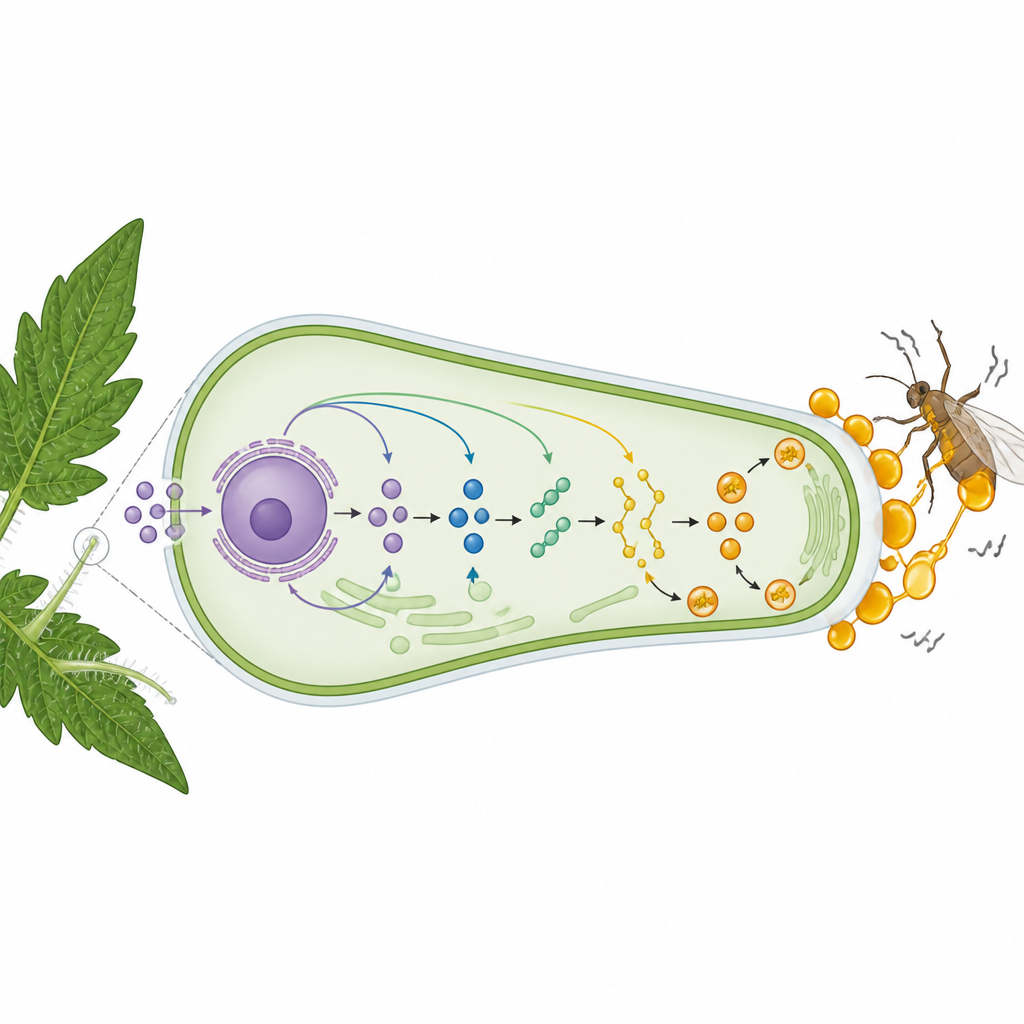
To understand how SlWRI3 works, the team examined which genes change their activity when SlWRI3 is missing, and where SlWRI3 protein binds on the DNA. They found that SlWRI3 directly turns on components of an enzyme complex called acetyl‑CoA carboxylase, which converts a simple two‑carbon unit into malonyl‑CoA, the key starting block for building fatty chains. In mutant plants lacking SlWRI3, levels of malonyl‑CoA and several fatty acids dropped, confirming that the fuel needed for acylsugar side chains was in short supply. At the same time, SlWRI3 also binds to and activates the gene for SlASAT1, the first enzyme that attaches these fatty chains onto sucrose to form the acylsugar core. This shows that SlWRI3 coordinates both the production of building blocks and the first step in assembling the defensive droplets.
A shared strategy across the nightshade family
Acylsugars are found in many nightshade relatives, from wild tomatoes to black nightshade and petunia, suggesting that this defense system is ancient. The scientists identified close versions of the WRI3 gene in several of these species and discovered that they are also most active in glandular hairs, unlike their counterparts in the model plant Arabidopsis, which lacks such hairs. When they partially silenced WRI3 relatives in two wild species, acylsugar levels fell there as well. This pattern of similar gene sequence, hair‑specific activity, and shared function points to an evolutionary shift in which a regulator of basic fat metabolism was repurposed to manage a specialized chemical shield.
What this means for future pest‑resistant crops
Overall, the study reveals that SlWRI3 acts as a central manager in tomato leaf hairs, linking everyday fat chemistry to the tailored production of acylsugars that discourage insect feeding. By turning on both the upstream supply of fatty building blocks and the early steps of acylsugar assembly, it helps ensure that the plant’s chemical defenses are strong where they are most needed. In the long term, this knowledge could inform breeding or genetic strategies that boost natural acylsugar‑based resistance in tomatoes and other crops, offering an additional tool for insect control.
Citation: He, Q., Zheng, J., Jin, J. et al. Functional diversification of WRINKLED3 integrates fatty acid metabolism with insecticidal acylsugar production in Solanaceae species. Nat Commun 17, 4465 (2026). https://doi.org/10.1038/s41467-026-70439-7
Keywords: tomato defense, acylsugars, trichomes, fatty acid metabolism, Solanaceae