Clear Sky Science · en
Ultrathin crown ether-based polyamide membrane for ion-ion separations
Turning salty waste into useful resources
Many industrial processes leave behind salty wastewater that still contains valuable metals, such as ingredients for batteries and fertilizers. Today’s filters are good at cleaning water, but they are not very good at picking out one type of dissolved ion from another when those ions look almost the same. This study shows how an ultrathin, specially designed membrane can act more like a smart sieve, favoring one ion over others and pointing the way toward more efficient recovery of useful materials from waste streams. 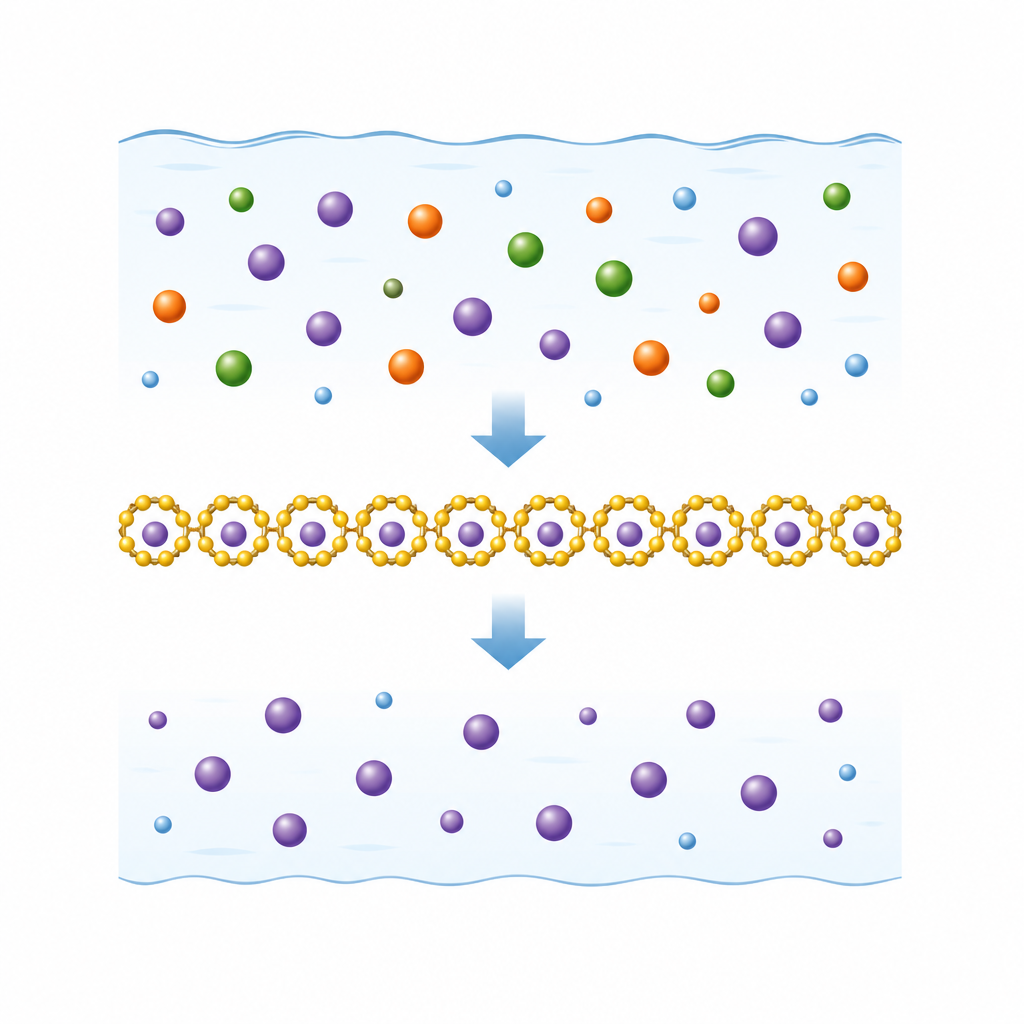
Why picking the right ion is so hard
In water, metal ions are tiny, charged particles wrapped in shells of water molecules. Common membrane filters mostly tell ions apart by their charge or by size, which works well for separating big, multicharged ions from small, single-charged ones. But it fails when ions have the same charge and almost the same size, like lithium, sodium, potassium, and cesium. Nature solves this problem in nerve cells, where protein channels let potassium zip through while keeping sodium out, even though the two ions are very similar. The challenge is to build an artificial membrane that mimics this kind of sharp choice while still being thin, robust, and practical to manufacture.
Borrowing a trick from molecular cages
The researchers turned to crown ethers, ring-shaped molecules that act like tiny cages for metal ions. Each type of crown ether prefers certain ions, in the same way a lock prefers a particular key. The team chose a version called 18-crown-6, which has a strong preference for potassium. They chemically modified these rings so they could link together and then used a standard membrane-making method, interfacial polymerization, to stitch them into a continuous film. The result was an ultrathin polyamide layer only about six nanometers thick, made largely from interconnected crown ether units, with many closely spaced ion-binding sites packed into a small volume.
How the ultrathin film behaves
Careful measurements showed that the film is mostly disordered rather than perfectly crystalline, but still mechanically robust and continuous. When the membrane was exposed to salty solutions, it took up more potassium than competing ions such as cesium, especially when both ions were present together. That suggests potassium competes more successfully for the crown ether cages, crowding out rivals. In transport tests where a mixed-salt solution sat on one side of the membrane and pure water on the other, potassium crossed the membrane faster than lithium, cesium, or magnesium. For lithium and cesium, the membrane transported potassium about four times more quickly, despite all three ions having similar sizes in water. 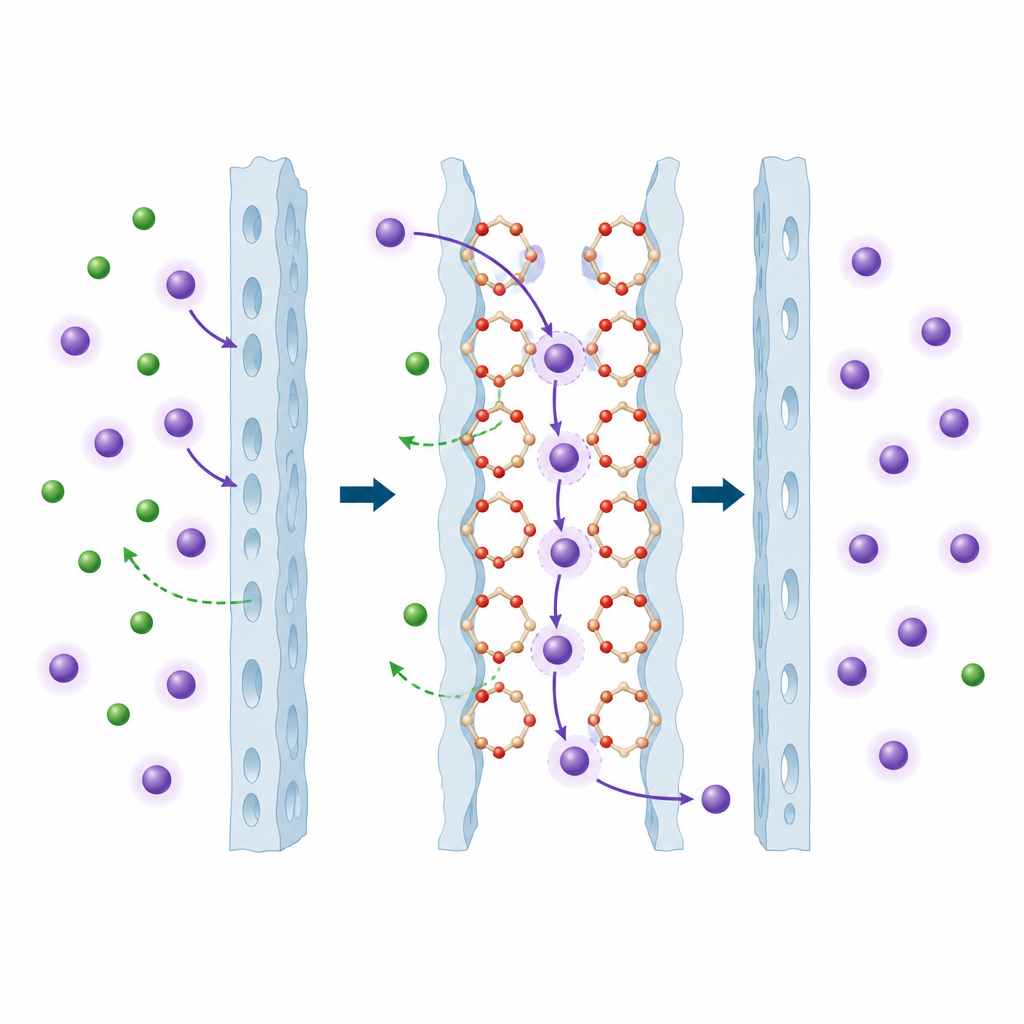
A different way to move ions
The results point to a transport process that is not just about squeezing ions through tiny pores. Instead, potassium appears to hop from one crown ether cage to the next, helped by the short distance between binding sites and the extreme thinness of the film. Because the membrane is so thin, potassium does not get “stuck” for long in any single cage, avoiding the slowing effect seen in older, much thicker crown ether membranes. Other ions, which do not fit the cages as well, must rely more on less efficient free gaps in the polymer network. As potassium fills the preferred sites, it also makes it harder for competing ions to enter, sharpening the selectivity.
What this means for future separations
To a lay reader, the key message is that the authors have built a very thin plastic film that behaves a bit like a smart gatekeeper, especially favoring potassium over other similar ions. Although it is not yet as selective as the highly ordered channels found in crystals or in biology, it is made using industrially familiar methods and could be scaled up more easily. With further tuning of the crown ether structure, how the rings are spaced, and how well they are aligned, similar membranes could one day recover valuable ions such as lithium or rare earths from waste streams, helping turn what is now discarded saltwater into a source of useful materials.
Citation: Villalobos, L.F., Zhang, J., Lee, J. et al. Ultrathin crown ether-based polyamide membrane for ion-ion separations. Nat Commun 17, 4263 (2026). https://doi.org/10.1038/s41467-026-70431-1
Keywords: ion-selective membranes, crown ether, potassium transport, nanofiltration, ion separation