Clear Sky Science · en
Light-programmable mechanical computing via polyaniline composite film
Light That Teaches Materials New Tricks
Imagine a sheet of plastic that can sense light, move, think in simple logical steps, and even change its appearance to blend into its surroundings—without any conventional electronics. This paper describes such a material system, showing how beams of light can rewire tiny mechanical switches inside a flexible film to perform calculations and create adaptive camouflage patterns. It points toward a future where parts of robots, buildings, or clothing quietly compute and respond to their environments all by themselves.
A Flexible Film That Feels the Light
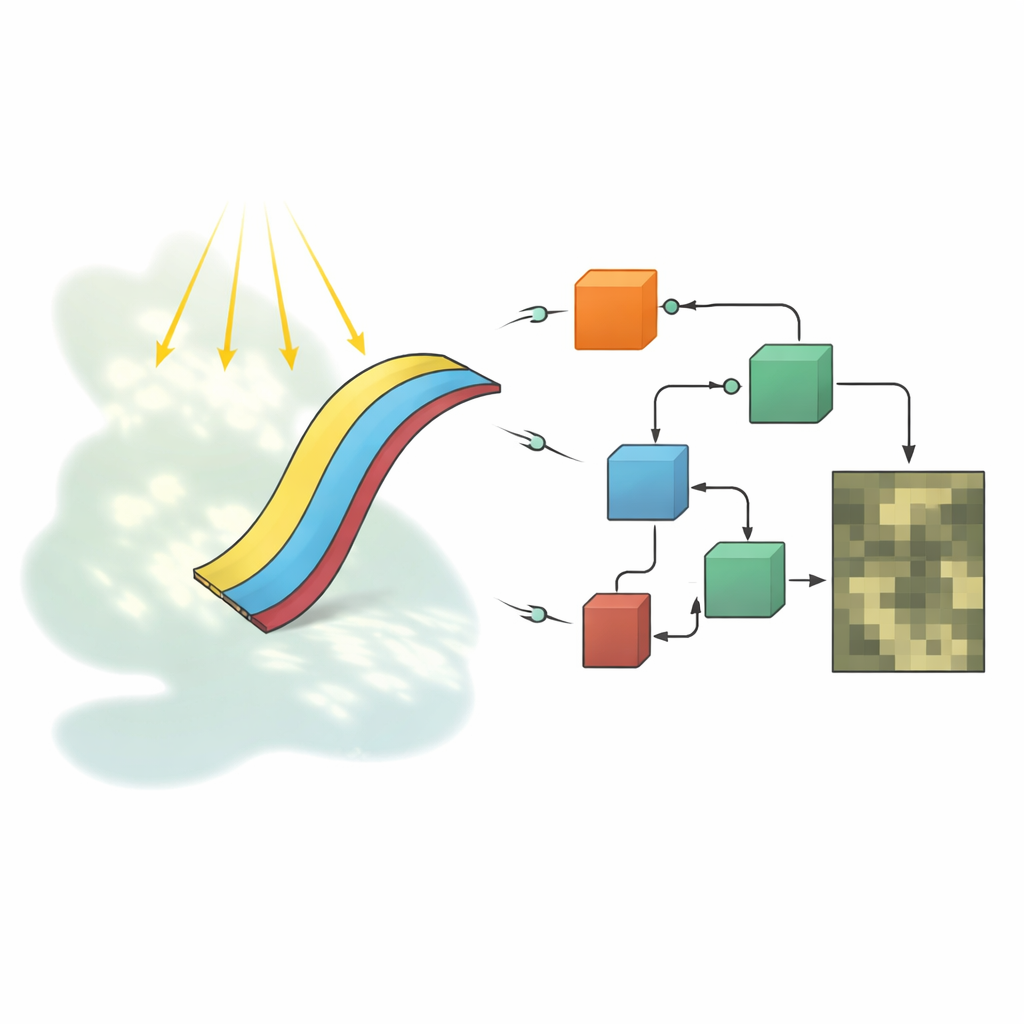
At the heart of the work is a thin, layered film called a polyaniline composite film. It is built like a microscopic sandwich of three key layers: a top layer that turns light into heat and shrinks when warmed, a middle layer of silver nanowires that carries electrical signals, and a soft silicone base that gently expands when heated. When light shines on the film, the top layer heats and contracts while the base layer expands, causing the whole strip to bend out of plane. Because the silver network remains flexible and conductive as the film bends, the path that electricity can follow changes whenever the film moves. This coupling of light, heat, motion, and conductivity allows optical beams to reshape where and how signals travel through the material.
Turning Bending Strips into Logic Switches
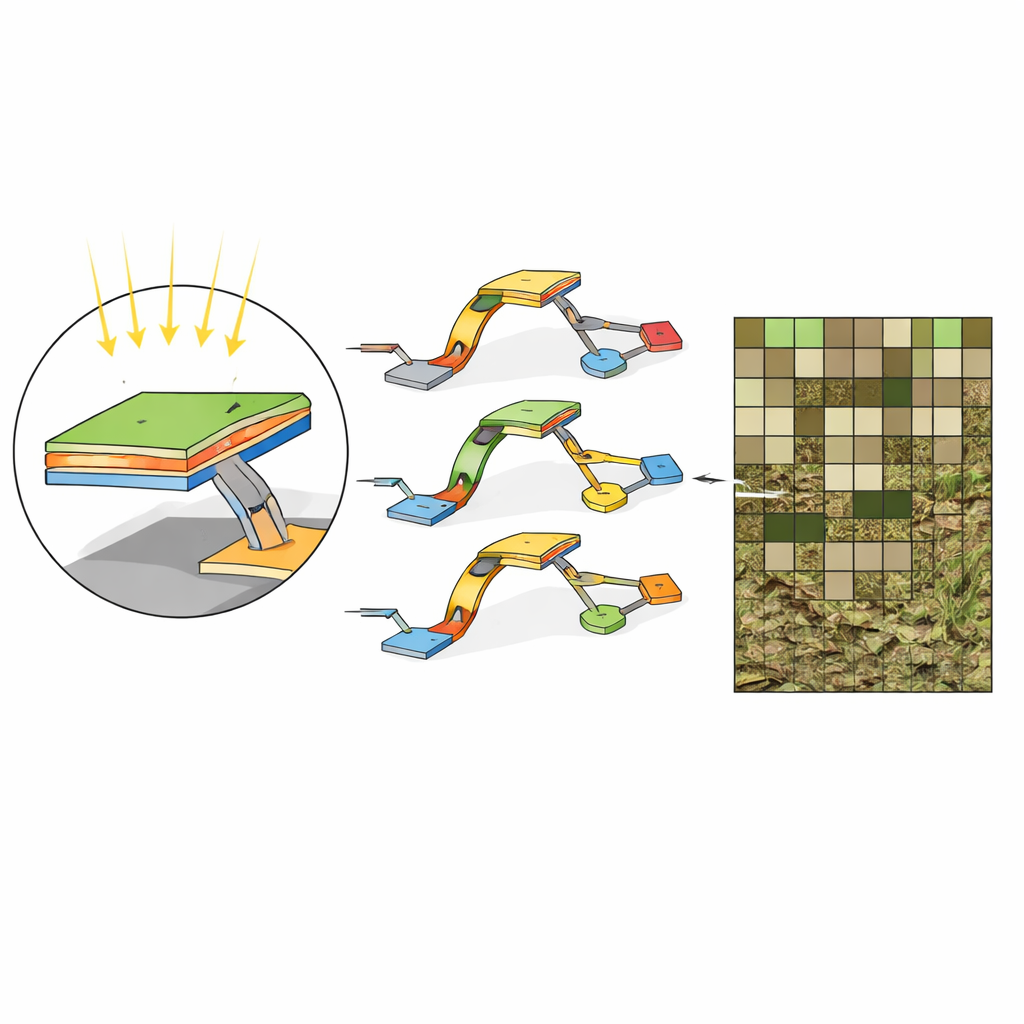
The researchers use this bending motion to build simple mechanical relays, the same kind of switching elements that once formed the basis of early telephone and computing systems. In their single-pole single-throw version, the film hovers above two metal contacts. In the dark it stays flat, leaving the electrical path open. Under light, it bends down to touch the second contact, closing the circuit. In a single-pole double-throw version, the same strip chooses between two different contacts depending on whether it is lit or unlit, routing a signal along one of two paths. By arranging these relays in series or in parallel, the team constructs standard logic functions such as AND, OR, XOR, and NOT—basic building blocks of digital computing—controlled purely by light patterns rather than wires and transistors.
From Simple Gates to Tiny Mechanical Adders
Because these relays are made from the same repeating film units, they can be chained together to build more complex circuits. The authors demonstrate a one-bit and then a two-bit full adder, the kind of circuit that lies at the core of binary arithmetic. Here, the output voltage from one stage drives a light source, which in turn illuminates the next relay stage, effectively passing information as beams of light across a flexible board. Blue and red light-emitting bulbs serve only as indicators of the results. While each switching cycle takes a few seconds—slower than electronic chips—the system is reversible, stable over hundreds of cycles, and well suited to scenarios where adaptability and low power matter more than speed, such as soft robots or smart skins.
Mechanical Camouflage That Learns Its Background
To show a practical use, the team builds an "intelligent" camouflage module inspired by octopuses and cuttlefish. They arrange small sensing–computing–emitting units in a three-by-three grid. Each unit uses light-sensitive relays to read the brightness in nearby patches of an incoming image, processes this information through simple logic, and then drives a matching pattern of tiny light sources. By tiling nine of these units, the system can reproduce gradual brightness changes and textures from its surroundings. In tests with artificial images and with photos of coral, rocks, and sand, the output patterns closely resembled the input textures. Even when some units are deliberately damaged in simulations, the overall camouflage effect persists, thanks to the distributed and redundant layout.
Why This Matters for Future Smart Materials
The study shows that it is possible to combine sensing, actuation, and computation into a single thin material that is controlled just by light and humidity, without conventional electronic chips. While this approach will not replace high-speed silicon processors, it opens a different path: mechanical intelligence that can operate in harsh, noisy environments where electronics struggle, and that can be spread across the very surfaces that need to adapt. In simple terms, the authors have taught a flexible film to act like a network of tiny, light-steered switches that can add numbers and disguise itself to match its background, hinting at future "skins" for machines that both think and blend in.
Citation: Yan, X., Li, Y., Zhao, Y. et al. Light-programmable mechanical computing via polyaniline composite film. Nat Commun 17, 4011 (2026). https://doi.org/10.1038/s41467-026-70425-z
Keywords: mechanical computing, light-responsive materials, adaptive camouflage, smart skins, soft robotics