Clear Sky Science · en
Genetic alternative splicing regulation mapping of cartilage and synovium reveals tissue-specific mechanisms of joint-related traits
Why our joints matter more than we think
When knees or hips start to ache, we often blame worn-out cartilage or "inflammation" without thinking about what is happening inside our cells. This study peeks under the hood of human joints and shows that tiny genetic differences can change how our genes are stitched together, altering the behavior of cartilage and the joint lining. Those subtle changes help explain why some people develop osteoarthritis or rheumatoid arthritis, or grow taller than others, even when they live in similar environments.
The two key tissues inside your joints
Joints are built around two key tissues: cartilage, the smooth blue-white coating that lets bones glide, and the synovium, the thin inner lining that feeds and lubricates the joint. Cartilage damage is central to osteoarthritis, a painful condition affecting more than 500 million people worldwide. Synovium is a major driver of inflammation in both osteoarthritis and rheumatoid arthritis. Cartilage cells are also crucial for determining human height. Because of this, the authors focused on these two tissues, asking how inherited DNA differences change the way genes are spliced—how cells cut and paste gene messages—specifically in cartilage and synovium.
Reading the joint’s genetic messages
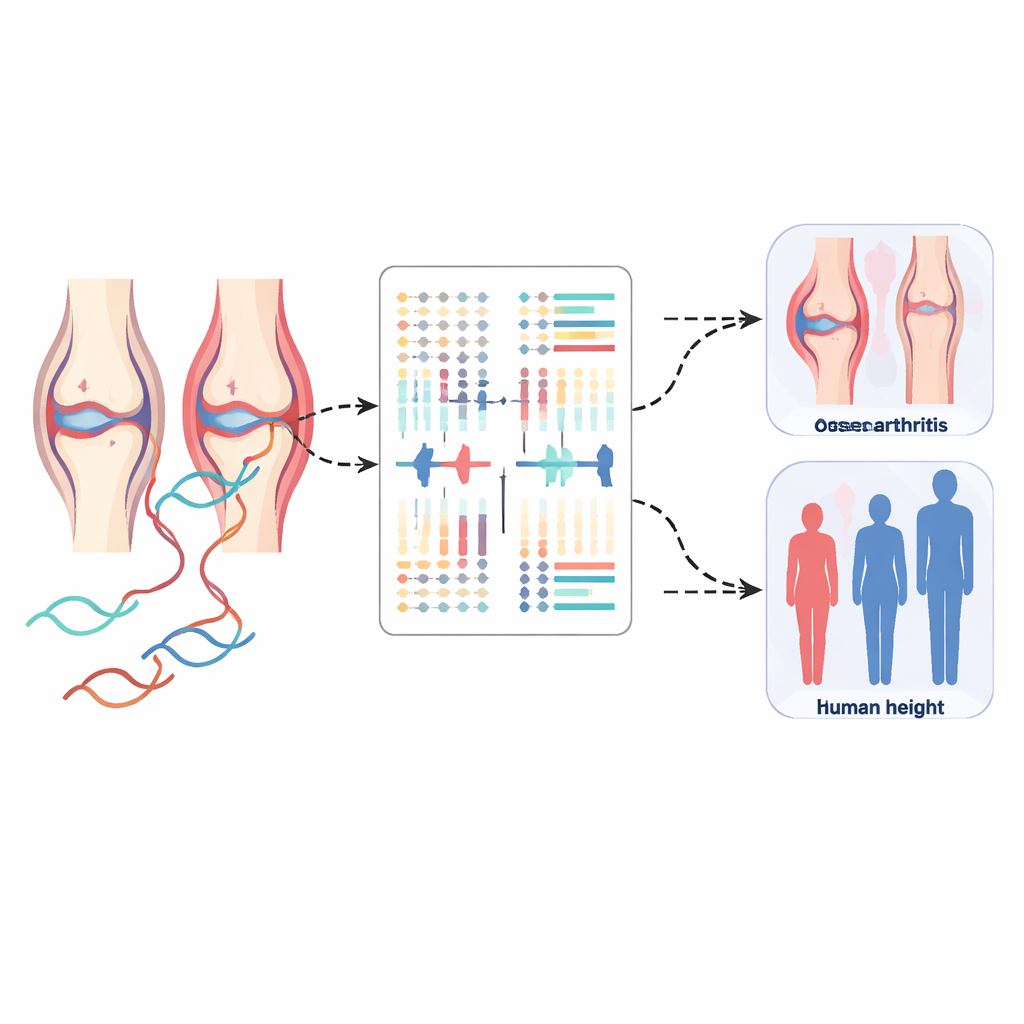
The researchers collected tissue from the knees of 238 people undergoing joint replacement surgery. From cartilage and synovium samples, they measured which pieces of each gene were used, creating a detailed picture of alternative splicing. They then compared those patterns with each person’s genetic profile. This allowed them to map thousands of splicing "switches"—places where a particular DNA variant consistently nudged a gene message toward one version or another. They found 2,796 such splicing signals close to the genes they affect, spread across 2,340 genes, and even detected a few long-range effects where distant DNA regions influenced splicing.
Hidden control switches in the genome
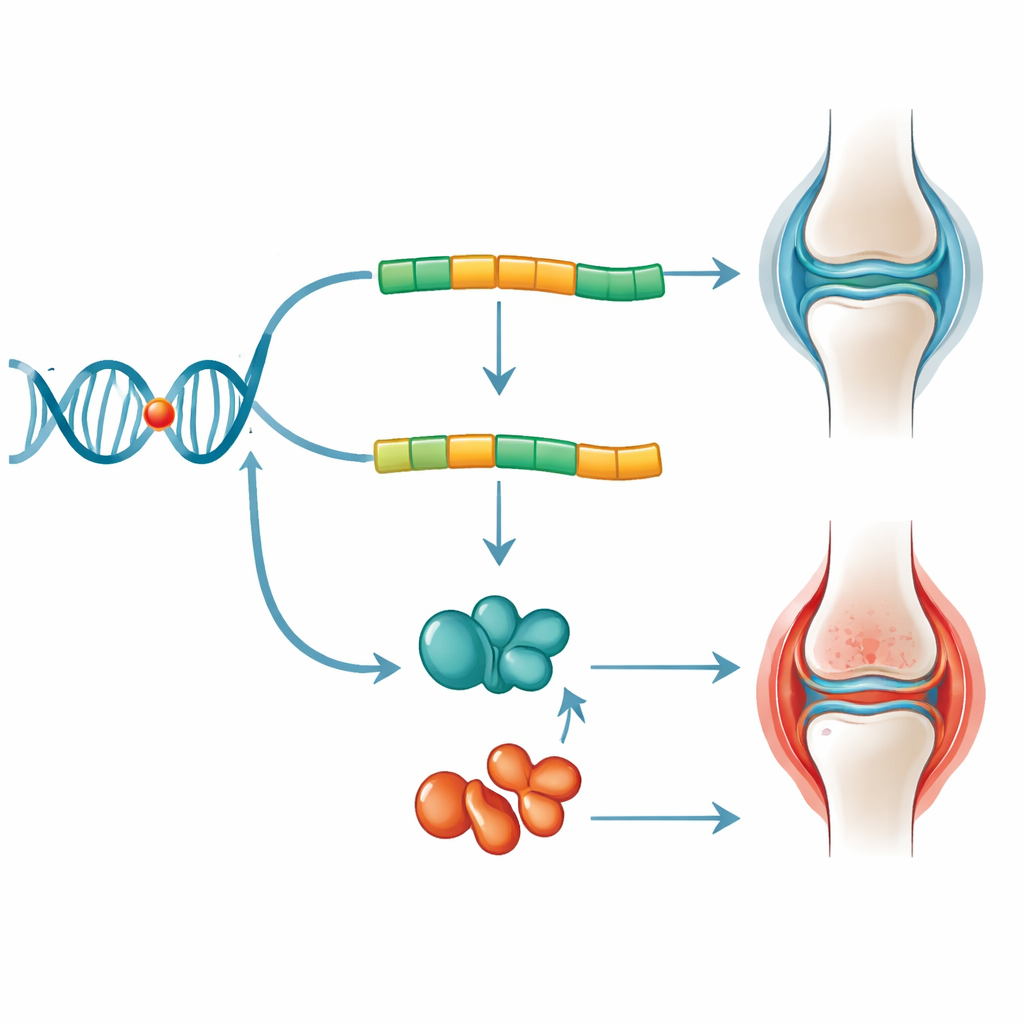
To go beyond simple statistical links, the team used an artificial-intelligence model that predicts whether a DNA change is likely to create or destroy a splice site, the molecular cut-and-paste points of a gene. By cross-checking these predictions against the real tissue data, they pinpointed 116 high-confidence DNA variants that directly alter splicing. Many sat right at classic splice sites, where disrupting just two letters almost shut down splicing at that point. Others lay several bases away, showing that splicing can also be steered by less obvious sequence features. Importantly, these splicing changes often occurred independently of changes in overall gene activity, revealing a distinct and previously underappreciated layer of genetic control in joint tissues.
Tissue-specific splicing and joint disease
Not all splicing switches were shared between tissues. The team identified 51 cartilage-specific and 128 synovium-specific genetic effects on splicing. Synovium-specific genes were heavily enriched in immune and inflammatory pathways, including a key immune regulator implicated in rheumatoid arthritis and osteoarthritis. Cartilage-specific genes included well-known players in cartilage structure and resilience. The DNA variants driving tissue-specific splicing often lay farther from the splice sites and overlapped tissue-specific enhancer regions—stretches of DNA that act as long-distance dimmer switches—hinting that distant regulatory elements can shape how gene messages are cut in particular cell types.
Connecting splicing to arthritis and height
To link their maps to real-world traits, the authors combined their joint-tissue splicing data with large genetic studies of osteoarthritis, rheumatoid arthritis, and human height. They found that regions of the genome influencing splicing in cartilage and synovium are especially rich in variants associated with these traits, more so than regions that only change overall gene activity. For osteoarthritis, they highlighted 12 likely "effector" genes where the same variant affected both disease risk and splicing, often in a tissue-specific way. One striking example was COL2A1, the main collagen of cartilage: a risk variant was tied to greater inclusion of an early exon, and diseased cartilage from the same people showed higher usage of this exon compared with intact cartilage. For height, 183 genes showed shared signals between cartilage splicing and stature, many involved in building and organizing the cartilage matrix. In rheumatoid arthritis, six synovium genes, including central immune regulators, appeared to influence risk through altered splicing rather than changes in total gene output.
What this means for joint health
Taken together, the findings show that alternative splicing in cartilage and synovium is not just a background detail but a central part of how inherited DNA shapes joint health, inflammation, and growth. By creating the first large-scale splicing maps for these tissues and tying them to disease risk, the study offers a catalog of specific genes and genetic switches that can now be tested experimentally. In the long run, understanding and eventually manipulating these splicing choices could open new routes to diagnose who is at risk and to design treatments that fine-tune gene messages in joint tissues, rather than simply blocking pain or inflammation after damage is done.
Citation: Tian, W., Hu, SY., Dong, SS. et al. Genetic alternative splicing regulation mapping of cartilage and synovium reveals tissue-specific mechanisms of joint-related traits. Nat Commun 17, 3846 (2026). https://doi.org/10.1038/s41467-026-70419-x
Keywords: alternative splicing, osteoporosis and joint disease, cartilage biology, rheumatoid arthritis, human height genetics