Clear Sky Science · en
Site-defined Cu-O ensembles enable hydrogen-conserving light-driven ethane upgrading
Turning a Common Gas into a Valuable Building Block
Ethylene is one of the most important molecules in the chemical industry, feeding into plastics, textiles, and countless everyday products. Today, much of it is made by burning huge amounts of fuel to crack larger hydrocarbons at very high temperatures, releasing large quantities of carbon dioxide. This study explores a gentler route: using light and a carefully designed copper–titanium oxide catalyst to turn abundant ethane from shale gas directly into ethylene while conserving hydrogen, potentially cutting both energy use and emissions.
Why Upgrading Ethane Is So Difficult
Ethane looks simple on paper—two carbon atoms and six hydrogens—but its carbon–hydrogen bonds are stubbornly strong. Traditional catalysts must run at 600–800 °C just to start prying those bonds apart, which encourages side reactions: carbon buildup that clogs the catalyst, over-stripping hydrogen that wastes valuable H2, and over-oxidation that burns ethane all the way to carbon dioxide and water. These trade-offs make it hard to achieve the trifecta of high activity, high selectivity for ethylene, and long catalyst life. Photocatalysis, which uses light to create highly reactive electrons and holes on a solid surface, promises a way around these limits, but most existing systems suffer from poor ethylene yields, short lifetimes, and a hazy understanding of how surface hydrogen builds up and deactivates the catalyst.
Designing Single-Atom Copper Sites on Titanium Oxide
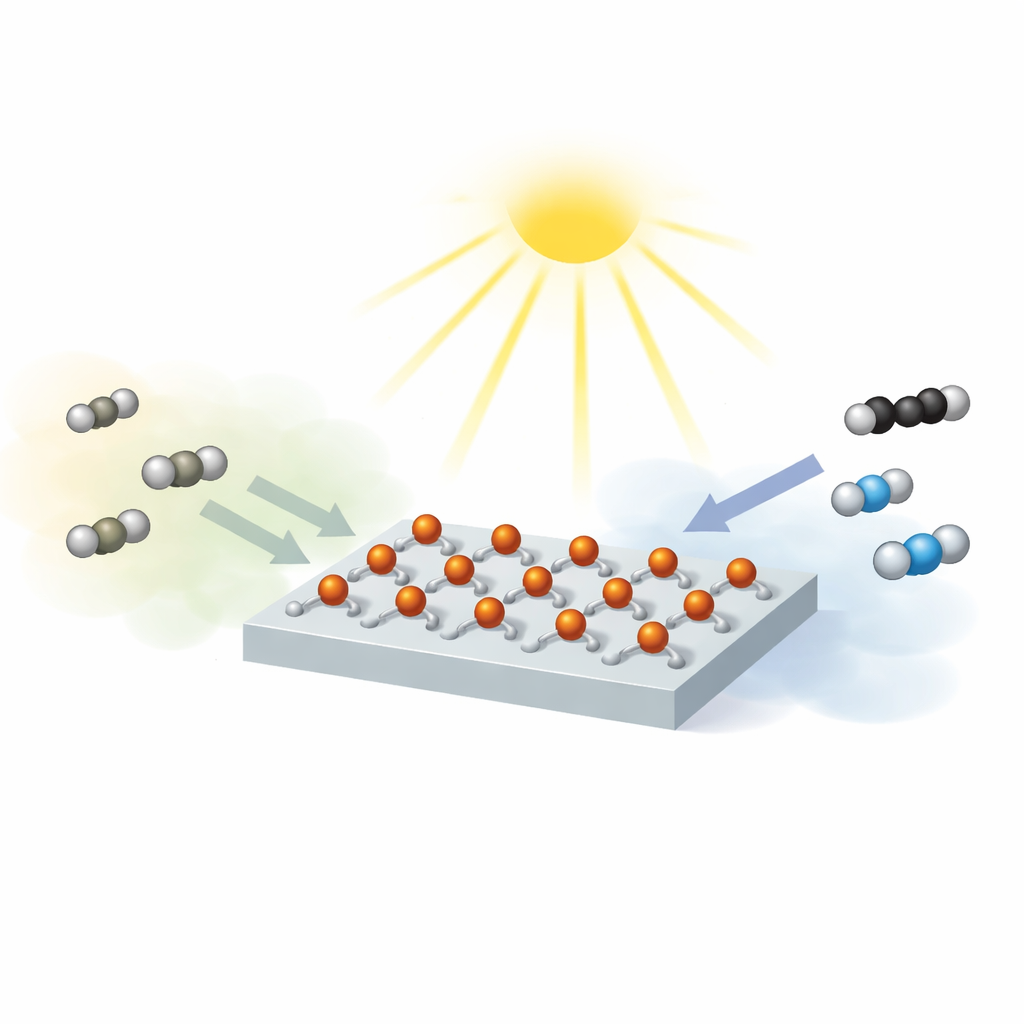
The researchers tackled this challenge by building a catalyst in which isolated copper atoms are locked into the crystal lattice of titanium dioxide (TiO2) and bridged by oxygen atoms. They first made a titanium-based porous framework with vacant titanium sites, let copper ions slip into those vacancies, and then heated the material to transform it into TiO2 containing single copper atoms. Advanced imaging and X-ray techniques revealed that the copper atoms are individually dispersed and bonded to three or four oxygen atoms, forming well-defined copper–oxygen “ensembles” on the TiO2 surface rather than clumps or nanoparticles. These atomic-scale sites mean that nearly every copper atom is accessible for chemistry, maximizing metal efficiency and allowing the team to directly connect atomic structure with catalytic behavior.
Using Light to Pull Off Hydrogen, Step by Step
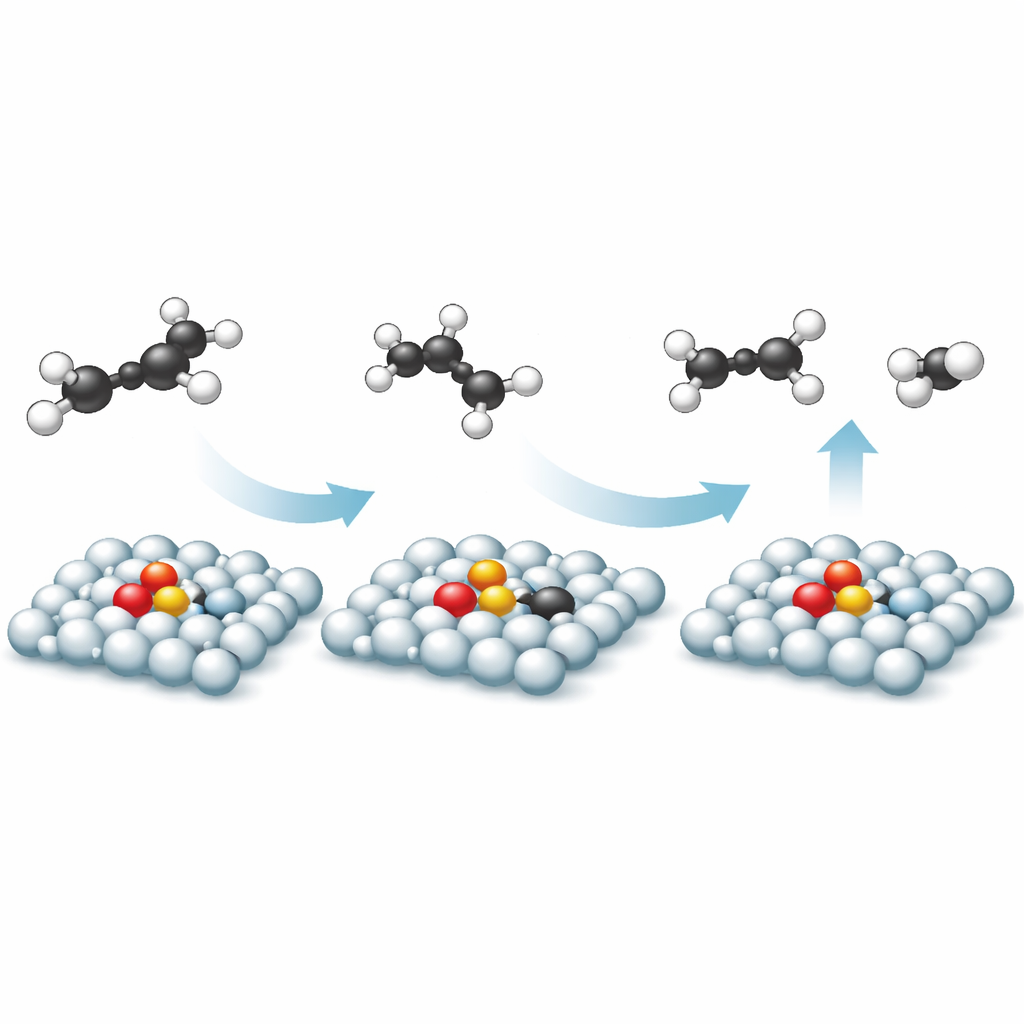
When the copper–TiO2 catalyst is illuminated, it produces an impressive flow of ethylene and hydrogen at just about 100 °C, far below the temperatures used in conventional plants. Careful product analysis showed that ethane is converted almost exclusively into ethylene and hydrogen in nearly one-to-one amounts, with little over-dehydrogenation or unwanted carbon buildup. Comparisons with other metals on TiO2 revealed that gold and silver favored coupling reactions that form larger molecules, while palladium and platinum drove deep dehydrogenation and carbon deposition. Only the single-atom copper sites delivered high ethylene selectivity. Time-resolved optical measurements and chemical “quenchers” indicated that light-generated holes gather at oxygen atoms bound to copper, where they help break the first C–H bond in ethane, forming an ethyl fragment. Neighboring copper atoms then help remove a second hydrogen—a so-called beta hydrogen—releasing ethylene and leaving hydrogen atoms adsorbed on the surface to be paired up and released as H2 with the help of photogenerated electrons.
Stopping the Catalyst from Poisoning Itself
The same hydrogen that the process seeks to conserve can also become a problem. The team found that when hydrogen atoms collect on certain oxygen sites not directly partnered with copper, they become difficult to remove, gradually changing the copper’s oxidation state and dulling the catalyst. The surface even changes color as this happens. Both experiments and computer simulations showed that these trapped hydrogen atoms stretch and weaken copper–oxygen bonds and block the most active copper–oxygen ensembles. Introducing carbon dioxide into the gas feed solves this problem in a subtle way: CO2 reacts with the accumulated surface hydrogen to form a surface-bound intermediate that ultimately produces a small amount of carbon monoxide and water, sweeping hydrogen away from the blocked sites while leaving the main ethane-to-ethylene pathway largely untouched. With CO2 present, the catalyst maintains more than 95% of its initial activity over many hours of operation.
A Blueprint for Cleaner Molecule Making
In plain terms, this work shows how a precisely engineered surface—where every copper atom sits in a carefully chosen oxygen environment—can use light to gently but efficiently peel hydrogen from a stubborn molecule like ethane. The result is a highly selective conversion of ethane into ethylene and hydrogen with minimal waste and long-term stability, especially when a little CO2 is added to keep the surface clean. Beyond ethane, the same design principles for arranging single metal atoms and managing surface hydrogen could guide the development of next-generation photocatalysts that upgrade other simple hydrocarbons under mild, energy-efficient conditions.
Citation: Zhang, Q., Liu, C., Xu, C. et al. Site-defined Cu-O ensembles enable hydrogen-conserving light-driven ethane upgrading. Nat Commun 17, 3712 (2026). https://doi.org/10.1038/s41467-026-70416-0
Keywords: photocatalysis, ethane dehydrogenation, single-atom catalysts, ethylene production, Cu-doped TiO2