Clear Sky Science · en
Regenerating end-of-life membranes for enhanced sustainability and unexpected performance
Turning Old Filters into a Fresh Solution
Modern life leans heavily on thin, porous filters called membranes to clean drinking water, treat wastewater, capture gases, and recover valuable chemicals. Yet these workhorse filters usually follow a wasteful path: they are made from fossil-based plastics, used for a few years, then burned or buried. This study shows that instead of throwing worn-out membranes away, we can dissolve them and remake them into new ones that are not only greener, but actually work better than brand‑new commercial filters.
Why Used Filters Are a Hidden Resource
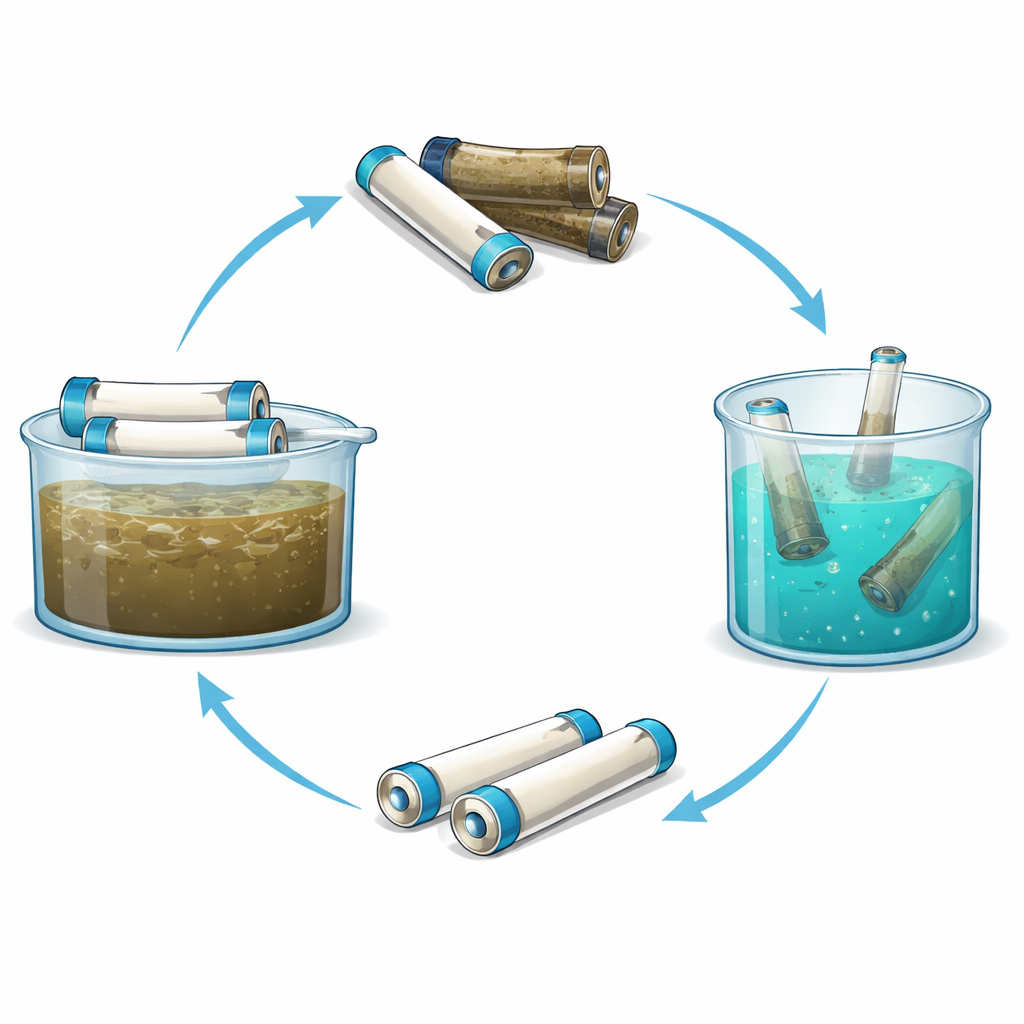
Conventional water treatment membranes are typically made from tough, non-biodegradable plastics such as polyvinylidene fluoride (PVDF). In large treatment plants, thousands of hollow fibers quietly strain out particles and microbes for years. Over time, however, grime builds up inside their pores and the plastic slowly ages under repeated chemical cleanings. Once the flow of water drops too low or fibers begin to crack, the entire module is retired and usually dumped or incinerated, consuming new fossil resources for replacements and adding to greenhouse gas emissions. The authors argue that this “take–make–dispose” pattern clashes with the goals of a circular economy, where materials are kept in use as long as possible.
Melting Down the Problem
Instead of treating end‑of‑life membranes as trash, the researchers collected real, heavily fouled PVDF fibers from a full‑scale wastewater plant and used them as raw material. They dissolved the old fibers in an organic solvent to make a casting solution, then recast that solution into flat sheet membranes using a standard industrial technique called phase inversion. Surprisingly, the regenerated filters allowed more than five times as much water through as the old ones, while blocking more of a test protein pollutant. Even more striking, they outperformed “reference” membranes made from pristine PVDF powder using exactly the same procedure, suggesting that something about the history of use and fouling had improved the material rather than ruined it.
Helpful Dirt and Tamed Polymer Chains
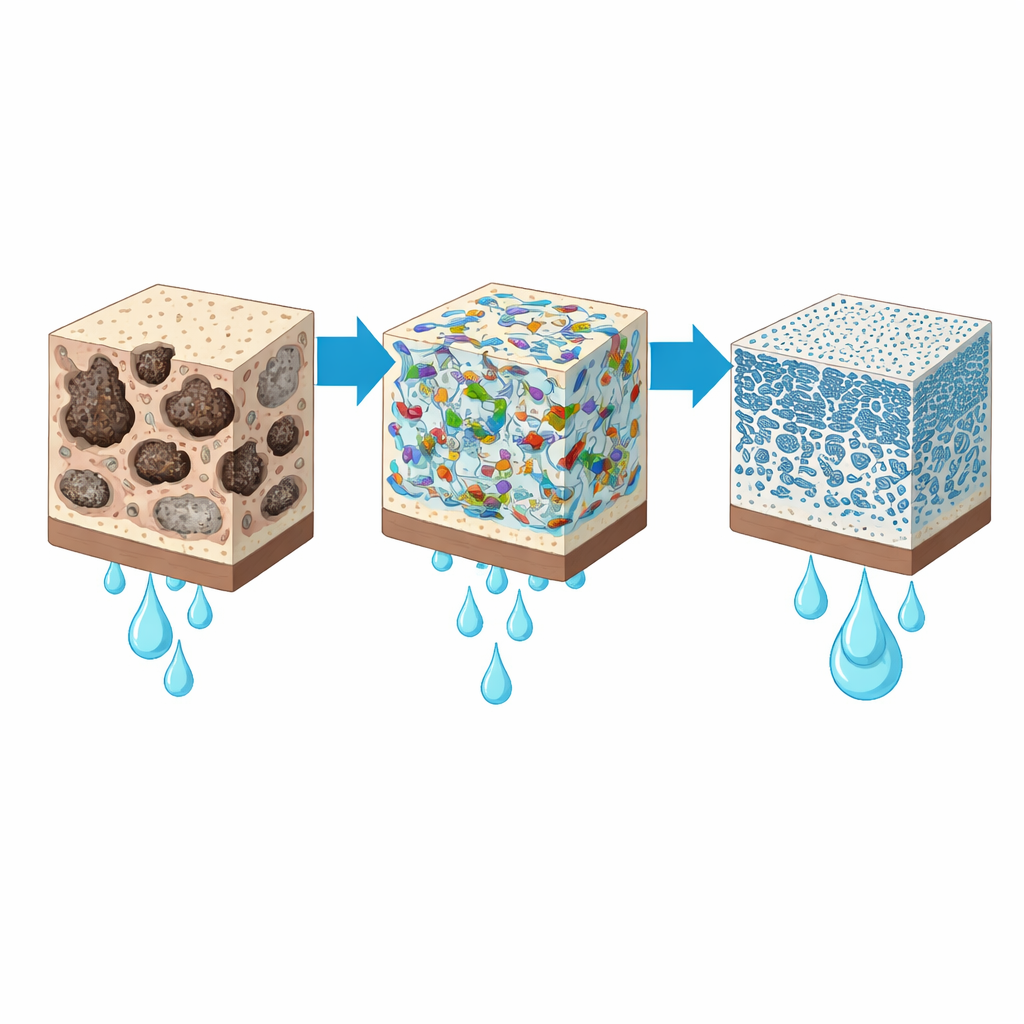
To find out why, the team dissected two unlikely heroes: the grime lodged in the old filters and the subtle rearrangement of the plastic chains themselves. Microscopic and chemical analyses showed that bits of organic material and tiny mineral particles from wastewater do not simply clog pores; when the old membrane is dissolved and recast, many of these residues become embedded inside the new plastic network. In controlled experiments, adding protein or silica particles as stand‑ins for real foulants made pores slightly smaller and the surface more water‑loving, which helped the membrane reject pollutants and resist new fouling. At the same time, the polymer chains in end‑of‑life membranes were found to be less tightly knotted together than those in fresh powder, likely due to their first trip through the manufacturing process and years of chemical cleaning. This “low‑entangled” state allows the chains to spread more evenly in the solvent and reorganize smoothly when the membrane sets, producing a denser, more orderly separating skin.
Proving It Works in Practice
The new membranes were put through rigorous tests. They passed water rapidly while rejecting a high fraction of protein, and they fouled more slowly than conventional membranes when challenged with several common foulants found in real wastewater. Their pores were smaller and more uniformly distributed, their surfaces smoother and more wettable, and their mechanical and thermal stability comparable to commercial products. The team repeated the regeneration process with worn membranes gathered from different facilities and even explored using a greener solvent, showing that the approach is robust and compatible with more sustainable chemicals and milder processing conditions.
Greener Filters and a Leaner Bill
Beyond performance, the researchers asked whether regenerated membranes make sense for the planet and the bottom line. Using life cycle assessment and cost modeling over a 60‑year period for a typical treatment plant, they compared the traditional “replace and discard” path with a circular route that repeatedly regenerates end‑of‑life modules. Regeneration cut overall costs by about three‑quarters, largely by avoiding the purchase of new membranes, and reduced climate‑warming emissions by nearly 40%. Most remaining impacts came from electricity and solvent use, hinting that further gains are possible as greener solvents and cleaner energy sources become more common.
What This Means for Clean Water and Climate
For non‑specialists, the central message is both simple and powerful: the very processes that wear out a membrane can prime it to become a better one when recycled. Rather than accepting membrane disposal as an unavoidable cost of clean water, the study shows that used filters can be dissolved, reshaped, and upgraded within existing factories. If adopted widely and extended to other plastics and membrane types, this strategy could shrink the environmental footprint of water treatment and related industries while delivering safer, more reliable filtration—a rare win–win where yesterday’s waste becomes tomorrow’s high‑performance tool.
Citation: Tian, C., Chen, J., Qiu, Z. et al. Regenerating end-of-life membranes for enhanced sustainability and unexpected performance. Nat Commun 17, 3672 (2026). https://doi.org/10.1038/s41467-026-70415-1
Keywords: membrane recycling, water purification, circular economy, PVDF membranes, filtration sustainability