Clear Sky Science · en
Dissecting the contributions to non-photochemical quenching in a land plant under fluctuating light
How Plants Keep Their Cool in Blinking Sunlight
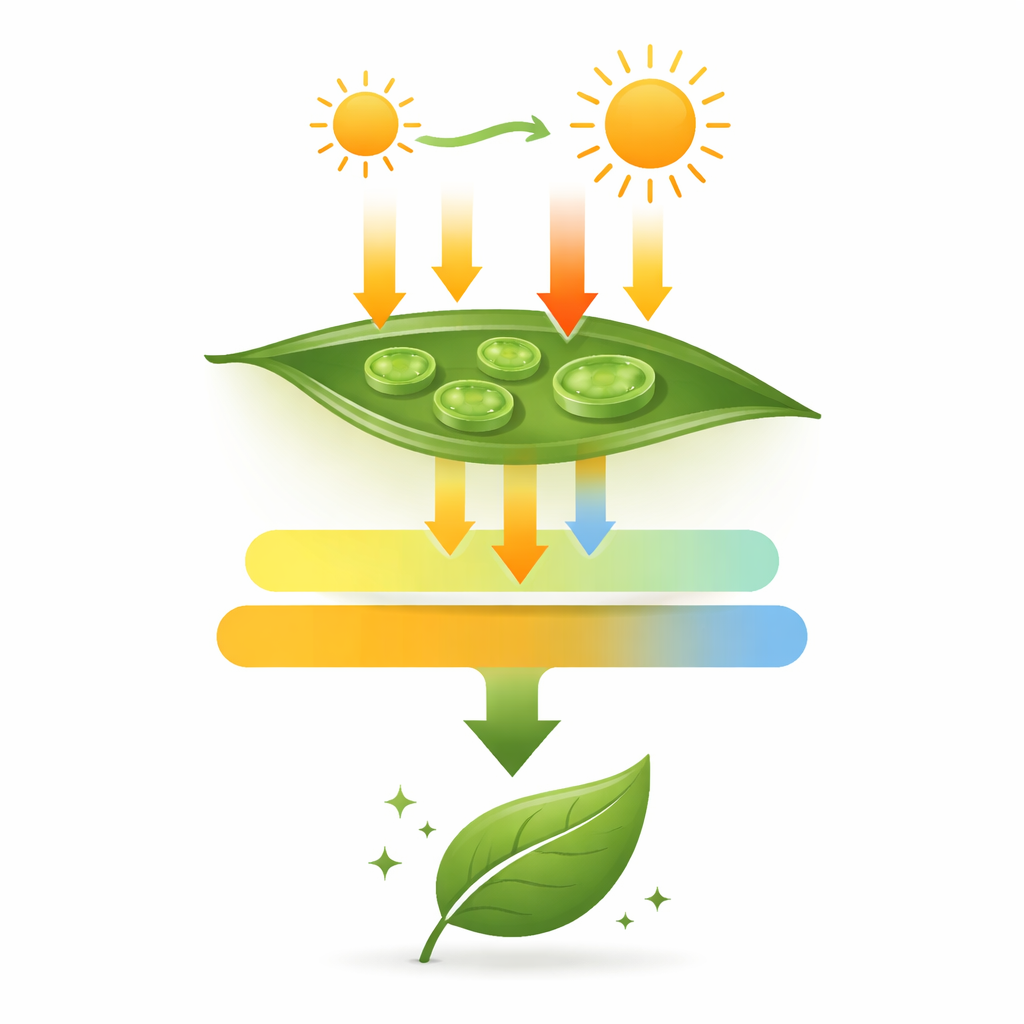
On a windy day, when clouds race across the sky, leaves are hit by bursts of bright sun followed by shade, over and over again. These rapid swings in light can damage the delicate machinery that plants use to turn sunlight into food. This study explores how a common tobacco relative juggles several built‑in “safety valves” to shed excess light as harmless heat, and how understanding this juggling act could help breeders design crops that stay productive under real‑world, ever‑changing skies.
The Problem of Too Much Sun
Photosynthesis starts when a pigment called chlorophyll absorbs a packet of light and passes that energy to specialized centers that power the plant’s chemistry. Under gentle light, this flow is smooth. Under strong light, however, the system can clog: the reaction centers become saturated, and excited chlorophyll lingers too long. In that state it can switch into a more dangerous form that reacts with oxygen to create highly reactive molecules that damage membranes, proteins, and pigments. To avoid this, plants use a collection of “non‑photochemical quenching” tricks, in which the extra energy is safely drained away as heat before it can do harm.
Many Safety Valves on Different Timers
These safety valves do not all work the same way, or on the same schedule. Some switch on in seconds when light suddenly intensifies and switch off almost as quickly when light drops again. Others respond more slowly and can stay active for minutes or longer, while the slowest form reflects true damage that can take days to repair. Several special yellow‑orange pigments, known as xanthophylls, sit next to chlorophyll and play starring roles in these processes. They can be chemically converted from one form to another as light levels change, and they interact with a small protein sensor that reacts to acidity inside the plant’s light‑harvesting membranes. Together, these ingredients create overlapping, partly independent routes for venting excess energy.
Disentangling Overlapping Defenses
Because all of these routes can run at once, teasing apart who does what is hard. The authors tackled this in a land plant called Nicotiana benthamiana, using a suite of carefully engineered mutants, each missing one or more pieces of the protective system. Instead of looking only at brightness of leaf glow, they measured how long excited chlorophyll stayed lit after a brief laser pulse, a quantity called fluorescence lifetime. Shorter lifetimes mean stronger quenching. They tracked these lifetimes over time while exposing leaves to repeated cycles of strong light and darkness, and they paired these measurements with precise counts of the different pigments present, obtained by chemical separation.
Building a Predictive Light‑Safety Model
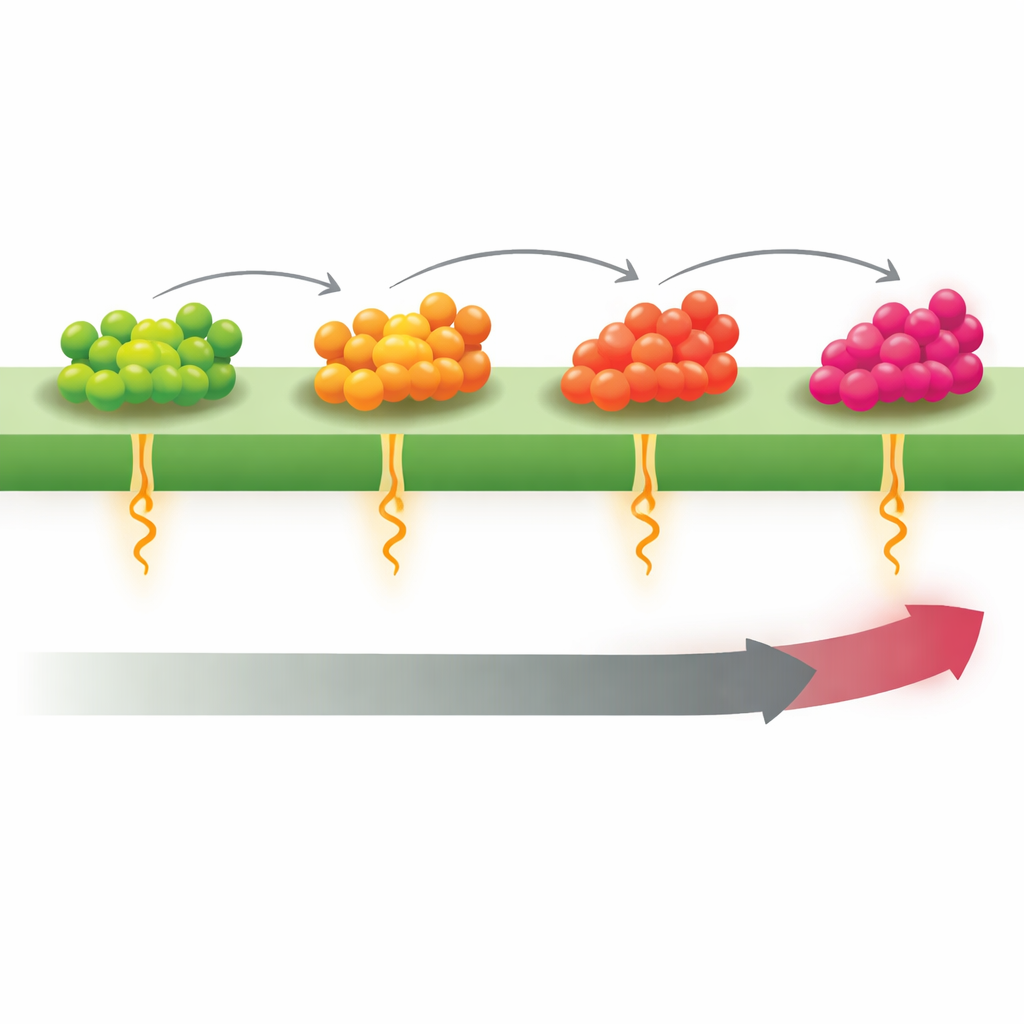
From these data, the team built a compact mathematical model that describes how pigment pools shift and how different quenching routes contribute to the observed lifetimes. Crucially, the model does not assume any detailed microscopic mechanism; instead, it treats each protective component as adding its own extra “turn‑off” rate for chlorophyll, much like adding new drains to a bathtub. By fitting this model first to the simplest mutants and then progressively to more complex ones, the researchers could isolate fast pigment‑based responses, a slower pigment‑dependent route, and the very slow damage‑linked component. When they added these pieces together, the model accurately reproduced the behavior of normal plants and of several mutant combinations under a variety of light–dark patterns.
Who Does the Heavy Lifting?
The model reveals that different pigments dominate at different times after a burst of strong light. Very early on, a widely abundant pigment called lutein and an intermediate xanthophyll form take the lead. Within a few minutes, another pigment, zeaxanthin, becomes increasingly important, and over longer high‑light exposures it clearly takes center stage, both in a route that depends on light‑triggered protein changes and in a route that can remain active even in the dark. The analysis shows that, molecule for molecule, zeaxanthin is by far the most powerful quencher, although lutein’s sheer abundance means it still matters. Plants that lack key parts of this system accumulate more long‑term damage, underscoring how important these rapid valves are in preventing lasting harm.
Tuning Plant Shields for Better Harvests
Because the model connects pigment levels, protein activity, and fluorescence lifetimes, it can be used as a testbed for hypothetical genetic tweaks. The authors used it to simulate overexpression of three central players: the enzymes that make and remove zeaxanthin and the small sensor protein that helps switch quenching on. Certain combinations, especially those that modestly boost the pigment‑cycling enzymes and the sensor together, produced faster activation and faster relaxation of protection without locking the plant into a permanently “dimmed” state. To a layperson, the main message is that plants rely on a finely tuned mix of fast and slow safety valves to handle flickering sunlight, and that with careful quantitative insight it may be possible to tune these valves to keep crops both safe from light damage and highly productive.
Citation: Lam, L., Lee, R., Patel-Tupper, D. et al. Dissecting the contributions to non-photochemical quenching in a land plant under fluctuating light. Nat Commun 17, 3664 (2026). https://doi.org/10.1038/s41467-026-70414-2
Keywords: photosynthesis, plant photoprotection, non-photochemical quenching, xanthophyll cycle, crop yield