Clear Sky Science · en
Predator-driven microbial feedback loops promote plant health
How Tiny Soil Predators Quietly Guard Our Crops
Farmers and gardeners know that sick plants often trace back to problems hidden underground. This study reveals that some of the most important bodyguards for plant roots are not chemicals or even helpful bacteria, but tiny worm‑like predators in the soil. By hunting specific microbes, these nematodes reorganize the entire microscopic community around roots, creating a living shield that helps crops resist a devastating wilt disease. Understanding this natural protection could reduce reliance on pesticides and inspire new ways to design healthier soils for agriculture.
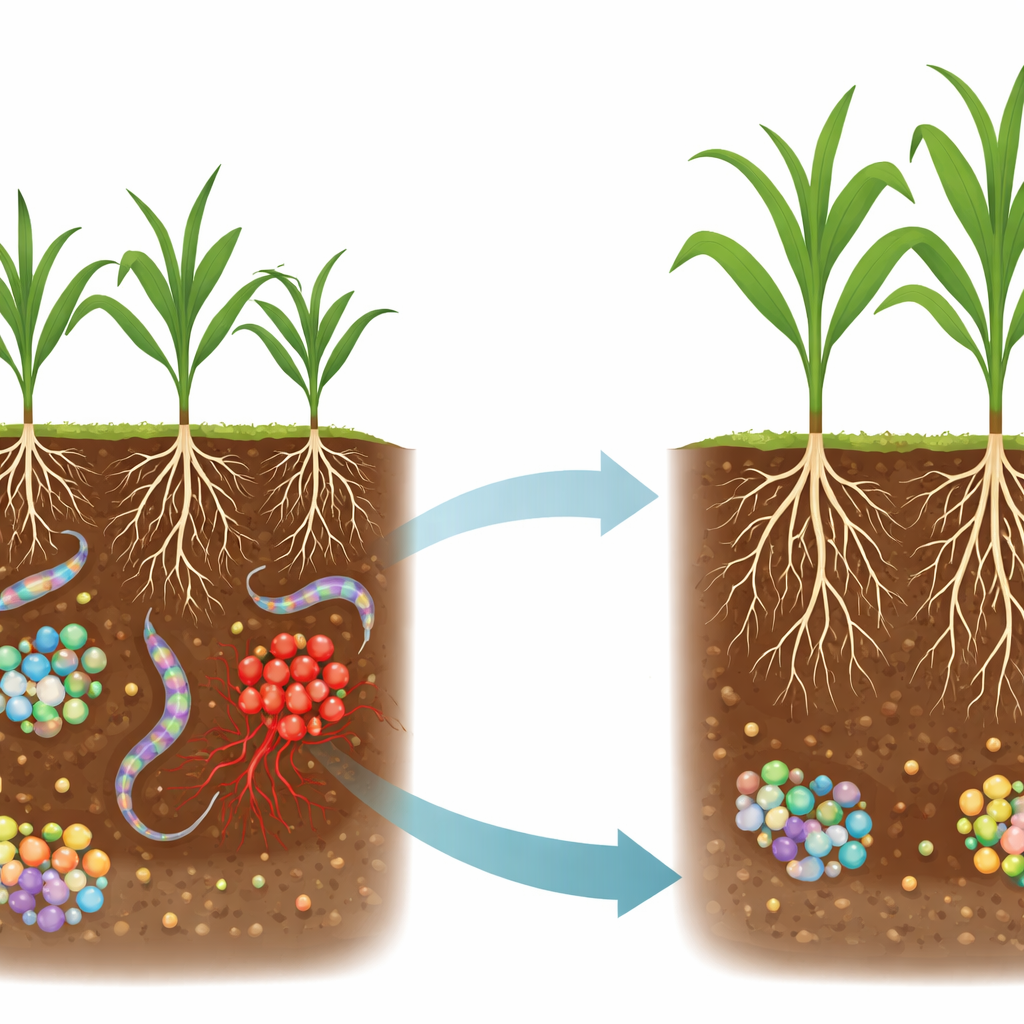
The Underground Crowd Around Plant Roots
Plant roots are surrounded by a bustling community of bacteria, fungi, and small animals. Together, they form a soil “food web” that can either help or harm plants. The authors focused on a notorious soil-dwelling bacterium, Ralstonia solanacearum, which causes bacterial wilt in more than 200 plant species, including tomato and tobacco. They wanted to know how interactions between this pathogen, beneficial bacteria, and microscopic worms called nematodes determine whether plants get sick or stay healthy.
Field Clues from Healthy and Sick Soils
The team first sampled soils from 124 tobacco fields in China, comparing the root zones of healthy plants with those suffering from bacterial wilt. By analyzing DNA from both bacteria and nematodes, they built maps of which species tended to appear together or avoid one another. Healthy roots hosted more intense and more negative links between bacteria and nematodes, suggesting stronger predator–prey interactions. In particular, bacterivorous nematodes—those that mainly eat bacteria—were tightly connected to microbial communities where the pathogen was kept in check.
Greenhouse Tests of a Living Defense System
To move beyond patterns in the field, the researchers built a simplified but realistic root community in the lab. They assembled a synthetic mix of 122 known bacterial strains from the tomato root zone and added tomato plants, the wilt pathogen, and carefully chosen nematode species. When plants received only the bacteria and the pathogen, disease eventually took over. But when nematodes were added to the same mix, plants stayed healthy far longer and often never developed wilt. Measurements showed that nematodes reduced pathogen levels in the root zone by more than half and sharply lowered the number of diseased plants. The most effective protection came from nematodes that mainly ate bacteria, rather than those that also fed on other prey.
How Predators Rebuild the Microbial Neighborhood
Diving deeper, the scientists tracked how nematodes changed the mix and activity of bacteria over several weeks in soil‑like cultures. At first, nematodes reduced overall bacterial biomass, but soon both predators and prey stabilized. The key shift was in balance: nematodes knocked back the single most dominant bacterial species and favored several less common members of the Proteobacteria group. This made the community more even, like a city where no single business dominates the entire economy. These favored bacteria proved highly versatile in using many kinds of food sources and switched on genes involved in metabolism and making antibiotic‑like compounds. When challenged with the wilt pathogen, communities shaped by nematodes were far better at stopping its growth and used a wider range of carbon sources, leaving fewer “open niches” for the invader.
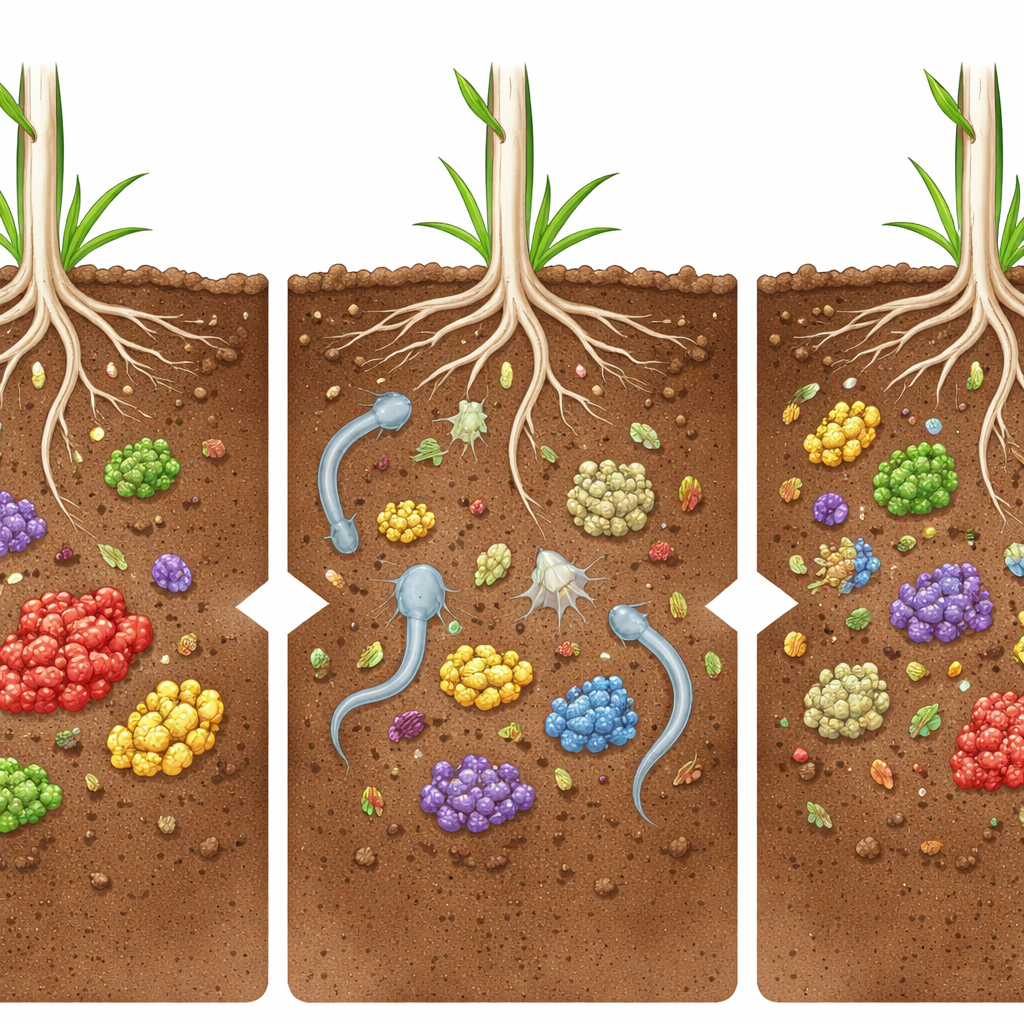
A Helpful Feedback Loop Between Predator and Microbes
The team then zoomed in on two star bacterial players, Klebsiella michiganensis and Raoultella ornithinolytica, which both increased under nematode pressure and hindered the pathogen. These two species complemented each other: secretions from one boosted the growth of the other, and together they suppressed the pathogen more strongly than either alone. Nematodes preferred to feed on Klebsiella, which in turn supported their growth, while interactions with Raoultella strengthened that bacterium’s ability to fight the pathogen. When all three—two bacteria plus nematodes—were present with plants in greenhouse pots, disease was lowest, beneficial microbes and soil carbon were highest, and plants grew tallest. This revealed a self‑reinforcing feedback loop in which predators and select bacteria boost each other and jointly keep the pathogen in check.
What This Means for Future Farming
Overall, the study shows that tiny soil predators do much more than simply eat bacteria. By selectively grazing, nematodes reshape the root microbiome into a more balanced, cooperative community that invests in metabolism and natural antibiotics, making it harder for pathogens to invade. For farmers, this suggests that supporting the right mix of soil life—including predators—may be as important as adding beneficial microbes themselves. Instead of relying solely on single “probiotic” strains or chemical pesticides, future crop protection strategies could deliberately design multitiered food webs where nematodes and compatible bacteria form stable, self‑maintaining shields that keep plants healthy.
Citation: Li, G., Liu, T., Chuai, H. et al. Predator-driven microbial feedback loops promote plant health. Nat Commun 17, 3957 (2026). https://doi.org/10.1038/s41467-026-70413-3
Keywords: soil microbiome, nematodes, plant disease suppression, bacterial wilt, rhizosphere ecology