Clear Sky Science · en
Data-driven intelligent carbonization unifies diverse biomass into high-performance hard carbon negative electrodes
Turning Plant Waste into Better Batteries
Modern life runs on rechargeable batteries, but the materials inside them are often scarce, costly, and carbon‑intensive to make. This study shows how everyday plant matter—such as cotton, crop waste, and nutshells—can be rapidly transformed into a new kind of battery material using a data‑driven heat treatment. The result is a cleaner, cheaper way to build high‑performance electrodes for next‑generation lithium‑ and sodium‑ion batteries, which are crucial for electric vehicles and large‑scale renewable energy storage. 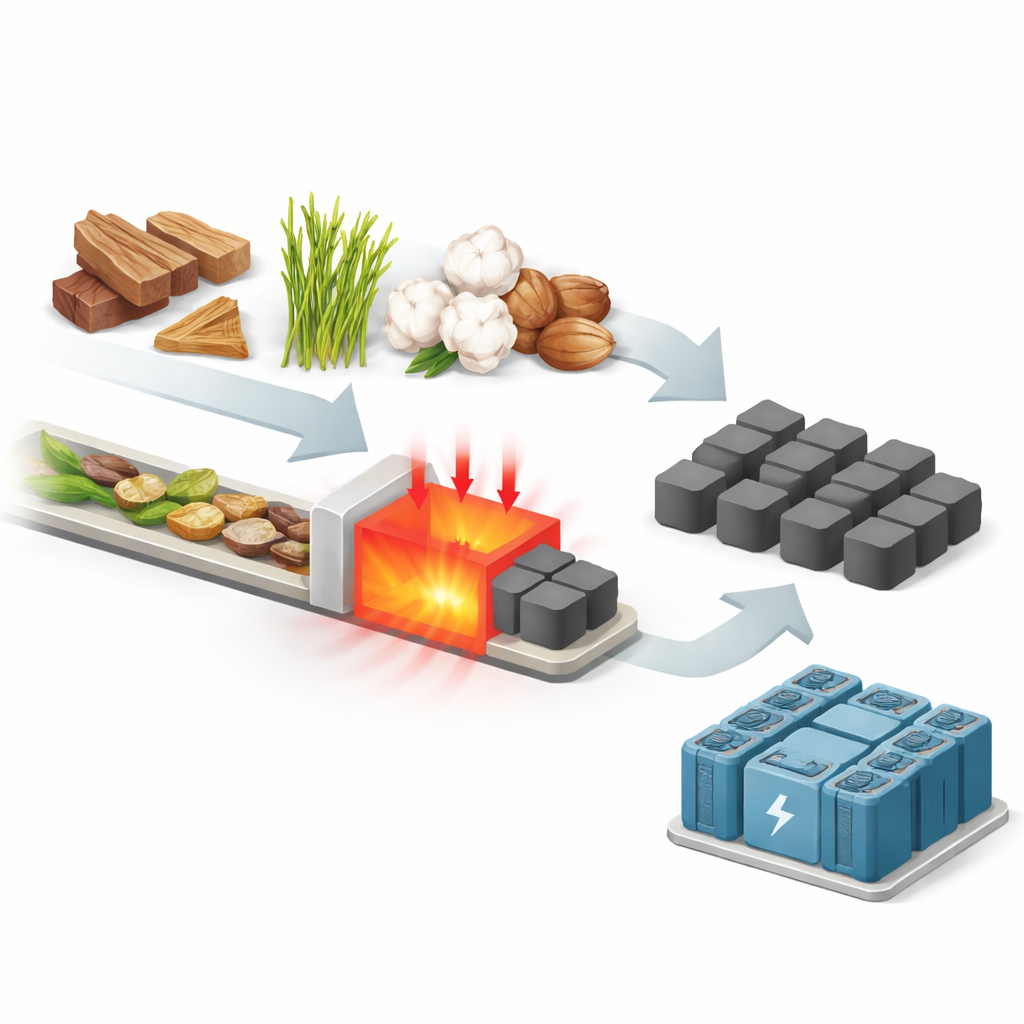
Why Plants Are a Promising Power Source
Biomass is produced on Earth in staggering quantities every year and is widely available as agricultural and industrial waste. If this plant matter can be converted into useful battery components, it would turn a disposal problem into a resource for clean energy. The material of interest here is "hard carbon," a disordered form of carbon that works especially well as the negative electrode in sodium‑ion batteries, a cheaper cousin of today’s lithium‑ion cells. The challenge is that different plants have very different structures and chemistries, and traditional furnace treatments are slow, energy‑hungry, and give inconsistent results. This variability has kept biomass‑derived hard carbons from becoming reliable, large‑scale industrial products.
A New Way to Heat and Learn
The authors introduce "intelligent carbonization," which marries a new kind of ultra‑fast heating with machine learning. Instead of baking plant‑based precursors in a furnace for hours at more than 1,400 °C, they first make a simple intermediate material called biochar, then pass it through a programmable Joule‑heating stage that flashes it to 1,000–2,000 °C for just 10–60 seconds. This drastically cuts energy use—down to about 0.1 kilowatt‑hours per gram, only a small fraction of the energy used to make the original biochar—while still reshaping the carbon at the atomic level. Because each run takes less than a minute, the team can rapidly explore hundreds of heating recipes and feed the resulting performance data into machine‑learning models that search for the best conditions.
Finding the Hidden Structural Sweet Spot
To understand why some samples store more charge than others, the researchers relied on X‑ray diffraction, which reveals how carbon layers are arranged. Traditional metrics focus on the size of graphitic domains and the spacing between layers. By training a neural‑network model on both their own data and values mined from previous studies, the team discovered a new combined indicator they call the performance‑correlated factor. This factor essentially measures how much in‑plane order the carbon has relative to its overall crystalline content. High values signal that the carbon has broad, well‑organized sheets that are not stacked too tightly, along with closed pores of the right size. These features give sodium (and lithium) ions plenty of space to slip between layers or cluster inside pores, boosting capacity and speed without trapping too many ions irreversibly.
From Messy Feedstocks to Uniform Performance
Armed with this structural fingerprint, the machine‑learning system can work backward: it predicts which heating conditions will deliver the desired internal architecture and then recommends process settings in real time. Using this loop, the researchers produced what they call digital hard carbon, which delivers about 369 milliamp‑hours of reversible capacity per gram—more than double the starting biochar and higher than a commercial hard carbon benchmark—while enduring over 5,000 rapid charge‑discharge cycles. Remarkably, when they started from very different precursors, including cotton, peanut shells, and simple sugar, the intelligent carbonization route tuned each one to nearly the same internal structure and a similar capacity around 340 milliamp‑hours per gram. This shows that the method can neutralize the natural variability of biomass and yield predictable, high‑quality products. 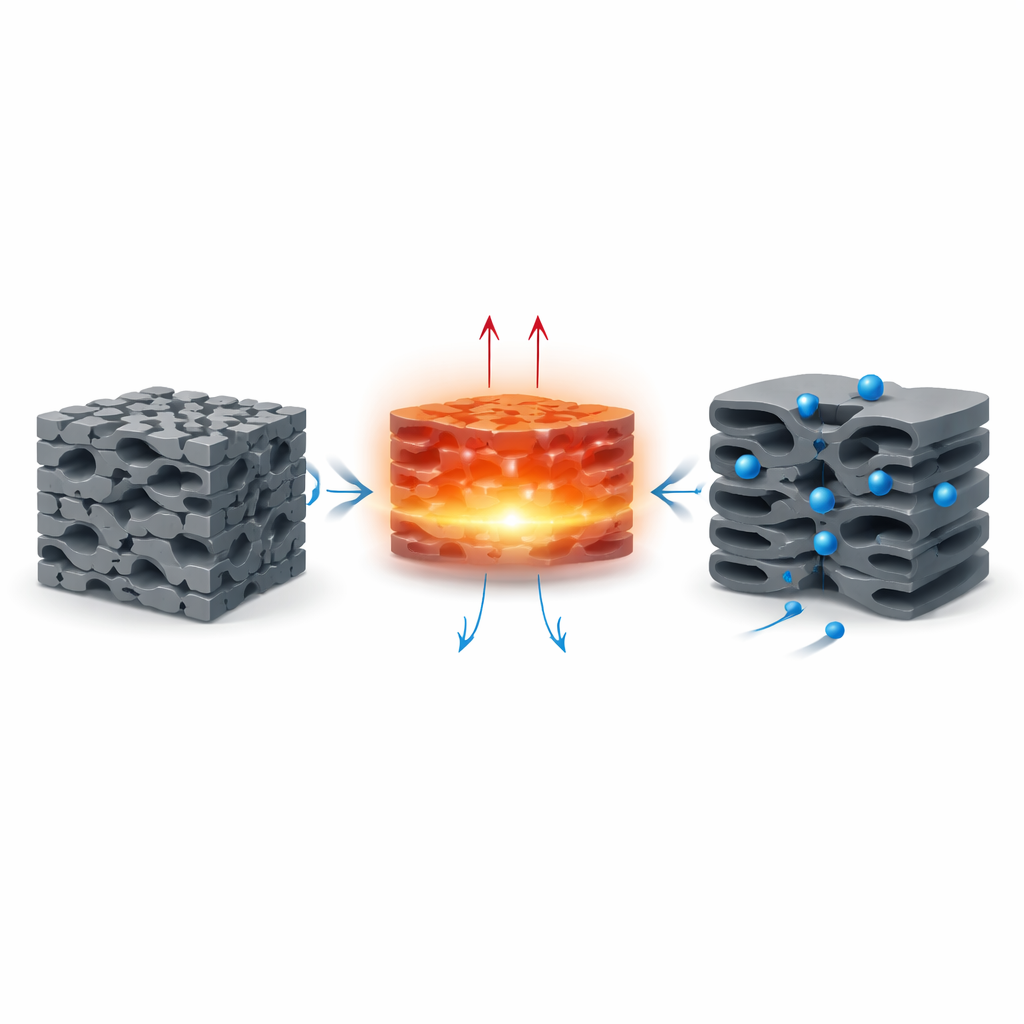
Cleaner Batteries from Common Plants
For non‑specialists, the takeaway is that the authors have built a kind of "smart oven" for plant‑based battery materials. It heats quickly, measures the internal structure on the fly, and uses algorithms to steer the process toward the best‑performing carbon every time. Compared with conventional routes, this intelligent carbonization dramatically cuts energy use, carbon emissions, and manufacturing costs, while turning diverse plant waste into a consistent, high‑performance electrode material. If adopted at scale, it could help make sodium‑ion and improved lithium‑ion batteries cheaper, longer‑lasting, and more sustainable, supporting a cleaner and more resilient energy system.
Citation: Cui, J., Rao, Y., Gao, J. et al. Data-driven intelligent carbonization unifies diverse biomass into high-performance hard carbon negative electrodes. Nat Commun 17, 3885 (2026). https://doi.org/10.1038/s41467-026-70411-5
Keywords: biomass hard carbon, sodium-ion batteries, machine learning materials, sustainable electrodes, Joule heating