Clear Sky Science · en
Molecular insights into the regulation of GNPTαβ by LYSET
Why Our Cells Need Careful Waste Management
Inside every cell, worn-out parts and unwanted molecules must be broken down and recycled. Specialized compartments called lysosomes act as the cell’s recycling centers, packed with powerful digestive enzymes. For these enzymes to reach lysosomes, they must be labeled and shipped along a precise delivery route. This paper uncovers how a little-studied protein, LYSET, safeguards that delivery system, with direct implications for rare genetic diseases, infection, and even how tumors survive under stress. 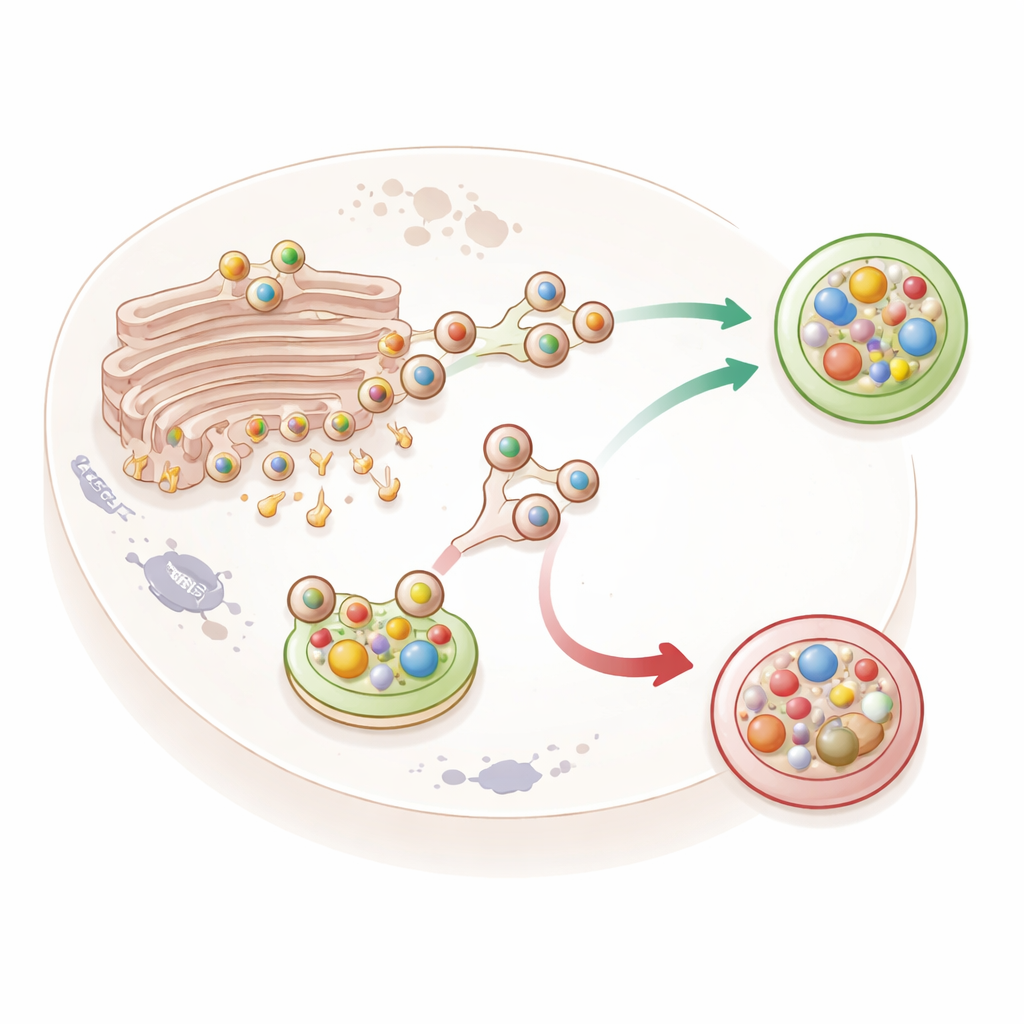
The Postal Code That Guides Cellular Garbage Trucks
Lysosomal enzymes rely on a sugar “postal code” called mannose‑6‑phosphate (M6P) that tells the cell where to send them. At the Golgi apparatus – a central sorting hub – an enzyme called GlcNAc‑1‑phosphotransferase (GNPT) attaches the M6P tag to newly made lysosomal enzymes. Receptors then recognize this tag and load the enzymes into transport carriers that ultimately fuse with lysosomes. If this tagging step fails, enzymes are misdirected outside the cell instead of to lysosomes, leading to accumulation of undigested material and severe disorders known as mucolipidoses. LYSET, a membrane protein in the Golgi, was recently found to be essential for this pathway, but how it acted on GNPT was unclear and competing models had been proposed.
A Missing Helper Causes Enzymes to Vanish
The authors revisited LYSET’s role by comparing normal cells with cells lacking LYSET in several human cell types. Without LYSET, they found far less GNPT protein and an almost complete loss of the processed, active form of the enzyme. Correspondingly, the characteristic M6P tag was essentially absent from lysosomal enzymes, which now accumulated as immature forms and were secreted instead of delivered to lysosomes. Inside the cell, undigested cargo built up in lysosomes, confirming that the entire degradative system was compromised. These results showed that LYSET is not just a peripheral player: it is required both for GNPT’s stability and for its ability to activate lysosomal enzymes.
Keeping a Fragile Enzyme in the Right Place
To understand why GNPT disappears without LYSET, the researchers tracked newly made GNPT over time. In normal cells, GNPT was efficiently cut by a protease called S1P into its active form and remained stable. When LYSET was deleted, this processing was almost abolished and both the precursor and any cleaved GNPT were rapidly degraded. By isolating lysosomes, the team showed that GNPT was misdirected to these digestive compartments and broken down, regardless of whether it had been cut by S1P. They also mapped LYSET’s structure and found it spans the Golgi membrane twice, with both ends facing the cytosol, allowing it to recruit other trafficking factors that keep GNPT at the Golgi instead of letting it drift toward destruction. 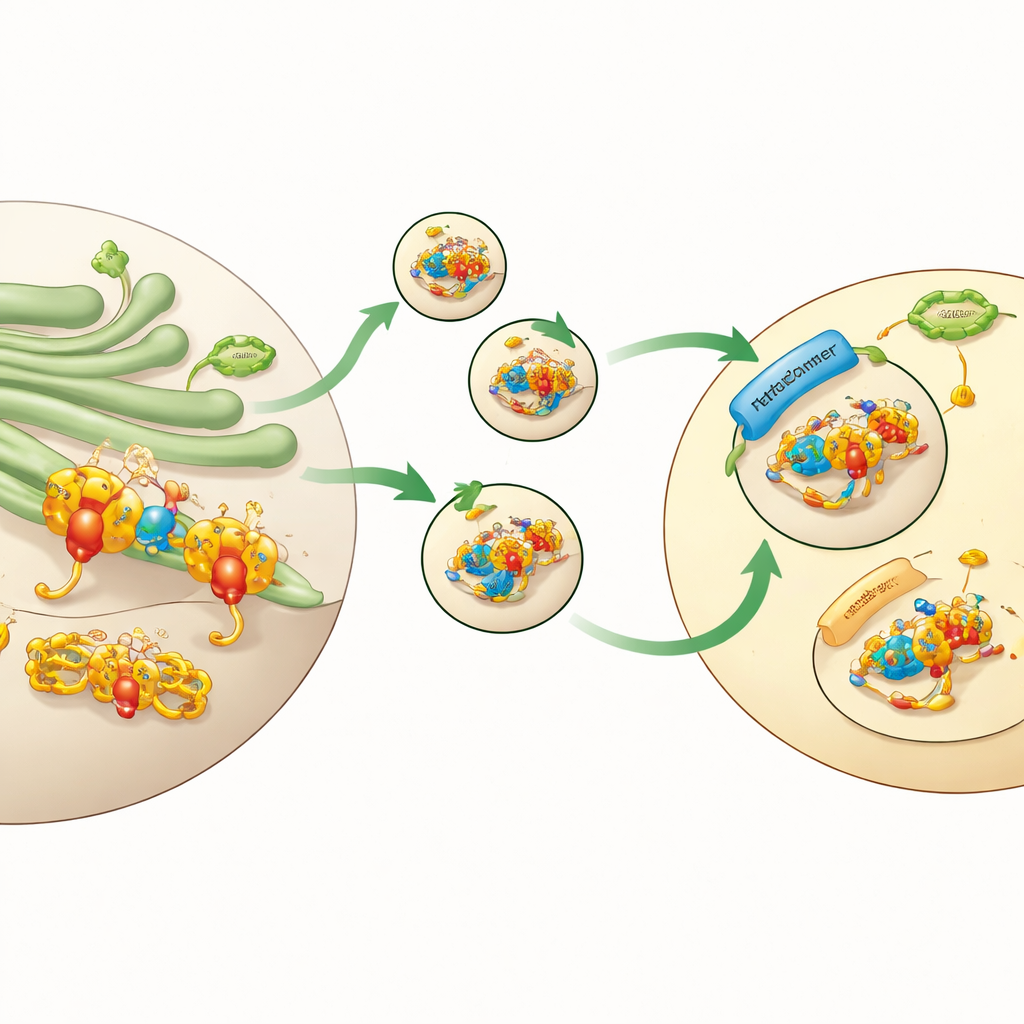
A Molecular Dock That Recycles Key Components
Through systematic mutation of LYSET, the authors pinpointed specific stretches of amino acids that are crucial for its function. A short sequence at LYSET’s N‑terminal tip turned out to be essential for binding a Golgi adaptor protein called GOLPH3, which connects cargo to the COPI coat that shuttles material within the Golgi. Disrupting this motif – including a change known from human patients with severe skeletal disease – weakened Golgi localization and function. At the opposite end of LYSET, two hydrophobic patches in its C‑terminal tail were required for interaction with the retromer machinery, which retrieves proteins from late compartments back to the Golgi. When a core retromer component was removed, both LYSET and GNPT accumulated in lysosomes and were partially degraded, but restoring LYSET could rescue GNPT’s Golgi presence. Together, these findings reveal LYSET as a hub that links GNPT to both local recycling inside the Golgi and long‑range retrieval from endosomes.
How a Small Anchor Protein Protects Cellular Health
Viewed as a whole, the study shows that LYSET acts like a protective dock and retrieval tag for GNPT. By physically partnering with GNPT and simultaneously engaging GOLPH3‑COPI and retromer pathways, LYSET keeps this fragile tagging enzyme concentrated at the Golgi, where it can repeatedly label lysosomal enzymes with M6P. When LYSET is missing or mutated, GNPT is misrouted to lysosomes and digested, the M6P label is lost, and lysosomal enzymes fail to reach their destination. This breakdown mirrors the pathology seen in certain genetic bone and storage diseases, and helps explain why LYSET also influences viral infections and tumor growth. Understanding this multi‑layered control system may ultimately guide therapies that fine‑tune lysosomal function in a wide range of human conditions.
Citation: Yang, X., Doray, B., Henn, D. et al. Molecular insights into the regulation of GNPTαβ by LYSET. Nat Commun 17, 3776 (2026). https://doi.org/10.1038/s41467-026-70402-6
Keywords: lysosome biogenesis, mannose-6-phosphate pathway, LYSET, GlcNAc-1-phosphotransferase GNPT, Golgi trafficking