Clear Sky Science · en
In-situ recomposition of polyethyleneimine additive enables a multiprocess long-lifetime thermocell
Turning Everyday Warmth into Power
Much of the heat around us—from warm windows, electronics, or industrial pipes—is too low in temperature to drive traditional turbines. This study explores a clever liquid battery-like device, called an ionic thermocell, that can tap into such gentle warmth and turn it into useful electricity. By adding a common polymer, polyethyleneimine, the researchers dramatically boost both the voltage and lifetime of these cells, pointing to compact, low-cost generators that could one day charge small electronics from waste heat alone. 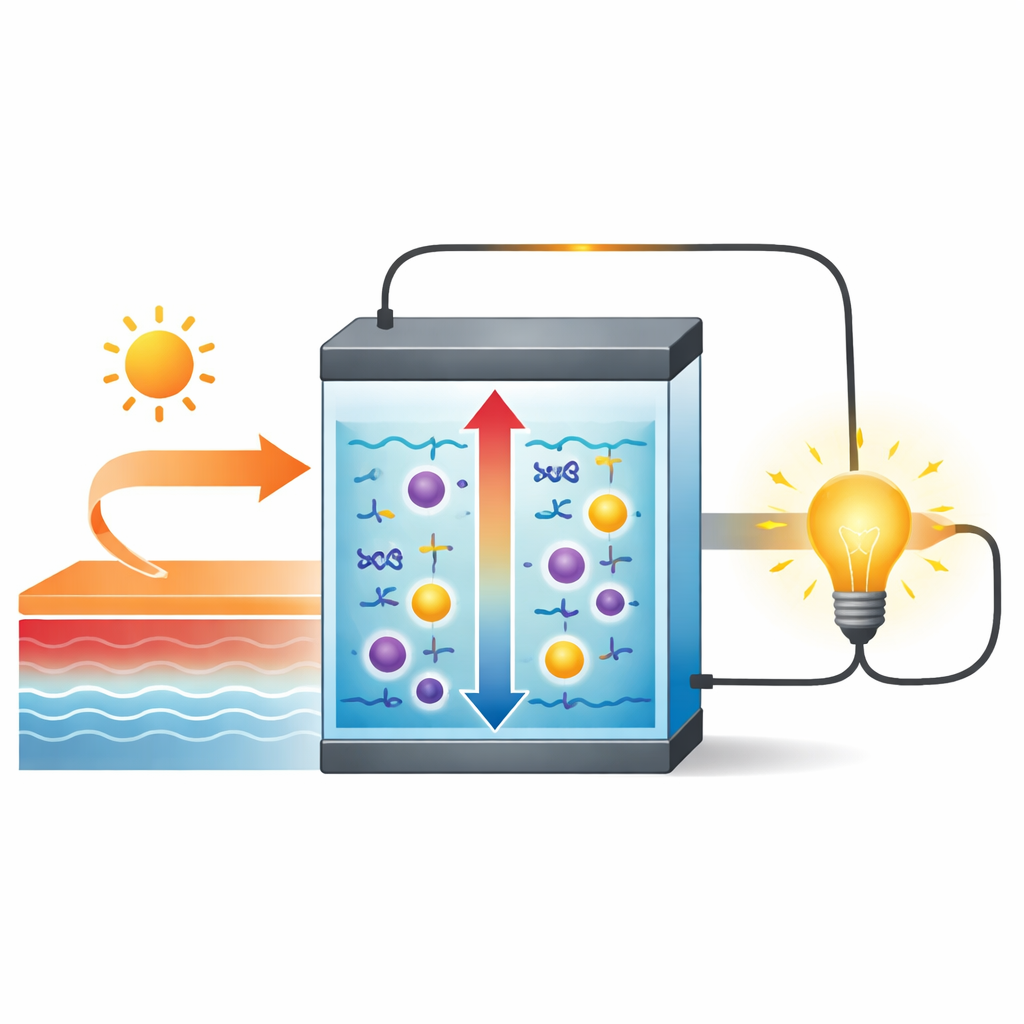
A Simple Cell for Gentle Heat
Ionic thermocells generate electricity from temperature differences using ions in a liquid rather than electrons in a solid crystal. The workhorse system in this field is a pair of iron-cyanide ions dissolved in water, which naturally develops a small voltage—about 1.4 millivolts per degree of temperature difference—between a hot and a cold electrode. That is promising, but still too weak for practical devices, especially when real-world temperature gaps are often only 20 to 50 degrees Celsius. Previous attempts to improve performance relied on either fancy electrodes or extra chemicals that worked only in narrow conditions and often degraded over time.
A Multifunctional Helper Molecule
The authors introduce polyethyleneimine (PEI), a branched, amine-rich polymer already used in many industrial and biomedical applications, as a single “helper” additive. When mixed into the iron-cyanide electrolyte, PEI behaves differently at hot and cold electrodes. At the cooler side, its positively charged chains cling to the electrode surface and attract negatively charged redox ions, while at the hotter side many of these chains let go and retreat into the bulk liquid. This temperature-sensitive sticking and unsticking creates an electrical imbalance across the cell, adding to the basic voltage of the iron-cyanide couple.
Shaping Ions and Reactions with Heat
PEI does more than just sit at the interface. At the cold side, it selectively binds more strongly to one of the iron-cyanide states, forming clusters and even tiny solid particles rich in that form. This effectively pulls one partner of the redox pair out of circulation in the cold region while leaving the other more available, building up a concentration difference that further increases the cell’s voltage. At the hot side, elevated temperature activates a slow chemical reaction in which the oxidized iron species gently “nibbles” on a small fraction of PEI’s amine groups, converting itself back to the reduced form while turning PEI into slightly modified molecules. This reaction helps keep the redox cycle going, subtly reshaping the local environment around the ions in ways that favor higher thermoelectric output. 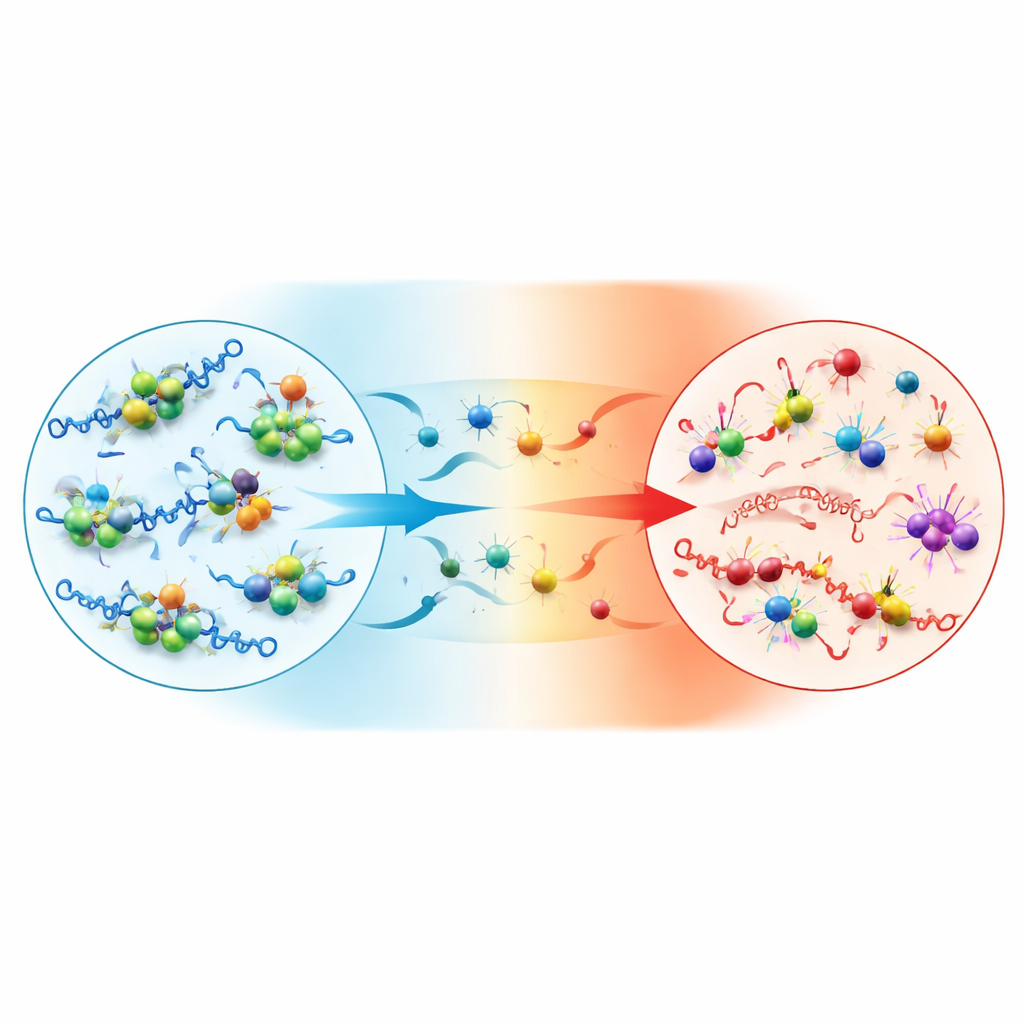
Cascading Effects for Stronger and Steadier Output
Together, these processes form four linked steps: temperature-driven PEI adsorption and desorption at the electrodes; the usual heat-to-voltage conversion of the iron-cyanide couple; selective clustering and partial solidification of certain ion–polymer complexes at the cold side; and temperature-activated chemistry at the hot side. Each step nudges the ion distributions and local solvent structure so that the next step is more effective, leading to a “cascade” that lifts the Seebeck coefficient—the voltage per degree of temperature difference—to about 7.8 millivolts per kelvin, roughly five times the original value. Importantly, the polymer’s reaction with the redox ions is self-limiting: only a modest fraction of its reactive groups are consumed even after more than 1,000 hours of operation, and the resulting products continue to help organize the ions and water in a beneficial way.
From Lab Cell to Working Panels
Because the chemistry is robust over a broad temperature range and does not rely on fragile crystal growth on one particular side of the cell, the enhanced thermocell is less sensitive to whether the hot side is above or below the cold side and to realistic temperature fluctuations. The team demonstrated panels with multiple cells connected in series, producing over 5 volts and several milliwatts under a 50-degree temperature difference—enough to power an electrochromic smart window, charge earbuds, and run a fitness tracker without extra electronics. With its combination of higher voltage, decent efficiency relative to the theoretical Carnot limit, long life, and tolerance of changing conditions, this polyethyleneimine-mediated thermocell offers a practical path toward harvesting ubiquitous low-grade heat for everyday devices.
Citation: Wu, X., Pang, C., Li, Q. et al. In-situ recomposition of polyethyleneimine additive enables a multiprocess long-lifetime thermocell. Nat Commun 17, 3649 (2026). https://doi.org/10.1038/s41467-026-70392-5
Keywords: ionic thermocell, waste heat harvesting, polyethyleneimine additive, thermogalvanic cell, low-grade heat energy