Clear Sky Science · en
Visualising reaction complexes in amine-based unloaded and CO2-loaded carbon capture solutions
Why this study matters for our future air
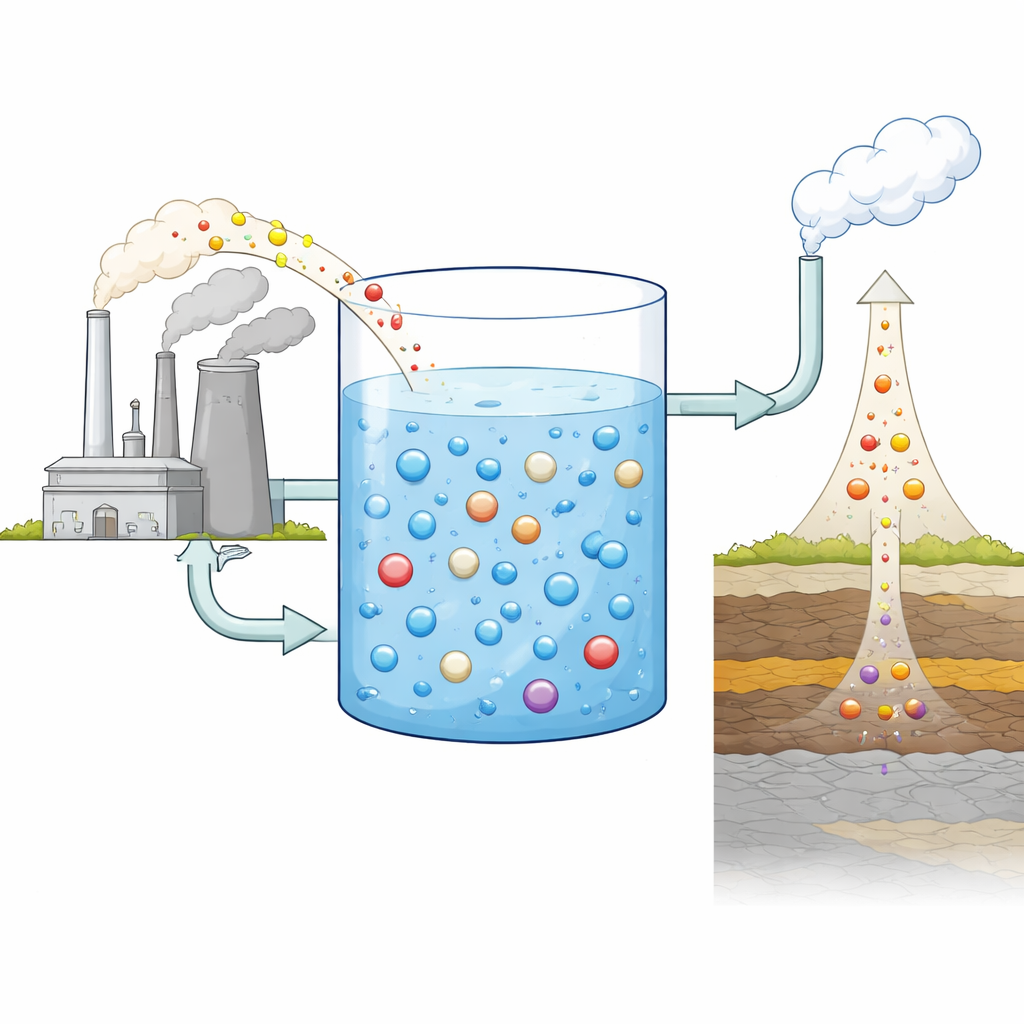
Cutting carbon dioxide (CO2) emissions is essential to slowing climate change, but many heavy industries cannot easily switch off their furnaces or replace them with renewables overnight. For these sectors, liquid chemicals that can grab CO2 from exhaust gases and release it again for storage or reuse are a crucial stopgap. This study peeks inside such liquids at the atomic level, revealing how their ingredients arrange themselves before and after they capture CO2. That hidden structure turns out to matter for how fast and how efficiently these liquids work, and it could guide the design of safer, cheaper and less energy-hungry carbon capture systems.
Capturing carbon with simple building blocks
The researchers focused on two closely related liquids: water solutions of sodium glycinate and potassium glycinate. Glycinate is the deprotonated form of glycine, the simplest amino acid, here paired with either sodium or potassium ions. These solutions act as model carbon capture agents, standing in for the more complex amine mixtures already used at industrial scale. When exhaust gas rich in CO2 is bubbled through such a liquid, the amine group on glycinate reacts with CO2 to form a carbamate, while water can also transform CO2 into bicarbonate. In real systems, these reactions run in both directions: one way to absorb CO2 from flue gas, and the other way, upon heating, to regenerate the solvent and release pure CO2 for storage.
Seeing molecular neighborhoods with neutron beams
Although engineers have long measured how much CO2 these liquids can hold, they have not been able to see clearly how the molecules organize themselves in solution. The team used neutron diffraction, a technique in which beams of neutrons scatter from atomic nuclei and reveal how atoms are arranged on average. By swapping hydrogen for its heavier twin, deuterium, in different parts of the molecules, and refining computer models until they matched the scattering data, the authors built detailed three-dimensional pictures of the local environments around key groups. This approach, called empirical potential structure refinement (EPSR), allowed them to count how many water molecules and metal ions sit near an amine group or a carbamate, and how strongly these neighbors interact.
Life before CO2: how the unloaded liquid is organized
In the unloaded state, where glycinate has not yet reacted with CO2, the amine group sits in a crowded neighborhood of water molecules and positively charged metal ions. The analysis shows that water molecules form a loose shell around the amine, while sodium or potassium ions can also draw close, pulled in by charge. Sodium, being smaller and more highly charged than potassium, nestles nearer to the amine and forms a deeper energetic well. At the same time, the surrounding water network is slightly disturbed compared with pure water, with hydrogen bonds somewhat weakened and water molecules moving more sluggishly. Occasionally, two glycinate molecules approach each other via their amine groups, a rare pairing that corresponds to a proposed “termolecular” reaction route for CO2 capture in which two amines work together to bind one CO2 molecule.
Life after CO2: how capture reshapes the liquid
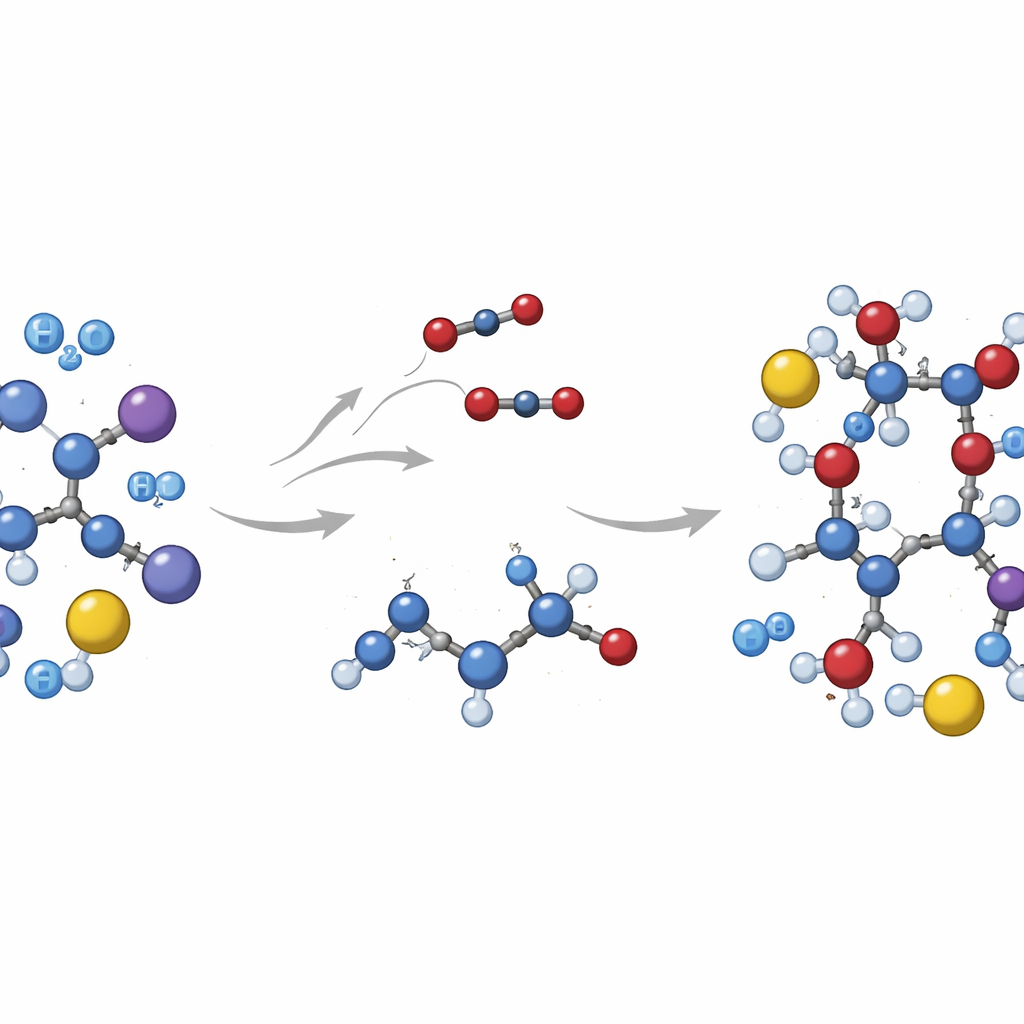
When CO2 is added, new carbamate groups appear on some glycine units and glycine zwitterions (neutral forms with both positive and negative sites) emerge. The local landscape changes markedly. Water molecules crowd more tightly and bind more strongly around the carbamate than they did around the original amine, attracted by the carbamate’s two negatively charged oxygen atoms. Metal ions also sit closer and interact more strongly with the carbamate than with the amine. The overall water network becomes more compact and less tetrahedral, resembling that found in salty or compressed water. The study also reveals specific attractions between carbamate groups and neighboring glycine zwitterions, though these pairings are relatively infrequent. By weighing how often each type of contact occurs against how strong it is, the authors conclude that around unreacted amines, water–amine contacts dominate, whereas around carbamates, water and metal ions contribute roughly equally to the local environment.
Why potassium outperforms sodium
A practical outcome of this microscopic view is an explanation for why potassium-based amino acid solvents tend to absorb CO2 faster than their sodium counterparts, as seen in previous measurements and confirmed here. Because sodium ions cling more tightly and sit closer to the amine and carbamate groups, they create a higher energy hurdle for approaching CO2 and for the structural reshuffling needed during capture and release. Potassium ions interact more loosely, leaving the reactive sites more accessible while still providing the necessary charge balance. These subtle differences in ion size and charge density ripple through the water network and ultimately influence how well a solvent performs in an industrial absorber column.
What this means for better carbon capture liquids
By combining neutron diffraction with advanced modeling, this work delivers an unusually detailed map of how a promising class of carbon capture liquids behaves before and after it binds CO2. For non-specialists, the key message is that performance is not just about what molecules are present, but about how they huddle together and jostle in the liquid. The study shows that tweaking the counter-ion (sodium versus potassium) and understanding how water, ions and reactive groups share their energetic budget can improve both the speed and energy cost of capture and release. The same methodology can now be applied to more complex blends and entirely new solvent families, helping chemists and engineers design carbon capture fluids from the bottom up to be cleaner, more robust and more compatible with large-scale deployment.
Citation: Laurent, H., Sault, D., Headen, T.F. et al. Visualising reaction complexes in amine-based unloaded and CO2-loaded carbon capture solutions. Nat Commun 17, 3828 (2026). https://doi.org/10.1038/s41467-026-70391-6
Keywords: carbon capture solutions, amine-based solvents, glycinate salts, neutron diffraction, CO2 absorption mechanisms