Clear Sky Science · en
Highly ordered mesoporous TiO2 nanomeshes with tunable pore periodicity via self-limiting modular monolayer assembly of monomicelles
Why Tiny, Holey Sheets Matter
As our world leans more on batteries for vehicles, gadgets, and the power grid, scientists are hunting for materials that move ions quickly, waste less energy, and last for thousands of hours. This paper reports a way to build extremely thin, neatly perforated sheets of titanium dioxide—called nanomeshes—that look a bit like ultra-flat sieves. These sheets not only display elegant nanoscale architecture but also dramatically extend the life of a promising type of water-based battery, showing how smart design at the nanometer scale can solve very practical energy problems.
From Flat Sheets to Nanoscale Sieves
The researchers set out to make two-dimensional materials that are not just thin but also full of regularly spaced, fairly large pores. Earlier work on porous graphene, zeolites, and metal–organic frameworks showed that pores can steer how molecules and charges move, but those pores were often very small and hard to tune. Here, the team created free-standing titanium dioxide (TiO2) sheets only about 17 nanometers thick—roughly one hundredth the thickness of a red blood cell—perforated by a single layer of long-range ordered, hexagonally arranged holes about 25 nanometers wide. Because the pores go all the way through, the sheets act as highly organized, two‑dimensional sieves with a large surface area for reactions and transport.
Building Order from Soft Nanoscale Blocks
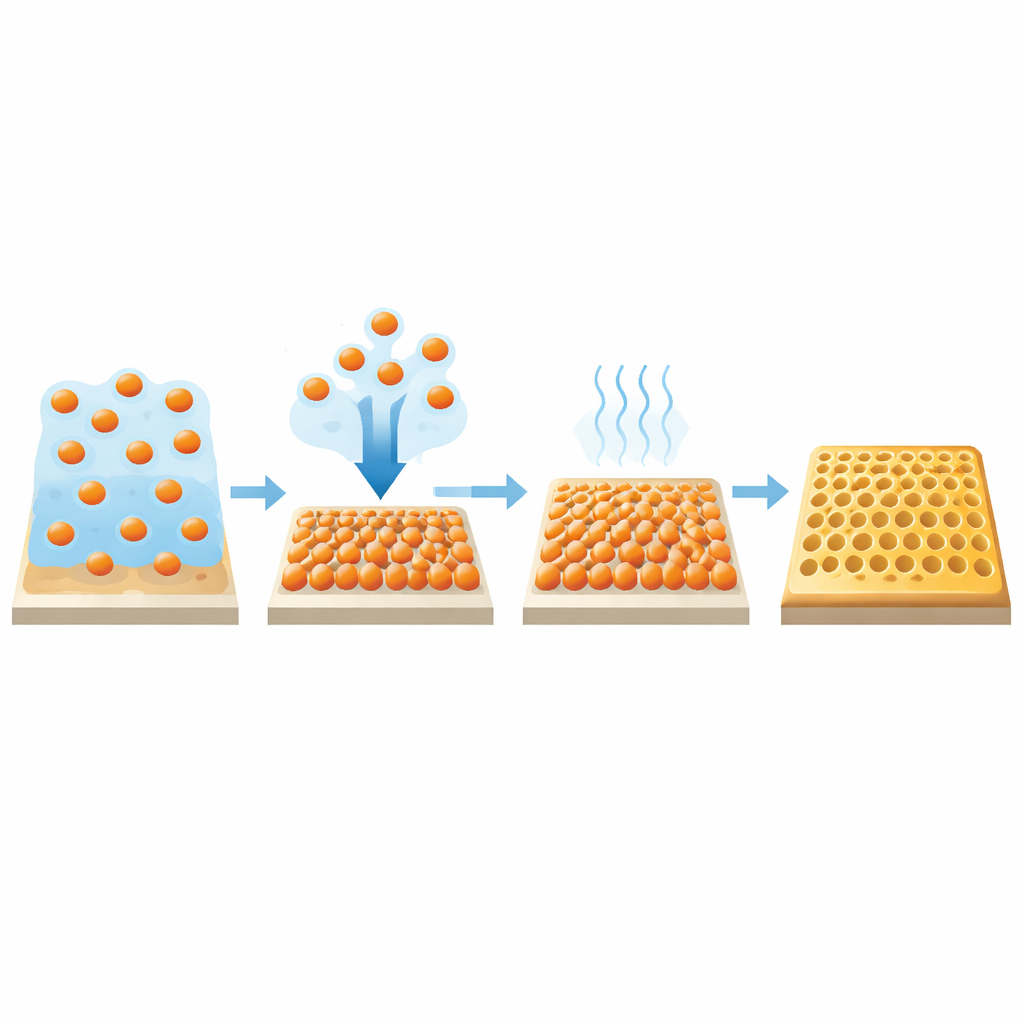
Achieving this level of order in such thin films is notoriously difficult. The key here is a clever self-assembly process that uses soft “monomicelles” as modular building blocks. Each monomicelle is a tiny spherical package made from a diblock polymer and positively charged titania clusters. In a carefully tuned acidic solvent, these composite spheres repel each other electrically, which stops them from clumping. When the solution is centrifuged over salt crystals, a thin liquid film forms and gently presses the charged spheres onto the solid surface. Because of their like-charge repulsion and the limited supply of spheres in the film, they naturally stop at a single layer rather than piling into multiple layers.
Locking in a Regular Nano Lattice
Once a monolayer of spheres is pinned to the surface, solvent evaporation and capillary forces coax them into an orderly hexagonal pattern, much like marbles settling into a tightly packed array. Subsequent heating causes the titania clusters to connect into a solid framework while the polymer components swell, rupture, and are finally burned away. The result is a continuous TiO2 sheet punctured by an evenly spaced array of round through-pores where the micelle cores once sat. By varying the ratio of titanium precursor to polymer, the team can thicken the walls between neighboring pores, which stretches the center-to-center spacing from about 30 to 51 nanometers without changing the pore diameter much. This makes the pore periodicity finely tunable—a valuable handle for designing transport and electronic properties.
Helping Batteries Breathe Smoothly
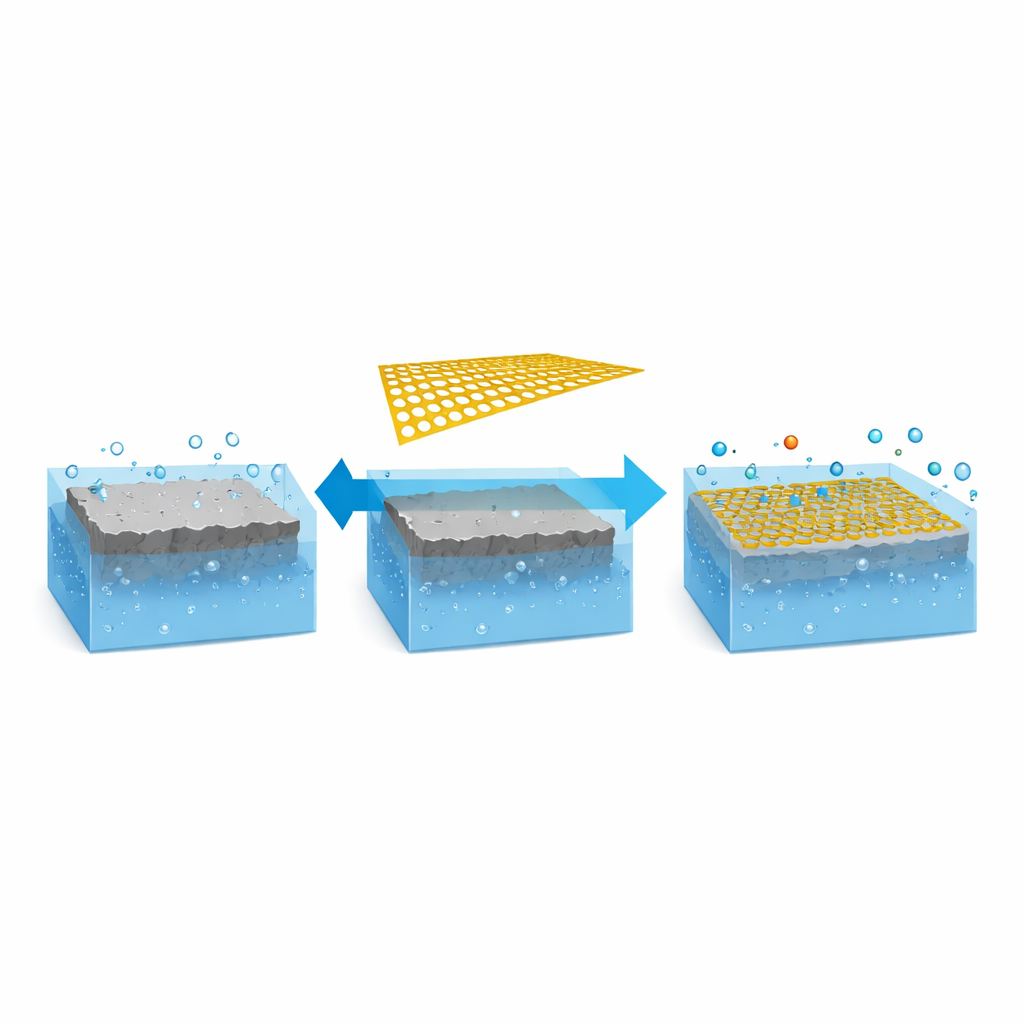
To show what these nanomeshes can do, the scientists placed them on top of tin metal anodes in a water-based tin battery. Bare tin surfaces tend to corrode, interact poorly with the liquid electrolyte, and grow uneven, tree-like metal deposits during charging, all of which shorten battery life. With the TiO2 nanomesh coating, the tin surface becomes more wettable to the electrolyte, ions move faster and more evenly through the ordered pores, and the charge-transfer resistance drops dramatically. Corrosion currents are roughly halved, and tin deposits grow smoothly instead of sprouting rough humps and dendrites. In symmetric test cells, the protected anodes cycle stably for over 1400 hours, compared with only 48 hours for unprotected tin.
Where This Could Lead Next
In plain terms, this work shows how arranging matter into a single, perfectly patterned layer of nanoscale holes can tame a reactive metal surface and make a battery last many times longer. Because the same self-limiting assembly strategy also works with other oxides such as zirconia and alumina, it offers a general recipe for ultrathin, porous protective skins and membranes. With further refinement, these ordered nanomeshes could find roles in next‑generation batteries, chemical separations, and sensors, where precise control over how ions and molecules move through a material is the difference between lab curiosity and real‑world technology.
Citation: Zhang, P., Liu, L., Zhou, W. et al. Highly ordered mesoporous TiO2 nanomeshes with tunable pore periodicity via self-limiting modular monolayer assembly of monomicelles. Nat Commun 17, 3810 (2026). https://doi.org/10.1038/s41467-026-70387-2
Keywords: mesoporous nanomeshes, titanium dioxide, aqueous batteries, self-assembly, ion transport