Clear Sky Science · en
An integrated germline and somatic genomic model for coronary artery disease
Why your DNA can hint at future heart trouble
Coronary artery disease is the world’s leading killer, yet many heart attacks still strike people who never knew they were at high risk. This study asks a simple question with big implications: can a single DNA sample give a clear, easy-to-understand estimate of a person’s chance of developing clogged heart arteries in the next decade? By blending several kinds of inherited and acquired genetic signals into one score, the researchers aim to move closer to that goal.

Bringing many genetic clues into one picture
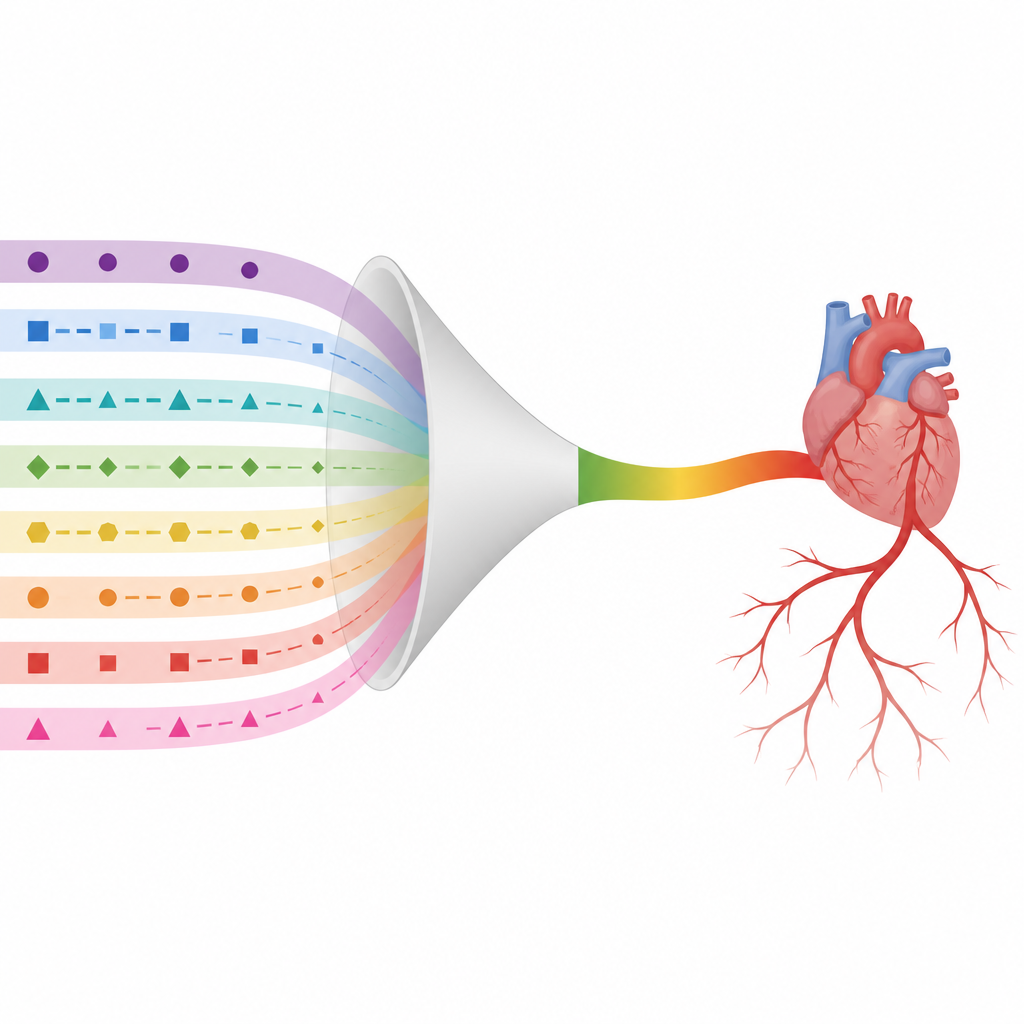
Doctors already use a mix of cholesterol levels, blood pressure, smoking, and diabetes to give patients a single 10-year heart risk. Genetics, however, has lagged behind. People might carry a rare cholesterol-raising mutation, have a high or low polygenic risk score, show signs of age-related DNA changes in blood cells, or have unusually short protective caps on their chromosomes called telomeres. Each of these clues says something about risk, but taken separately they can be confusing. This study builds an "integrated genomic model" that adds up six different DNA-based risk signals into one overall estimate for coronary artery disease.
What goes into the new genetic score
The team analyzed whole-genome data from almost 400,000 participants in the UK Biobank and over 34,000 people in a separate U.S.-based program called TOPMed. They combined four inherited (germline) features and two acquired (somatic) features. The inherited side included rare variants in familial cholesterol genes, a broad polygenic score built from millions of common variants, and two scores that genetically mirror blood levels of many proteins and metabolites linked to heart disease. The somatic side captured clonal hematopoiesis, in which certain blood cell clones gain growth-boosting mutations with age, and telomere length in white blood cells, which tends to shrink over time. Each factor was first shown to relate to heart disease on its own, then merged into two sub-scores for inherited and acquired risk, and finally into a single integrated genomic model.
How well the model spots higher risk
When applied to the UK Biobank, the integrated score produced a wide spread of 10-year coronary artery disease risk, from about 1 in 90 people at the low end to roughly 1 in 6 at the high end, with even steeper ranges in the TOPMed group. Men generally sat on a higher risk curve than women. Importantly, the model uncovered many different genetic paths to danger. Some people were at high overall risk because all their genetic signals pointed in the same harmful direction, while others reached similar risk levels through a mixture of milder but reinforcing factors. Conversely, some people with a single high-risk mutation were classified as low overall risk because the rest of their genetic background appeared protective.
Genetics alongside traditional clinical scores
The researchers also asked how this DNA-based score compares with and adds to a widely used clinical calculator known as the Pooled Cohort Equations, which relies on age, cholesterol, blood pressure, diabetes, and smoking. The integrated genetic model modestly improved prediction for the general population, but its benefits were sharper in middle-aged and younger adults, who often have not yet developed major clinical risk factors. Within each clinical risk category, the genetic score further separated people into lower and higher 10-year risk groups. Some individuals who appeared only borderline by clinical measures crossed above a commonly used treatment threshold once their genetic risk was taken into account, while others at high clinical risk but low genetic risk looked more like intermediate cases.
What this means for future heart prevention
To a layperson, the key message is that heart disease risk is not dictated by a single "bad gene" but by the combined push and pull of many inherited and age-related DNA changes. This study shows that it is possible to turn that complex information into one number that meaningfully reflects a person’s 10-year chance of coronary artery disease, especially early in life. The work does not yet prove that acting on this score will prevent heart attacks, and it needs further testing in the clinic. Still, it offers a framework for using one DNA sample to capture a lifetime’s worth of genetic influences on heart health, which could eventually help tailor prevention more precisely than current tools alone.
Citation: Yang, X., Kim, M.S., Zhu, X. et al. An integrated germline and somatic genomic model for coronary artery disease. Nat Commun 17, 4483 (2026). https://doi.org/10.1038/s41467-026-70379-2
Keywords: coronary artery disease, genetic risk score, polygenic risk, clonal hematopoiesis, telomere length