Clear Sky Science · en
Moisture-tolerant Mg-metal electrodes for practical fabrication of rechargeable Mg batteries
Why Making Better Batteries Matters
Our modern world leans heavily on rechargeable batteries, from phones and laptops to electric cars and massive energy storage farms for solar and wind power. Today’s batteries mostly rely on lithium, a relatively scarce and increasingly expensive element. Magnesium, by contrast, is cheap, abundant, and safer to handle. Yet magnesium batteries have struggled to leave the lab because magnesium metal reacts badly with even tiny traces of water, quickly forming a hard crust that stops the battery from working. This study introduces a simple way to make magnesium metal far more tolerant to moisture, opening a practical path toward cheaper and safer next-generation batteries.
The Big Problem with Water and Magnesium
At first glance, magnesium seems like an ideal battery metal: it can store a lot of charge, it is stable, and it is widely available. The catch is that magnesium metal is extremely sensitive to moisture. A brief encounter with humid air or a slight amount of water in the liquid inside a battery is enough to build a dense, rock-like film on the metal’s surface. This film blocks magnesium ions from moving in and out, so the battery can no longer be charged and discharged normally. To avoid this, researchers have had to dry every ingredient—salts, liquids, and metal parts—very aggressively and assemble cells in tightly controlled glove boxes. Such strict conditions are costly, slow, and difficult to scale up for mass production.

A Simple Dip that Changes the Surface
The authors discovered that a brief dip of scraped magnesium metal into a common liquid called trimethyl phosphate can dramatically change how the metal behaves in wet conditions. In only about 15 minutes at room temperature, a thin protective film forms on the metal surface. This film contains two key magnesium-based components: one acts as a chemical sponge for water, and the other helps hold water close to the surface where it can be neutralized. When these treated electrodes are later placed into typical battery liquids, they continue to work even when the liquid holds as much water as would be expected from ordinary handling in air, rather than in ultra-dry rooms.
How the Invisible Shield Cleans Up Water
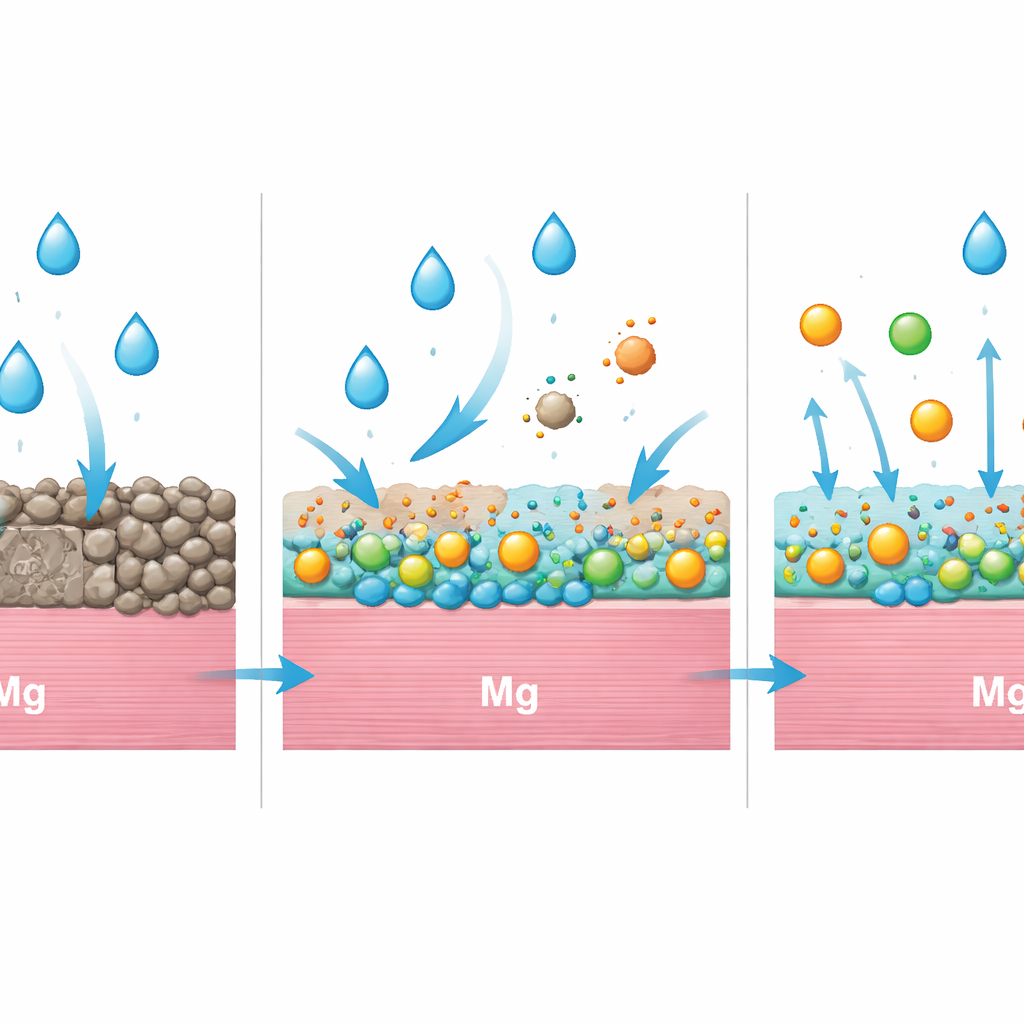
To understand why the treatment is so effective, the team probed the surface using infrared light, X-ray techniques, and gas analysis. They found that the protective film contains a magnesium–carbon compound that reacts very quickly with water, turning it into harmless products and forming magnesium hydroxide away from the shining metal core. At the same time, a phosphate-rich matrix on the surface attracts and traps water molecules, guiding them toward the reactive component. Together, these two effects work like a built-in drying agent: when the treated metal touches a moist electrolyte, the film scavenges water directly in the liquid and at the interface, lowering the water level fast enough for magnesium ions to move freely without being blocked by a thick crust.
Proving It Works in Real Battery Cells
The researchers then tested how this treated magnesium performs in realistic battery setups. In simple two-electrode cells, untreated magnesium quickly failed when the liquid contained only a few hundred parts per million of water, showing huge voltage losses and unstable behavior. In contrast, the treated magnesium cycled smoothly for more than a thousand hours, with moderate voltage changes, even in liquids containing several thousand parts per million of water. It also worked well in full batteries paired with three different positive materials, including a classic sulfide, an oxide with wide spacing for ions, and a high-surface-area carbon cloth. These full cells delivered stable energy storage over many cycles, even when assembled in a dry-room atmosphere rather than in a glove box. The treated electrodes also remained effective after being exposed to room air for up to about an hour, giving manufacturers a practical time window for assembly.
What This Means for Future Energy Storage
In plain terms, this work shows that a quick, scalable surface treatment can give magnesium metal a kind of self-drying skin, allowing it to operate in conditions much closer to those used for today’s lithium-ion battery production. By reducing the need for extreme drying and expensive atmosphere control, the method could sharply lower manufacturing costs and make magnesium-based batteries more competitive. If combined with continued progress on other battery components, this moisture-tolerant magnesium electrode may help turn magnesium from a promising idea into a real-world option for large, safe, and affordable energy storage.
Citation: No, W.J., Han, J., Hwang, J. et al. Moisture-tolerant Mg-metal electrodes for practical fabrication of rechargeable Mg batteries. Nat Commun 17, 3678 (2026). https://doi.org/10.1038/s41467-026-70378-3
Keywords: magnesium batteries, moisture-tolerant electrodes, surface treatment, energy storage materials, battery manufacturing