Clear Sky Science · en
C6-ROMP Enabled by Structure-Guided Monomer Design for Chemically Recyclable Polymers
Why better plastics matter
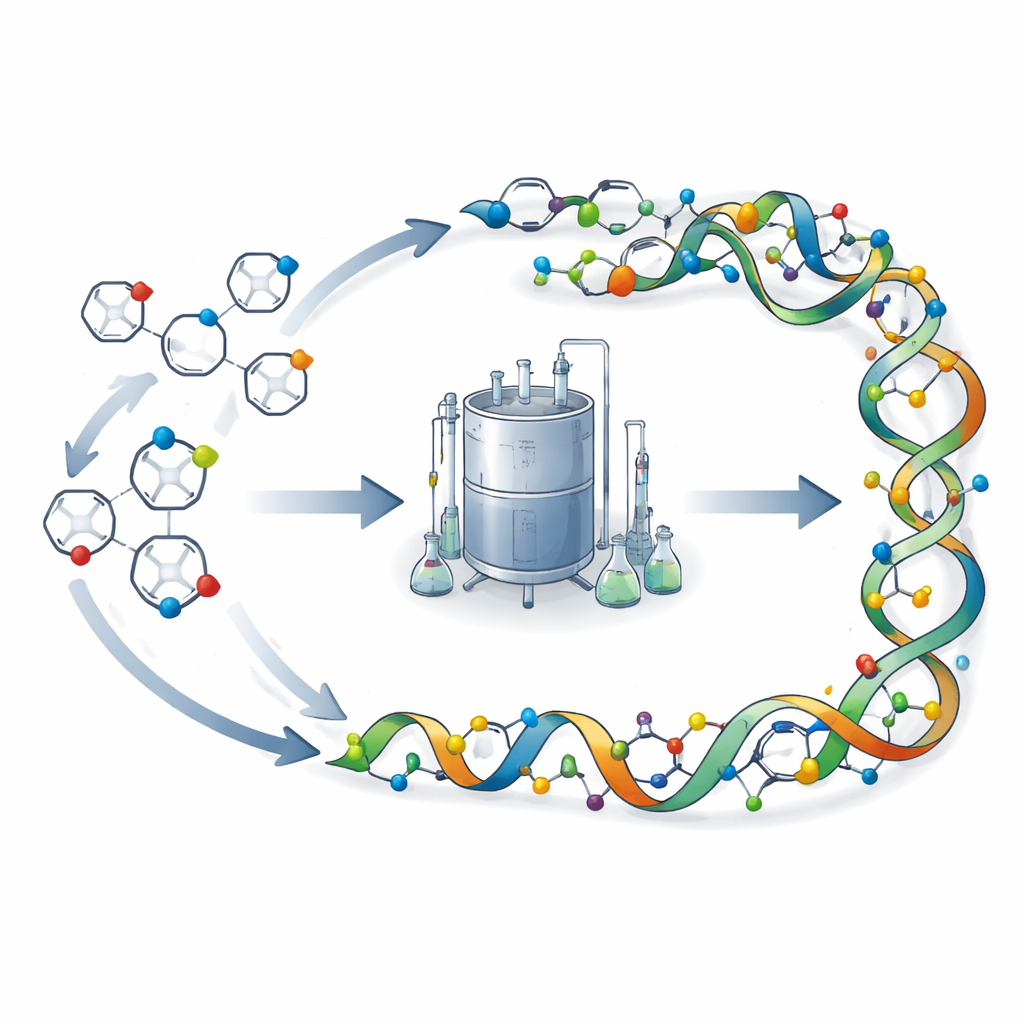
Plastics are everywhere—from phone cases to medical devices—but most are made to last forever, even when we want them to be recyclable. Chemists are now trying to design high‑performance plastics that can be taken apart deliberately and rebuilt, creating a true circular life cycle instead of a one‑way trip to the landfill. This paper describes a new way to build such plastics from a simple ring‑shaped molecule, cyclohexene, by carefully reshaping its structure so it can both form strong materials and later fall back into its basic building blocks.
Turning a stubborn ring into a useful building block
Cyclohexene is attractive because it is easy to make from common aromatic chemicals and can, in principle, be turned back into small molecules very cleanly. However, its ring is too relaxed to drive the key reaction used here, ring‑opening metathesis polymerization, which normally requires built‑in strain to push the ring to open. Earlier attempts either barely linked the rings together or had to bolt on large extra pieces that ruined cyclohexene’s simplicity. The authors tackle this by “borrowing” strain: they fuse a small five‑membered ring onto cyclohexene. This extra ring can later be removed, but while it is attached it twists the structure just enough to make polymer formation favorable.
Designing rings with just the right tension
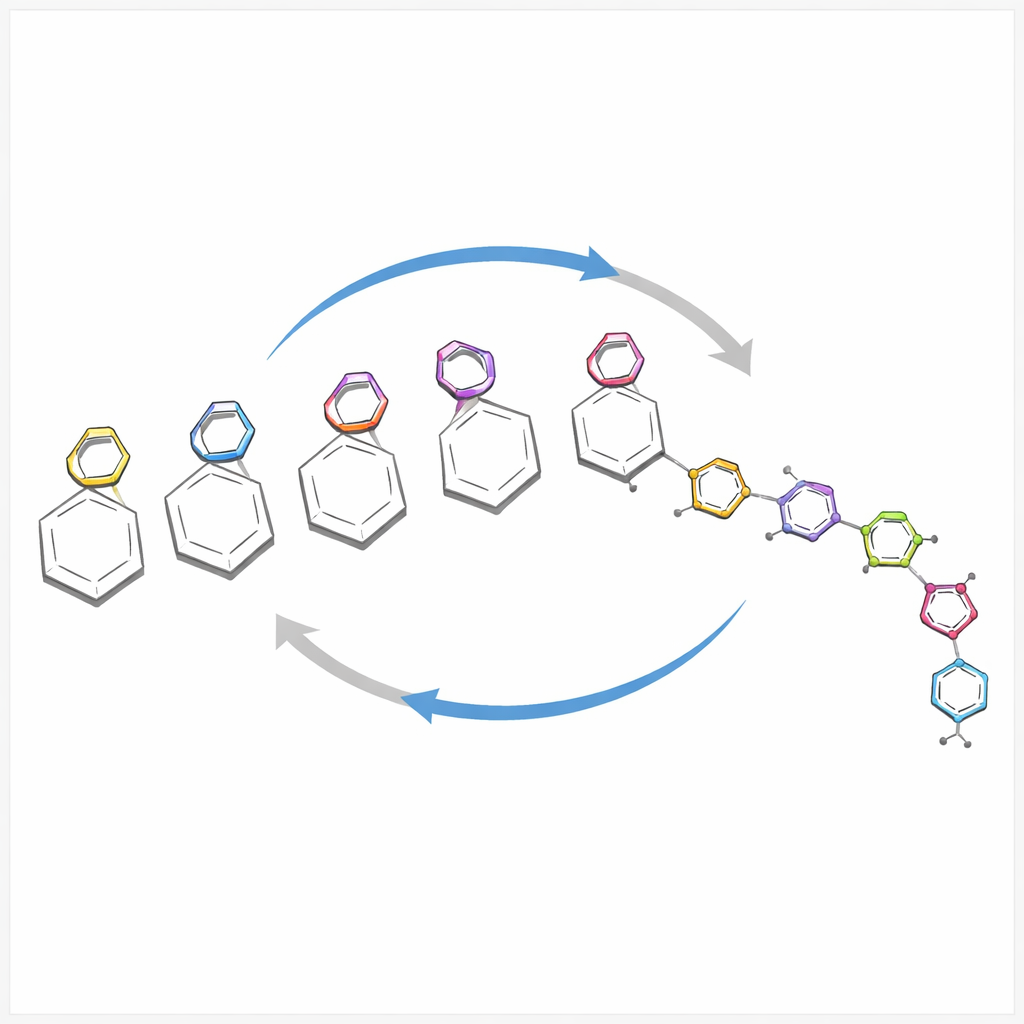
The team systematically explored several types of small fused rings—based on carbonate, carbamate, acetal, silyl ether, and boronic ester chemical motifs—and attached different side groups to them. Using quantum‑chemical calculations, they measured how much energy is stored in each fused ring and how much is released when the ring opens, a quantity they call the ethenolysis ring strain energy. By comparing these values with real polymerization experiments, they discovered a practical threshold: if the stored energy is below about 4.3 kilocalories per mole, the monomer does not polymerize well under mild conditions; above that, it forms polymers reliably. The exact 3‑D shapes of the fused rings—how flat or puckered they are, and how bulky their side groups are—strongly control this stored energy and thus whether the material will form at all.
Balancing build‑up and break‑down
Making a recyclable plastic is not only about forming chains; those chains must also be able to fall apart on command. The authors studied how readily their new polymers depolymerize through a reverse reaction called ring‑closing metathesis. Here, entropy—the measure of how many different shapes the molecules can adopt—becomes crucial. Rigid, bulky side groups tend to lock the chain segments into place, giving high "ceiling" temperatures at which the polymer prefers to stay assembled and making recycling more difficult. More flexible or asymmetric groups allow chain motion, lowering this ceiling and enabling efficient depolymerization at moderate temperatures and useful concentrations. By tuning side‑group size, rigidity, and location, the researchers created polymers that could be nearly fully converted back to monomers under gentle conditions, while others deliberately resisted breakdown until a two‑step process (removing protective groups, then depolymerizing) was applied.
Tuning material properties without losing recyclability
Beyond reactivity, the same structural knobs let the team dial in material properties such as glass transition temperature—the point where a polymer changes from glassy and rigid to rubbery and flexible. Polymers whose side groups sit close to the main chain, especially bulky ones, restrict motion and yield high glass transition temperatures up to about 120 °C, suitable for tougher, heat‑resistant materials. When the groups are farther out or more flexible, the chains can move more easily, producing low or even sub‑zero glass transition temperatures ideal for soft or elastic applications. Notably, these differences in feel and performance are achieved without sacrificing the ability to chemically recycle the materials, because the same fused‑ring design that controls stiffness also encodes the conditions under which the chains will unzip.
What this means for future plastics
This work offers a clear recipe for creating next‑generation plastics that are both high‑performance and truly recyclable. By attaching and later removing carefully chosen small rings on cyclohexene, the authors show how to program when a polymer wants to form and when it wants to fall apart, all while tuning how hard, soft, or heat‑resistant the final material is. In everyday terms, it points toward a future in which plastic products can be engineered from the start to live in a controlled loop—built, used, taken apart, and rebuilt—rather than ending up as long‑lived waste.
Citation: Choi, K., Choi, W., Chung, M. et al. C6-ROMP Enabled by Structure-Guided Monomer Design for Chemically Recyclable Polymers. Nat Commun 17, 4133 (2026). https://doi.org/10.1038/s41467-026-70372-9
Keywords: chemically recyclable polymers, ring-opening metathesis, cyclohexene monomers, polymer design, circular plastics