Clear Sky Science · en
Vertical substitution strategy to enable cooperation between spin–orbit coupling and transition dipoles for organic phosphorescence
Glowing molecules that light up our world
From phone screens to medical scans, much of modern life depends on tiny glowing molecules. These dyes usually shine through fluorescence, a fast flash of light. A slower form of glow, called phosphorescence, can last long after the light is switched off and is ideal for high‑contrast imaging and advanced displays. Yet for purely organic molecules, strong, long‑lasting phosphorescence—especially in red light useful for bioimaging—has been hard to achieve without using heavy metals. This study shows a new way to design such molecules so they can glow as efficiently as the best fluorescent ones, but with a delayed, persistent afterglow.
Why afterglow matters
Fluorescence and phosphorescence are both ways excited molecules return to their resting state by emitting light, but they follow different routes. Fluorescence happens in billionths of a second and tends to be bright but fleeting. Phosphorescence involves a change in the electron’s spin state, which slows the return journey and allows light emission to stretch over milliseconds or even seconds—an “afterglow.” This slow glow is powerful for imaging because you can wait until background autofluorescence in cells fades, then record only the clean afterglow from your labels. The catch is that most organic dyes that are great at fluorescing are poor at phosphorescing, especially at the longer red wavelengths needed to see deep into tissue.
Turning side attachments from flat to upright
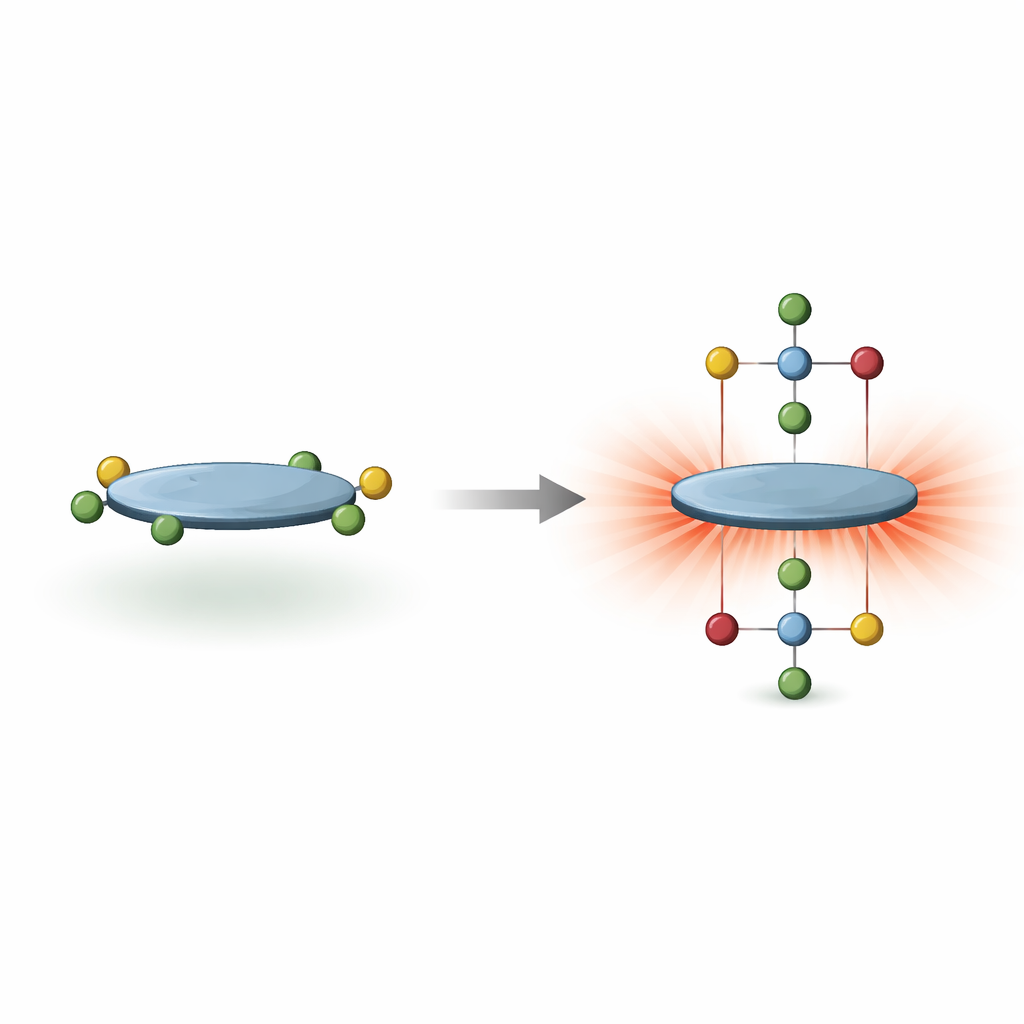
Traditional design rules for bright organic emitters focus on stretching out flat, conjugated carbon frameworks and decorating them with side groups lying in the same plane. These “horizontal” substituents boost a property called the transition dipole, which strengthens fluorescence. However, the same design actually works against efficient phosphorescence, because the contributions to light emission from different parts of the molecule can cancel each other out for the slow triplet state. The authors proposed a different approach: keep the flat light‑absorbing core, but place heavy main‑group atoms, such as selenium, above and below that plane as “vertical” substituents. This subtle three‑dimensional twist changes how electrons move and interact inside the molecule, opening a better pathway for phosphorescent emission.
Putting the new design to the test
The team synthesized a family of organic molecules based on the same rigid carbon skeleton but with different patterns of selenium‑containing groups: either arranged flat around the edge (horizontal) or sticking up and down from the core (vertical). They embedded these dyes in a solid organic host and measured both the fast blue fluorescence and the slower red afterglow. Molecules with more horizontal substituents shone strongly in fluorescence but had weak or short‑lived red phosphorescence. In contrast, molecules with multiple vertical substituents showed remarkably bright and efficient red afterglow, with phosphorescence yields far higher than their horizontally substituted cousins. Detailed experiments confirmed that all versions formed triplet states efficiently; the key differences lay in how those triplet states returned to the ground state—either by radiating light or by losing energy silently as heat.
How the new geometry boosts the glow
Using advanced quantum‑chemical calculations, the authors disentangled why vertical substituents tip the balance toward light emission. In simple terms, the heavy atoms promote mixing between states with different spin, which is needed for phosphorescence, but their exact placement matters. Horizontally placed heavy atoms strongly increase both the desired radiative return and the unwanted nonradiative loss, with the loss channel winning overall. Vertical substituents, however, are arranged so that they still cooperate with the large transition dipole of the flat core to strengthen light emission, while reducing certain orbital overlaps that would otherwise enable efficient nonradiative decay. As a result, the rate of light‑producing transitions is boosted more than the loss processes, leading to brighter and longer‑lived afterglow even in the red region, where phosphorescence is usually harder to maintain.
From new molecules to sharper cell images
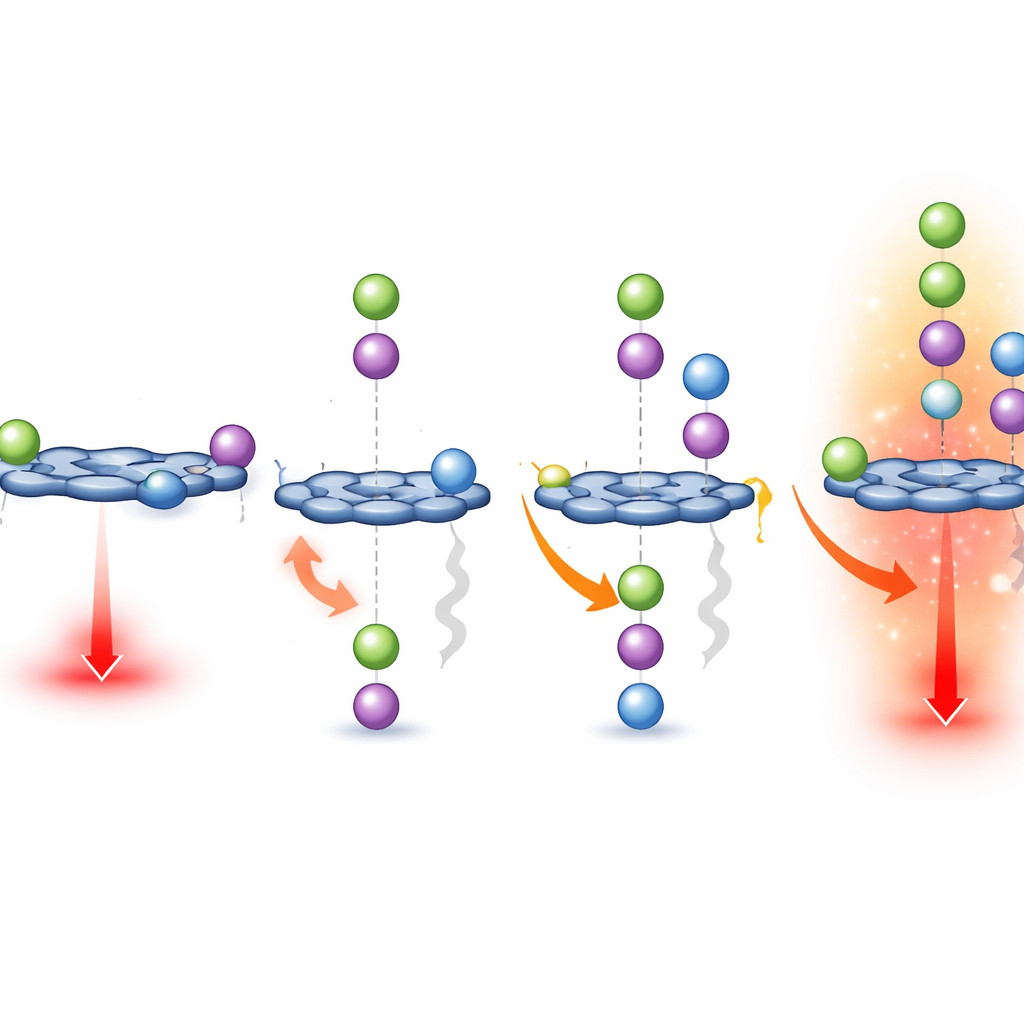
To show the practical impact of this design, the researchers built tiny crystalline particles that emit green or red afterglow with either short or long lifetimes, using their best vertically substituted dye for bright red emission. When these particles were added to living cells and excited with ultraviolet light, the microscope initially saw a mix of cellular autofluorescence and particle emission. Once the light was switched off and a short delay was introduced, only the particles’ afterglow remained, and each type could be distinguished by its color and how long it glowed. This multiplexed, autofluorescence‑free imaging demonstrates how the vertical substitution strategy can expand the palette and precision of organic phosphorescent probes. In the long run, these design rules could help create metal‑free organic materials that glow efficiently at any visible color, enhancing everything from biomedical imaging to next‑generation display and lighting technologies.
Citation: Hayashi, K., Shimura, R., Miyashita, R. et al. Vertical substitution strategy to enable cooperation between spin–orbit coupling and transition dipoles for organic phosphorescence. Nat Commun 17, 4098 (2026). https://doi.org/10.1038/s41467-026-70371-w
Keywords: organic phosphorescence, afterglow imaging, molecular design, heavy atom substituents, bioimaging probes