Clear Sky Science · en
Multi-electron nitrobenzothiadiazole sp-conjugated-alkynyl covalent organic frameworks for ammonium-ion batteries
Why a New Kind of Battery Matters
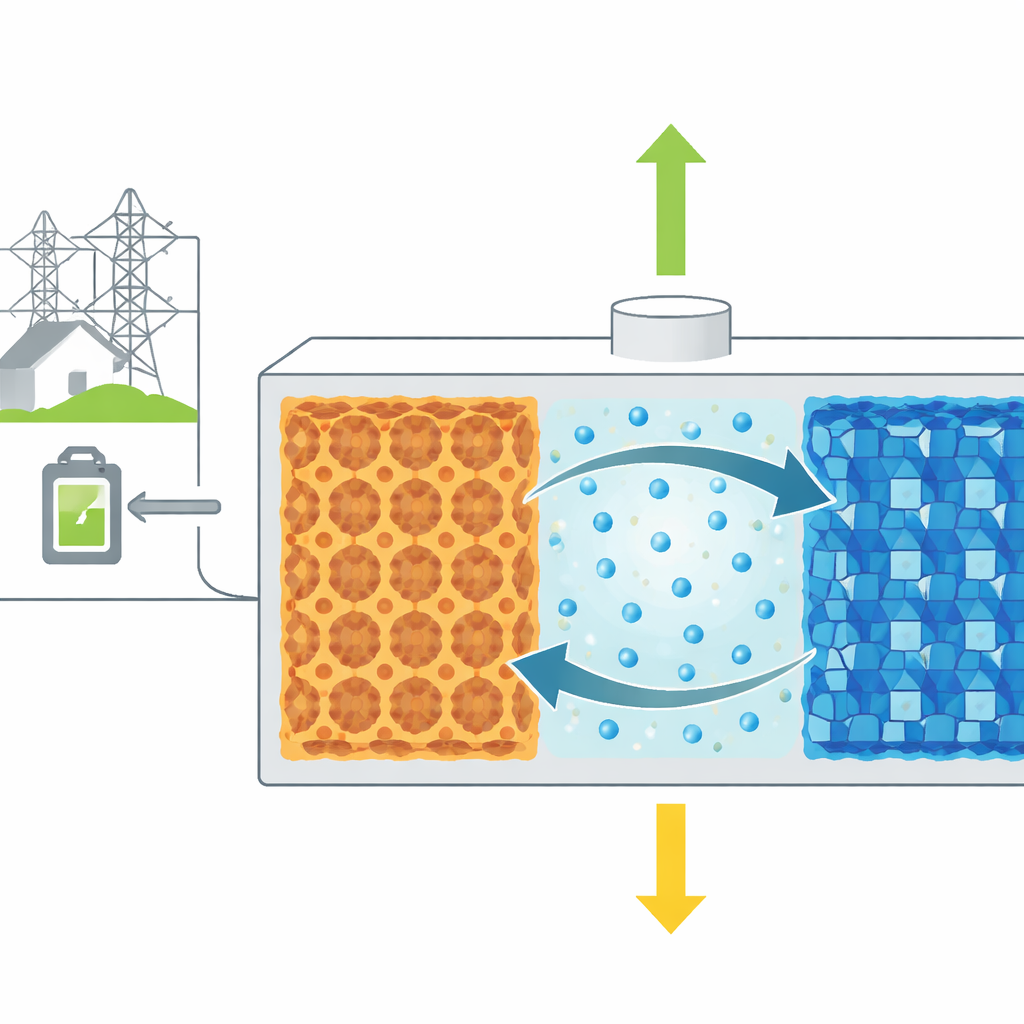
As our world leans more heavily on wind and solar power, we need safe, long‑lasting, and affordable batteries to store energy when the sun isn’t shining and the wind isn’t blowing. Today’s workhorse batteries mostly rely on metals like lithium, which are costly and raise safety and supply concerns. This study explores a very different approach: water‑based batteries that move tiny ammonium ions—built from common elements like nitrogen and hydrogen—through a tailor‑made organic framework, aiming for high capacity, safety, and an exceptionally long life.
A Safer Charge Carrier in Water
The researchers focus on aqueous ammonium‑ion batteries, which use water as the main ingredient in the liquid electrolyte and ammonium ions (NH4+) as the moving charge carriers. Compared with familiar metal ions such as lithium or sodium, ammonium ions are lighter, less corrosive, and less likely to trigger unwanted gas formation in water. They naturally form a tetrahedral shape that can latch onto nearby atoms through a web of hydrogen bonds. This special geometry makes ammonium a promising partner for organic host materials that can be precisely designed at the molecular level.
Designing a Robust Organic Scaffold
Organic battery materials often suffer from two problems: they can dissolve in the electrolyte and gradually wash away, and they may use only one electron per active site, which limits how much charge they can store. To tackle both issues at once, the team built a crystalline, porous polymer called a covalent organic framework (COF). In their new material, named nitro‑BTH‑COF, flat aromatic building blocks are linked together by stiff carbon–carbon triple bonds into an extended, grid‑like skeleton. Within this skeleton they embed nitrobenzothiadiazole units, which provide multiple spots that can undergo two‑electron redox reactions. The result is a highly ordered network with many closely packed, reusable “parking spaces” for ammonium ions.
How the Framework Grabs and Releases Ions
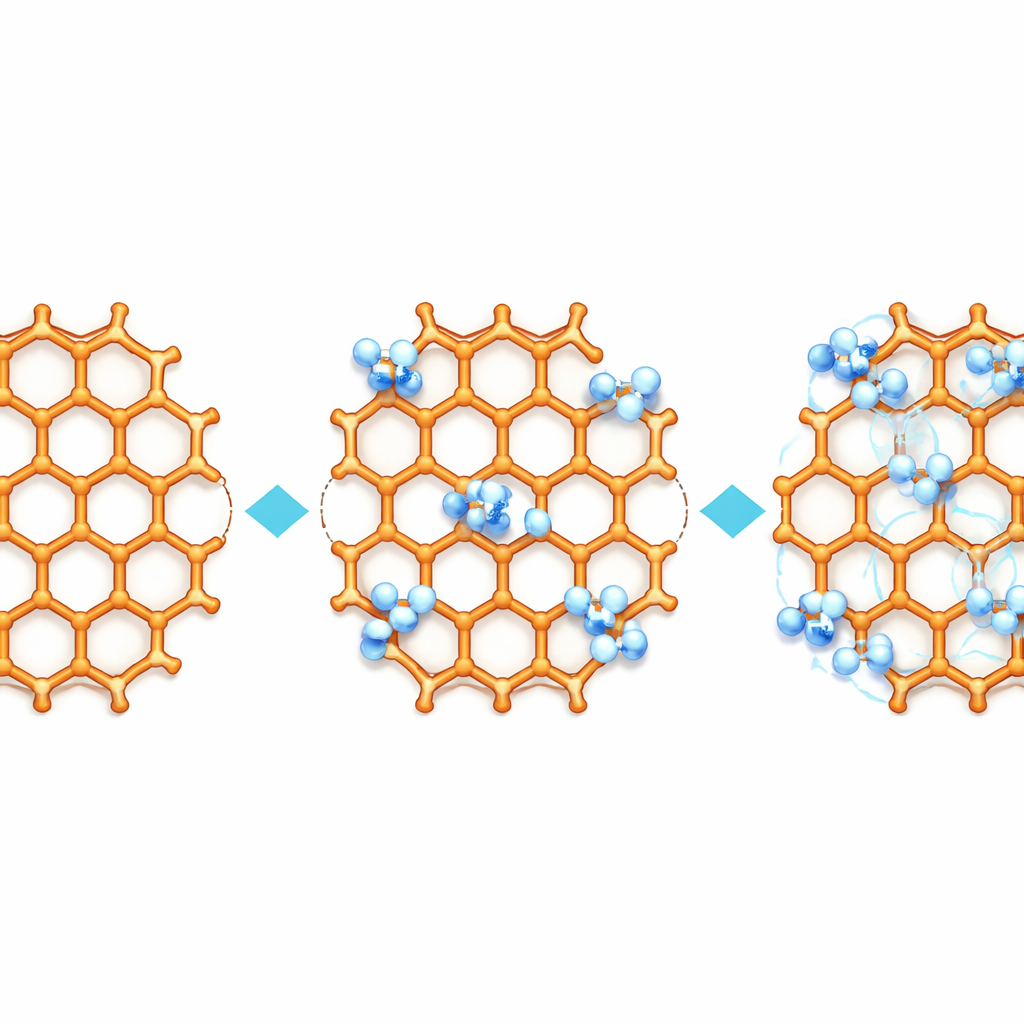
Using a combination of spectroscopy experiments and computer simulations, the authors show that the nitro‑BTH‑COF stores charge through hydrogen‑bond‑driven coordination. During discharge, ammonium ions first attach to nitro groups and then to neighboring nitrogen atoms in the ring, forming a dense web of hydrogen bonds around each active unit. This process involves up to twelve electrons per unit and is largely reversible when the battery is charged again. The rigid, conjugated backbone keeps its shape throughout, preventing the framework from collapsing or dissolving. Quantum‑chemical calculations reveal that the electronic structure of the material favors rapid electron movement and that the energy barrier for the ion‑binding reaction is lower than in a similar framework lacking the nitro groups.
High Capacity and Very Long Life
When tested as the negative electrode in a water‑based ammonium‑ion cell, nitro‑BTH‑COF delivered a remarkably high specific capacity—up to 317 milliampere‑hours per gram—and kept working even when charged and discharged at very high rates. Most strikingly, it retained more than 90% of its capacity after tens of thousands of rapid cycles, far beyond typical lifetimes for organic battery electrodes. When paired with a Prussian blue analogue as the positive electrode, the full battery reached an energy density of about 86 watt‑hours per kilogram (counting both electrodes) and survived 25,000 cycles with only modest fading, indicating that the organic framework remains structurally intact while the inorganic partner eventually wears down.
What This Means for Future Batteries
For non‑specialists, the main message is that carefully engineered organic frameworks in water‑based ammonium‑ion batteries can deliver both high energy storage and outstanding durability. By weaving together a rigid, conjugated scaffold with multi‑electron active sites, the researchers created a material that welcomes ammonium ions through a flexible network of hydrogen bonds without dissolving or degrading. This design strategy opens a broader toolbox for building safe, metal‑lean batteries that could eventually help stabilize renewable energy on the grid and power devices where long life and safety matter as much as raw energy density.
Citation: Chen, Y., Zhang, D., Qin, Y. et al. Multi-electron nitrobenzothiadiazole sp-conjugated-alkynyl covalent organic frameworks for ammonium-ion batteries. Nat Commun 17, 3599 (2026). https://doi.org/10.1038/s41467-026-70370-x
Keywords: ammonium-ion batteries, covalent organic frameworks, aqueous batteries, hydrogen-bonded charge storage, organic electrode materials