Clear Sky Science · en
Synthesis of monodisperse InSb colloidal quantum dots by monomer concentration control for short-wave infrared photodetectors
Sharper Vision in Invisible Light
Many of the most powerful cameras and sensors do not see colors like we do. They detect invisible “short-wave infrared” light used in night vision, driver-assistance lidar, food inspection, and medical imaging. This study shows how to make a new type of tiny crystal—indium antimonide quantum dots—much more uniform and reliable, enabling cleaner signals and better performance for these infrared eyes.

Tiny Crystals with Big Potential
Indium antimonide (InSb) quantum dots are nanometer-sized semiconductor crystals suspended in a liquid. Because of their very small bandgap and unusually large exciton size, they can be tuned to absorb light from just beyond the red edge of human vision deep into the short-wave infrared. They are also based on elements that comply with strict environmental regulations and can be integrated with standard microelectronics. These features make InSb quantum dots attractive building blocks for compact, low-cost infrared cameras—if they can be synthesized with very uniform sizes and high optical quality.
Why Uniform Size Matters
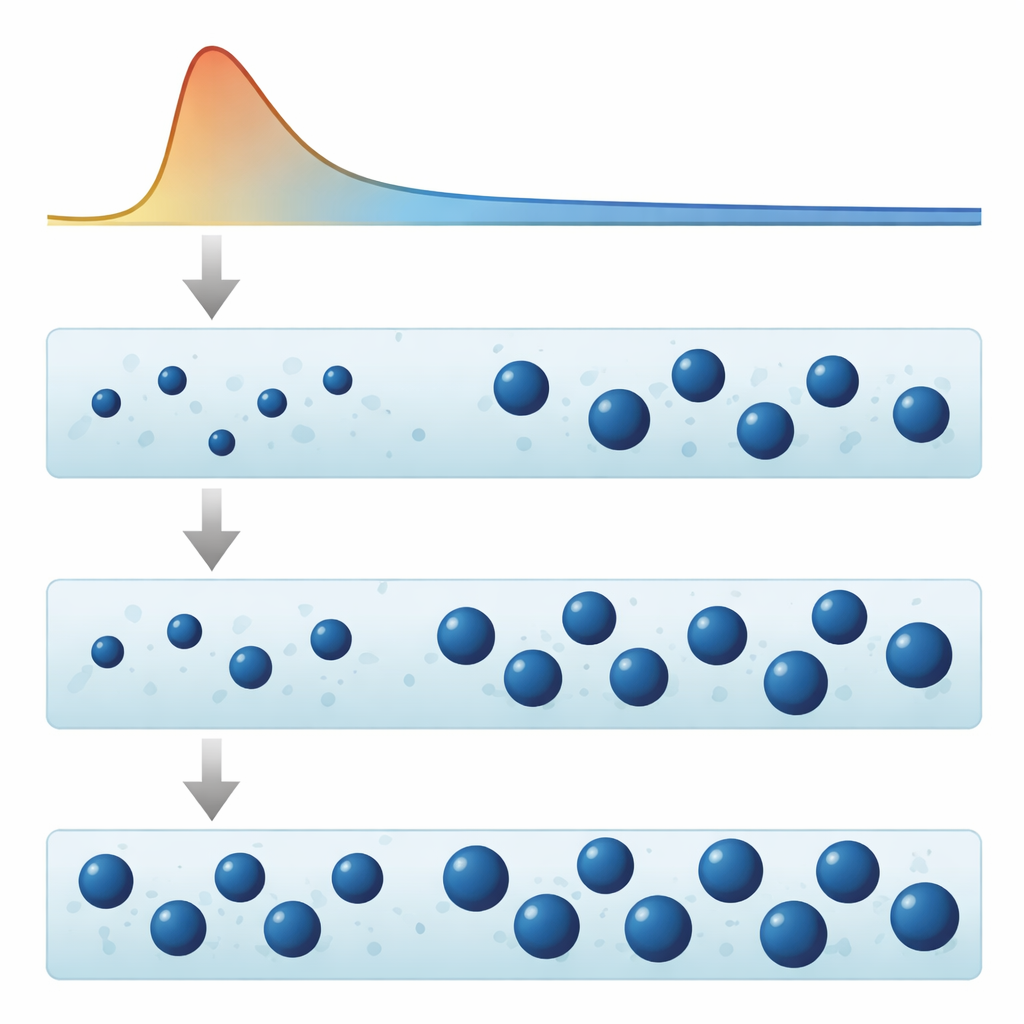
Previous recipes for InSb quantum dots fell into two camps. Simple “one-pot” and “hot injection” methods were easy to run but produced dots with a wide spread of sizes, which blurred their light absorption into a broad, weak feature. More sophisticated “continuous injection” methods sharpened the spectra somewhat but only for relatively small dots. The underlying problem was that new dots kept forming throughout the reaction, while existing dots were still growing. This continuous birth of fresh particles meant that, at the end, the mixture contained both young and old dots, each size absorbing slightly different wavelengths, smearing out the response that detectors depend on.
Taming Growth with Monomer Control
The authors tackled this problem by carefully controlling the concentration of the “monomers”—the smallest building blocks that assemble into quantum dots—during synthesis. They showed that earlier continuous-injection recipes kept the solution persistently oversaturated, matching a nucleation model in which new dots constantly appear. In their new monomer-concentration-control approach, they first inject precursor quickly to trigger a brief burst of nucleation, then slow the feed dramatically so that no new dots can form and only existing ones grow. By tuning reaction temperature and the total amount of precursor, they could consistently produce nearly monodisperse InSb dots whose infrared absorption peaks are the sharpest reported to date and can be tuned smoothly from about 950 to 1900 nanometers.
New Windows into Quantum Behavior
The high uniformity of these dots does more than clean up their spectra; it reveals subtle internal structure that had been hidden in earlier, blurrier samples. The team observed a clear splitting between so-called heavy-hole and light-hole states in the valence band, visible as a second, higher-energy absorption feature that shifts in a predictable way as the dots change size. They also measured unusually narrow emission linewidths and modest energy shifts between absorption and emission, suggesting that these dots probe a regime of strong quantum confinement where standard simple models fail and more advanced descriptions are needed.
Turning Better Dots into Better Detectors
To show practical impact, the researchers built short-wave infrared photodetectors using their best InSb dots coated with a thin shell of indium phosphide, which protects the surface from oxidation and reduces electronic defects. In carefully engineered device stacks, these core–shell dots delivered external quantum efficiencies of 22% at 1500 nanometers and 19% at 1580 nanometers—performance that surpasses all previously reported detectors of this type made from heavy-metal-free quantum dots and begins to rival commercial germanium and indium gallium arsenide sensors in this wavelength range.
What This Means for Future Infrared Tech
By learning how to steer the growth of InSb quantum dots from a messy, continuous process into a brief birth followed by orderly growth, the authors created a toolbox for making highly uniform, tunable infrared absorbers. For non-specialists, the takeaway is simple: better control at the nanoscale yields sharper signals and more efficient devices. These advances point toward more affordable infrared cameras and sensors for cars, agriculture, industry, and medicine, and provide a clean material platform for exploring the rich quantum physics inside these tiny crystals.
Citation: Peng, L., Dosil, M., Mandal, D. et al. Synthesis of monodisperse InSb colloidal quantum dots by monomer concentration control for short-wave infrared photodetectors. Nat Commun 17, 3871 (2026). https://doi.org/10.1038/s41467-026-70367-6
Keywords: short-wave infrared, quantum dots, indium antimonide, photodetectors, nanocrystal synthesis