Clear Sky Science · en
Ynimines as versatile precursors to 2-imido- and 2-amido-1,3-dienes for stereodivergent diels–alder reactions
Why this new chemistry matters
Chemists often need precise tools to build complex ring-shaped molecules that appear in medicines, fragrances and natural products. This study introduces a flexible way to turn a relatively new type of building block, called ynimines, into a family of useful ring systems with fine control over their three-dimensional shape. Because the method works under mild conditions and tolerates many different partners, it could simplify the preparation of molecules that are otherwise difficult to make.
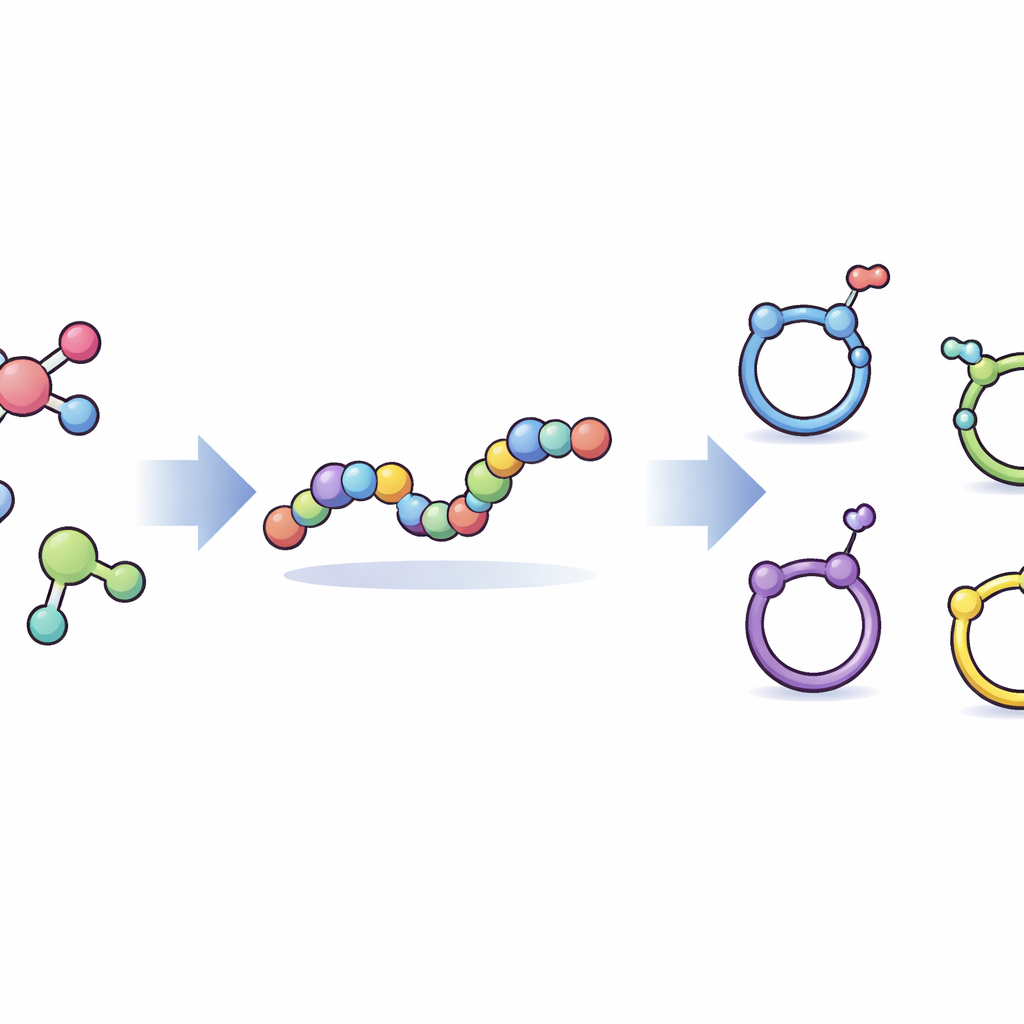
A new path from simple pieces to complex rings
The authors focus on a long-standing challenge: making 1,3-dienes that carry nitrogen in just the right position so they can later fold into six‑membered rings. These special dienes are powerful stepping stones but have been hard to prepare cleanly and safely. The team turns to ynimines, a cousin of better known ynamides, whose potential has not been fully tapped. They show that ynimines can act as springboards to two related families of nitrogen‑bearing dienes, called 2‑imido and 2‑amido dienes, which had previously been rare and difficult to access.
Turning ynimines into versatile diene building blocks
The key transformation begins when an ynimine meets an ordinary carboxylic acid. Under gentle heating in an organic solvent, the acid adds across the carbon–carbon triple bond in a controlled way, and a rearrangement then slides an acyl group from oxygen to nitrogen. The net result is a 2‑imido‑1,3‑diene, a conjugated chain that carries two acyl groups on nitrogen and is stable enough to isolate. By carefully choosing reaction conditions, the researchers can selectively trim off one of these acyl groups to obtain 2‑amido‑1,3‑dienes. Thus, a single starting material is converted into two closely related, tuneable building blocks.
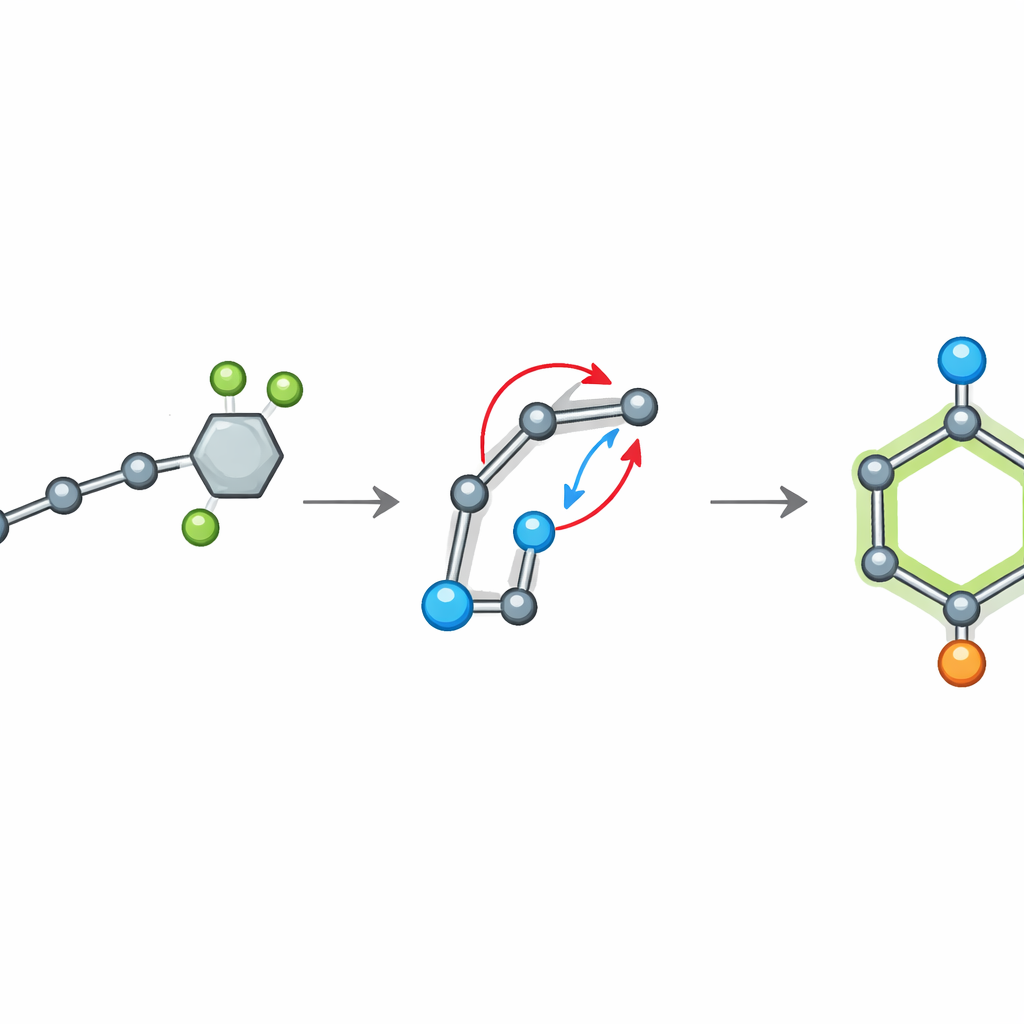
One‑pot assembly of tailored six‑membered rings
Once the 2‑imido dienes are formed, they readily undergo Diels–Alder reactions with electron‑poor alkenes, a classic way to build six‑membered rings in a single step. Remarkably, the team merges all steps into a three‑component process: an ynimine, a carboxylic acid and an electron‑poor alkene are mixed together, allowed to form the diene in situ, and then warmed so that the ring‑forming step follows automatically. No extra reagents beyond heat are required. The reaction works with a wide variety of aromatic groups and alkenes, forging multiple new bonds in one operation and consistently giving products where two key substituents on the ring sit trans to each other.
Fine control of mirror‑image shapes
The 2‑amido dienes, obtained by selective hydrolysis of the imido relatives, open a second channel. In the presence of a chiral squaramide catalyst, these dienes react with electron‑poor alkenes at low temperature to give similar six‑membered rings, but now the two substituents end up cis to each other and with high preference for one mirror‑image form over the other. Mechanistic experiments indicate that the imido dienes react in a single, concerted movement, while the more reactive amido dienes follow a stepwise path guided by hydrogen‑bonding from the catalyst. This switch in pathway explains why closely related starting materials lead to opposite three‑dimensional arrangements.
Building complex frameworks reminiscent of natural products
The authors also explore an intramolecular version, where the diene and its reaction partner are tethered within the same molecule. Heating such substrates with a carboxylic acid triggers internal trapping of the freshly formed diene, yielding compact tricyclic skeletons related to the core of the cannabis component trans delta‑9‑tetrahydrocannabinol. These frameworks carry useful handles, such as aryl halides, that can be elaborated further by standard cross‑coupling chemistry, highlighting the method’s potential in late‑stage diversification.
What this means going forward
Overall, the study establishes ynimines as powerful starting points for building nitrogen‑rich 1,3‑dienes and shows how to funnel these dienes into ring systems with either trans or cis arrangements on demand. By combining simple inputs, avoiding harsh reagents and offering precise control over shape, this strategy broadens the toolbox for constructing complex molecules that underlie many functional materials and bioactive compounds.
Citation: Wang, R., Zhu, XQ., Djaïd, M. et al. Ynimines as versatile precursors to 2-imido- and 2-amido-1,3-dienes for stereodivergent diels–alder reactions. Nat Commun 17, 4031 (2026). https://doi.org/10.1038/s41467-026-70363-w
Keywords: ynimines, Diels-Alder, dienes, organocatalysis, synthetic methodology