Clear Sky Science · en
Chirality transfer from chiral perovskite to molecular dopants via charge transfer states
Twisting Crystals That Feel the Twist of Light
Light can be “right-handed” or “left-handed,” a property known as circular polarization that today’s cameras and solar cells mostly ignore. This study shows how specially twisted crystals, called chiral perovskites, can be combined with a common organic dopant molecule to sense not only the color of light but also its handedness, and to do so across both ultraviolet and visible wavelengths. The work points toward new detectors that could help machines read hidden information in light for secure communication, advanced imaging, and spin-based electronics.
Why Twisted Materials Matter
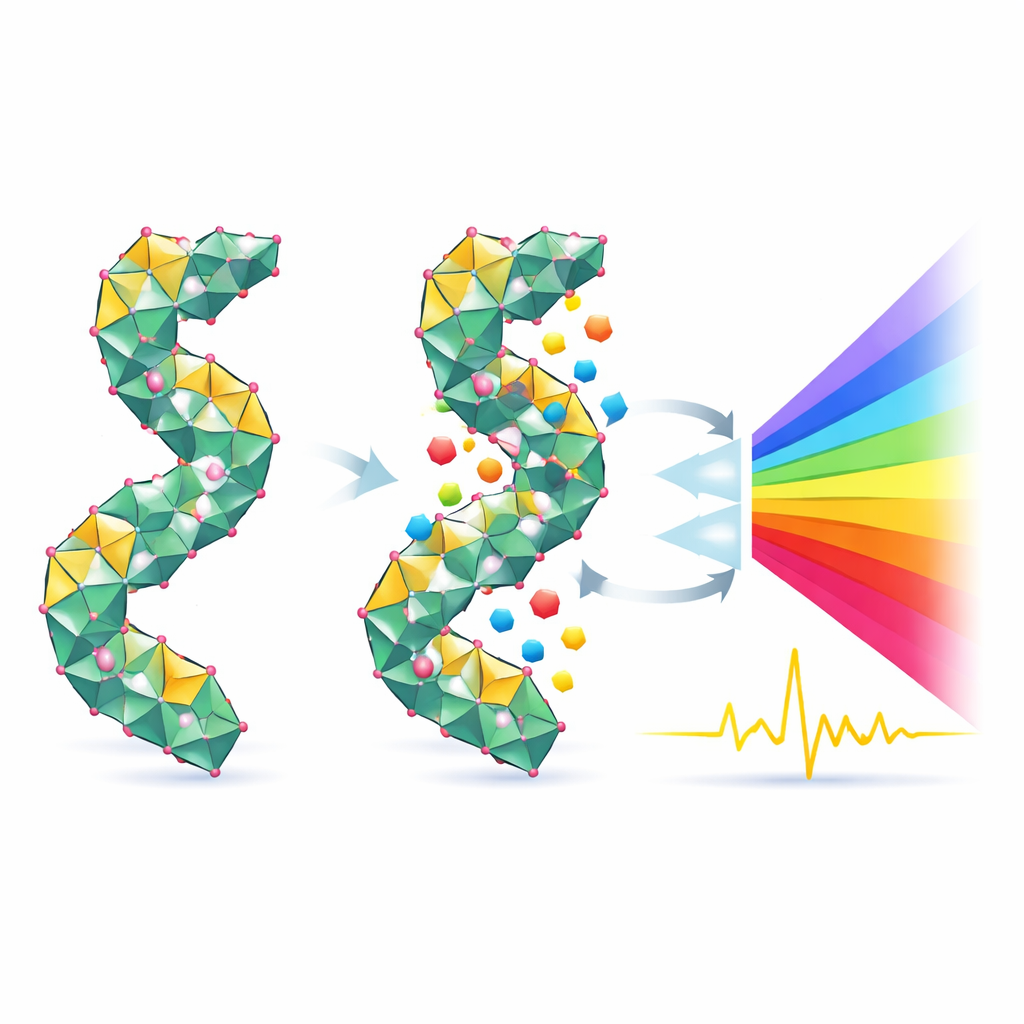
Chiral materials are those that cannot be superimposed on their mirror image, like left and right hands. When such asymmetry is built into a semiconductor, it can favor absorbing one “hand” of circularly polarized light over the other, and can even steer electrons of one spin more efficiently than the opposite spin. Chiral perovskites—hybrid materials made from metal-halide frameworks and organic molecules—have emerged as promising candidates for devices that can directly detect circularly polarized light. However, many of these materials behave like wide-bandgap insulators: they mainly respond to ultraviolet or blue light and conduct electricity rather poorly, which limits their usefulness in practical detectors.
Adding a Helper Molecule
The researchers tackle this limitation by adding a strong electron-accepting molecule, known as F4TCNQ, into a chiral lead–iodide perovskite. Instead of simply coexisting, the perovskite “host” and the F4TCNQ “guest” form new electronic states in which an excited electron sits on the dopant while the corresponding positive charge (the hole) stays largely on the perovskite backbone. These so-called charge-transfer states create a new, broad absorption band in the visible range from about 550 to 750 nanometers. Crucially, this new band shows a clear response to the handedness of circularly polarized light, meaning that the chiral character of the host crystal is transferred to the guest molecules through electronic coupling.
Watching Charges Move in Real Time
To understand how this hybrid system behaves after it absorbs light, the team used ultrafast pump–probe spectroscopy to monitor changes in absorption on timescales of trillionths of a second. When they excite mainly the perovskite, they observe new spectral fingerprints that appear only when F4TCNQ is present, including a distinct bleaching signal in the near-UV and a strong induced absorption in the visible. The timing of these features shows that charges move from the perovskite to the dopant in less than a picosecond, forming the charge-transfer state, and then recombine on hundreds-of-picoseconds timescales. Compared with the undoped material, the doped films exhibit longer initial lifetimes associated with exciton motion and shorter overall recombination times, consistent with a pathway where charges quickly separate at the interface and then return via the new conduction channels created by the dopant.
How the Structure Enables the Effect
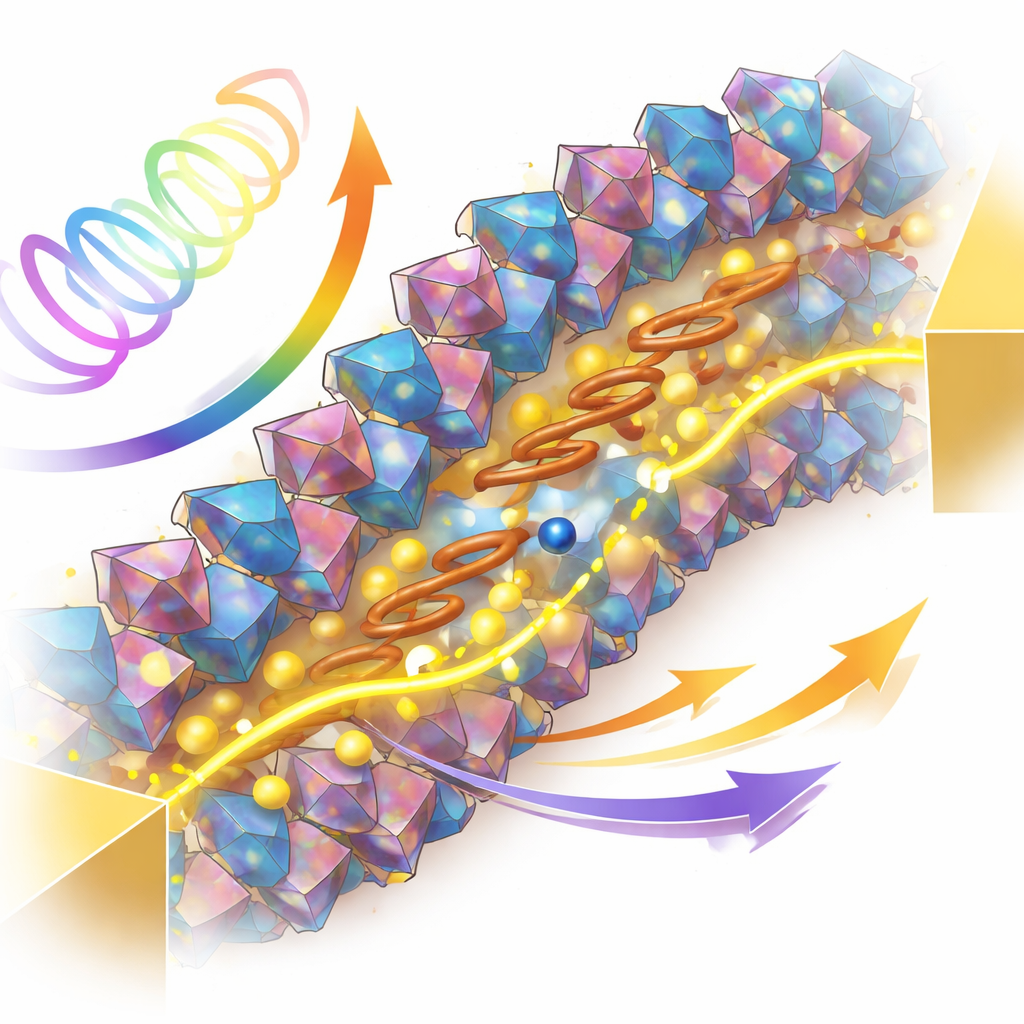
Computer simulations and X-ray scattering measurements reveal how the molecules must be arranged to produce such bright, visible charge-transfer absorption. Quantum-chemical calculations show that when F4TCNQ sits very close to, or effectively replaces, one of the organic components inside the perovskite lattice, the electron and hole wave functions overlap strongly enough to make the charge-transfer transition optically “bright” rather than nearly invisible. The resulting states are shifted to lower energy, matching the experimentally observed visible band. Grazing-incidence X-ray scattering of the thin films uncovers new, long-range structural features that indicate F4TCNQ molecules are inserted between perovskite chains in an ordered way, forming a closely packed superlattice. This structural intimacy is what allows chirality and optical activity to be passed from the twisted inorganic framework to the molecular dopant.
Building Polarization-Sensitive Detectors
Using these doped chiral perovskite films, the team fabricates simple photodetectors and illuminates them with circularly polarized blue and red lasers. The devices produce different currents depending on whether the incoming light is left- or right-handed, and the sign of this preference flips when the handedness of the chiral molecules in the perovskite is reversed. The detectors respond to both the original ultraviolet–blue absorption of the perovskite and the new visible charge-transfer band, showing handedness sensitivity over a much broader color range than before. Doping also boosts the electrical conductivity by more than two orders of magnitude and lowers the energy barrier for charge hopping, allowing thicker films to be used without losing the polarization contrast.
What This Means for Future Technologies
In everyday terms, this work shows how mixing a carefully chosen “guest” molecule into a twisted crystal “host” can both extend the range of colors it sees and preserve, even enhance, its sensitivity to the twist of light. The charge-transfer states created at the interface carry the imprint of the host’s handedness, enabling detectors that can tell left-handed from right-handed light in both the ultraviolet and visible regimes while conducting electricity efficiently. This strategy of chirality transfer through electronic coupling could be broadly applied to other chiral semiconductors, opening paths toward compact sensors, advanced imaging systems, and spin-aware devices that read far more information from light than its brightness alone.
Citation: Chen, GL., Tsai, H., Shrestha, R. et al. Chirality transfer from chiral perovskite to molecular dopants via charge transfer states. Nat Commun 17, 3757 (2026). https://doi.org/10.1038/s41467-026-70362-x
Keywords: chiral perovskites, circularly polarized light, charge transfer, molecular doping, photodetectors