Clear Sky Science · en
Textured piezoelectric ceramics with reduced grain size for high-frequency transducer applications
Sharper Sound for Clearer Pictures
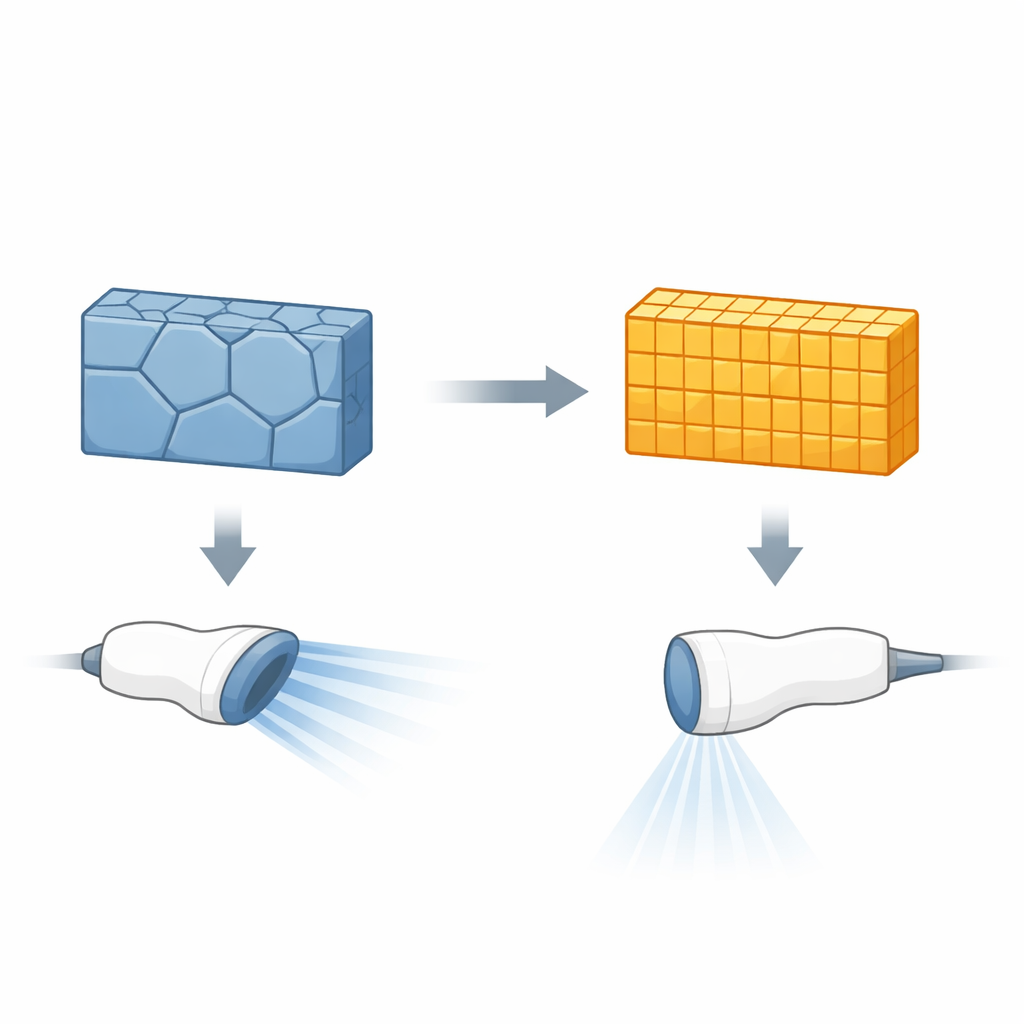
Ultrasound scans are a mainstay of modern medicine, letting doctors see inside the body in real time without surgery or radiation. To reveal ever finer details—tiny blood vessels, early-stage tumors, or delicate eye structures—ultrasound devices must operate at higher and higher frequencies. But the heart of each probe is a special “smart” ceramic that converts electricity into sound and back again, and these materials tend to lose much of their performance when made thin enough for very high frequencies. This study shows how carefully shrinking the internal grain structure of a leading piezoelectric ceramic can preserve its strength even in ultrathin layers, paving the way for sharper, more compact ultrasound tools.
Why the Building Blocks Inside Matter
The ceramics used in ultrasound probes are piezoelectric: when squeezed they generate electricity, and when voltage is applied they change shape. For high-frequency imaging—above about 20 megahertz—the active ceramic layer in a transducer must be thinner than a human hair. Conventional “textured” ceramics, engineered so many tiny crystals point in the same direction, can rival expensive single crystals in performance while being far cheaper to make. However, their grains are usually quite large, tens of micrometers across. As the ceramic is ground down to high-frequency thicknesses, damaged surface layers and built-in stresses begin to occupy a sizable fraction of each grain, making it harder for internal regions to flip and rotate their electric polarization. The result is a sharp drop in the material’s ability to convert between sound and electricity, a problem known as the thickness scaling effect.
Making Smaller, Better Aligned Grains
The researchers tackled this problem by redesigning the ceramic from the bottom up. They focused on a high-performance material known as PMN–PT, widely used in advanced ultrasound devices. To control how grains grow and orient, they used tiny plate-like particles of barium titanate as templates. A modified “topochemical” process, carried out in molten salt at carefully reduced temperature and duration, produced templates only about 2.7 micrometers long—less than half the usual size. When these smaller templates were mixed into PMN–PT powder and formed into ceramics, the resulting textured grains averaged about 7.8 micrometers across, more than 50% smaller than in comparable textured materials. Crucially, the grains still lined up extremely well along a preferred direction, giving the ceramic a single-crystal-like character.
High Performance That Survives Thinning
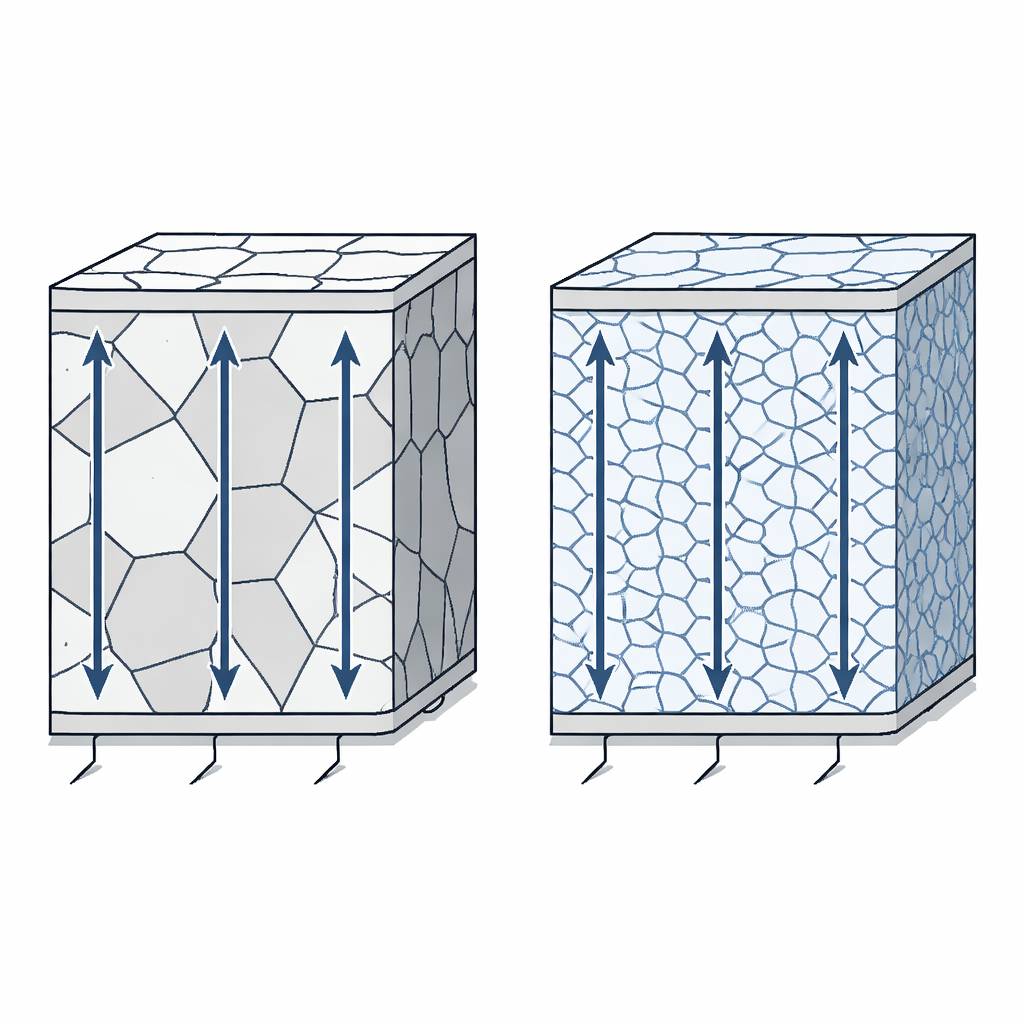
With the grain size tamed, the team measured how the new ceramics behaved as they were progressively thinned from 500 micrometers down to just 75 micrometers. Both the new, fine-grained textured ceramics and conventional, coarse-grained versions showed excellent piezoelectric response when thick, roughly four times that of similar nontextured ceramics. But their paths diverged as thickness decreased. In the conventional material, the key piezoelectric coefficient and dielectric constant fell by about one-third at the thinnest dimension, and energy losses rose noticeably. In the reduced-grain-size ceramic, by contrast, these measures dropped by only about 10–13%, and energy losses stayed low. Polarization loops and microscopic imaging revealed that in the fine-grained material, internal regions could still switch orientation readily despite the presence of surface damage, while larger grains in the conventional ceramic were more easily pinned and partially depolarized.
Peering Inside the Microscopic Workings
To understand why smaller grains helped so much, the authors separated the roles of grain interiors and grain boundaries, and probed how easily tiny polarization walls could move. Electrical tests showed that while the cores of grains conducted in much the same way in both materials, the fine-grained ceramic had more resistive, glass-like boundary regions. Normally, more boundary area would harm performance. Yet detailed “Rayleigh” analysis and nanoscale force microscopy demonstrated that domain walls—the internal borders between regions of different polarization—moved more freely in the smaller grains. This extra mobility more than compensated for the added boundary area, allowing the ceramic to polarize fully under realistic fields even after heavy thinning. In short, shrinking the internal structural units created a network of domains that were less sensitive to surface defects and residual stress.
Toward Sharper, Smaller Ultrasound Devices
The work shows that by engineering the microscopic grain structure, it is possible to build textured piezoelectric ceramics that retain single-crystal-like performance at the thin dimensions required for very high-frequency ultrasound. The reduced-grain-size PMN–PT ceramics maintain strong electromechanical coupling, large strain, and stable behavior down to thicknesses suitable for transducers above 20 megahertz. Because the template strategy is compatible with established ceramic processing and can be extended to other advanced piezoelectric compositions, it offers a practical route to compact probes that see finer details deeper in the body, without sacrificing signal strength or reliability.
Citation: Xiao, Y., Yang, S., Wang, M. et al. Textured piezoelectric ceramics with reduced grain size for high-frequency transducer applications. Nat Commun 17, 3750 (2026). https://doi.org/10.1038/s41467-026-70360-z
Keywords: piezoelectric ceramics, ultrasound transducers, grain size engineering, high-frequency imaging, textured materials