Clear Sky Science · en
Direct oxidative carbonylation of methane to acetic acid via high-valent iron-oxo mediated water activation
A New Way to Turn Natural Gas into Everyday Chemicals
Methane, the main ingredient in natural gas, is abundant but surprisingly hard to put to work. Turning this simple gas directly into useful chemicals normally requires high temperatures, complex plants, and energy‑intensive steps. This study describes a catalyst that can convert methane straight into acetic acid—the key ingredient in household vinegar and a major industrial chemical—under relatively mild conditions, using a carefully designed combination of metals inside a porous mineral. 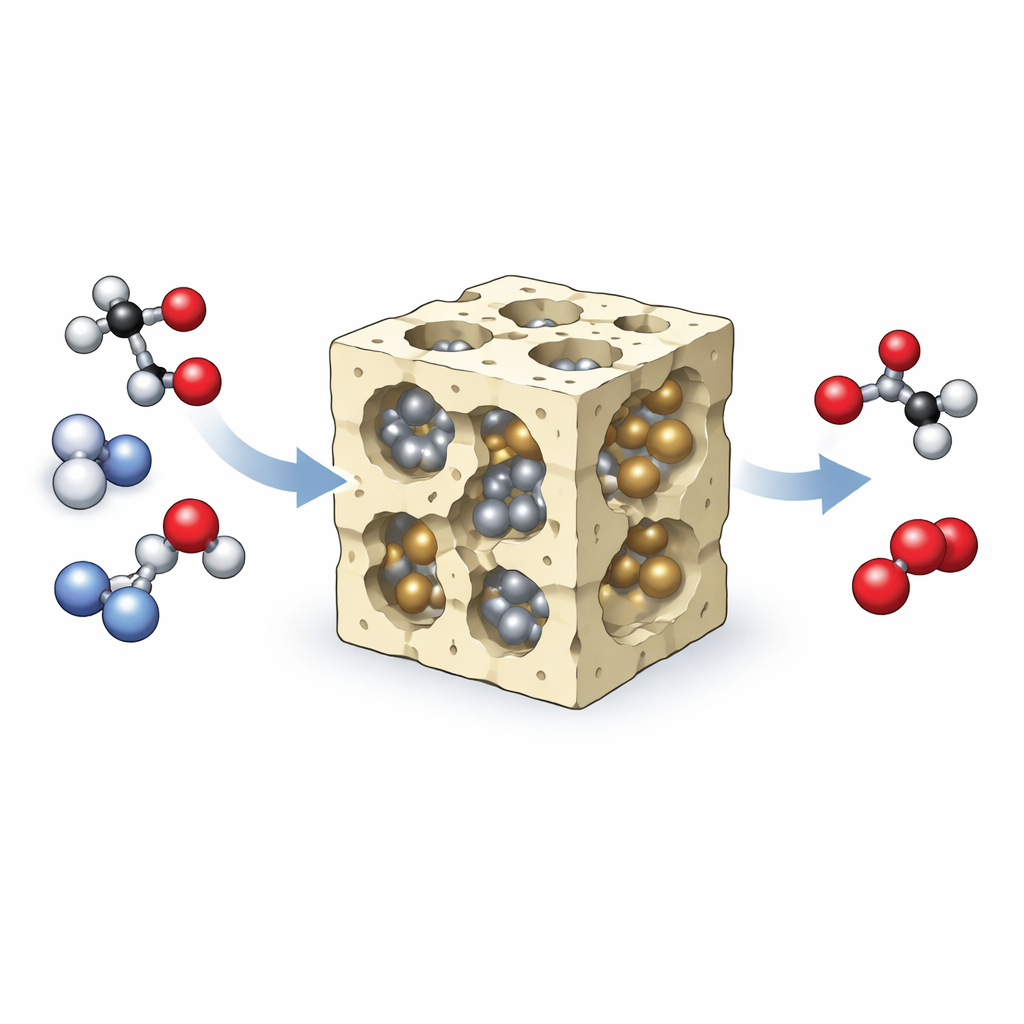
Why Methane Is So Difficult to Use
Methane looks simple, but its carbon–hydrogen bonds are some of the toughest in chemistry, which makes the molecule reluctant to react. Industry usually sidesteps this problem by first turning methane into synthesis gas and then into methanol, which is later converted to acetic acid in a separate process. Each step costs energy and money and generates extra emissions. Chemists have long sought a single reaction that would join methane with carbon monoxide to make acetic acid directly, but they have struggled to break methane’s strong bonds without over‑burning it to carbon dioxide, and to form the crucial new carbon–carbon bond efficiently.
A Dual-Metal Catalyst Inside a Tiny Labyrinth
The researchers tackle this challenge with a catalyst built from a zeolite called ZSM‑5, a crystalline material riddled with nanoscale channels. Inside these channels they anchor tiny amounts of two metals, rhodium and iron, arranged so that the metals sit near each other but on distinct sites connected through oxygen atoms. Tests show that rhodium alone in this structure can turn methane into some acetic acid, but adding iron boosts the rate almost six‑fold while raising the selectivity to about 92 percent, meaning nearly all of the liquid products are acetic acid rather than unwanted by‑products. The system remains active for at least 100 hours in continuous operation, suggesting that the catalyst is robust enough for practical use.
How the Catalyst Orchestrates Reactive Bits
To understand why the combination works so well, the team used a suite of advanced probes, including X‑ray absorption, Mössbauer spectroscopy, electron paramagnetic resonance, and infrared spectroscopy. These experiments reveal that oxygen in the reaction stream raises rhodium and iron to high “valence” states, making them powerful activators of small molecules. Rhodium sites pull a fragment—called a methyl group—off methane, creating a highly reactive methane‑derived radical. At nearby iron sites, oxygen helps form an iron–oxo unit that can split water into hydroxyl radicals. These hydroxyl fragments rapidly combine with carbon monoxide to form another short‑lived species related to formic acid. 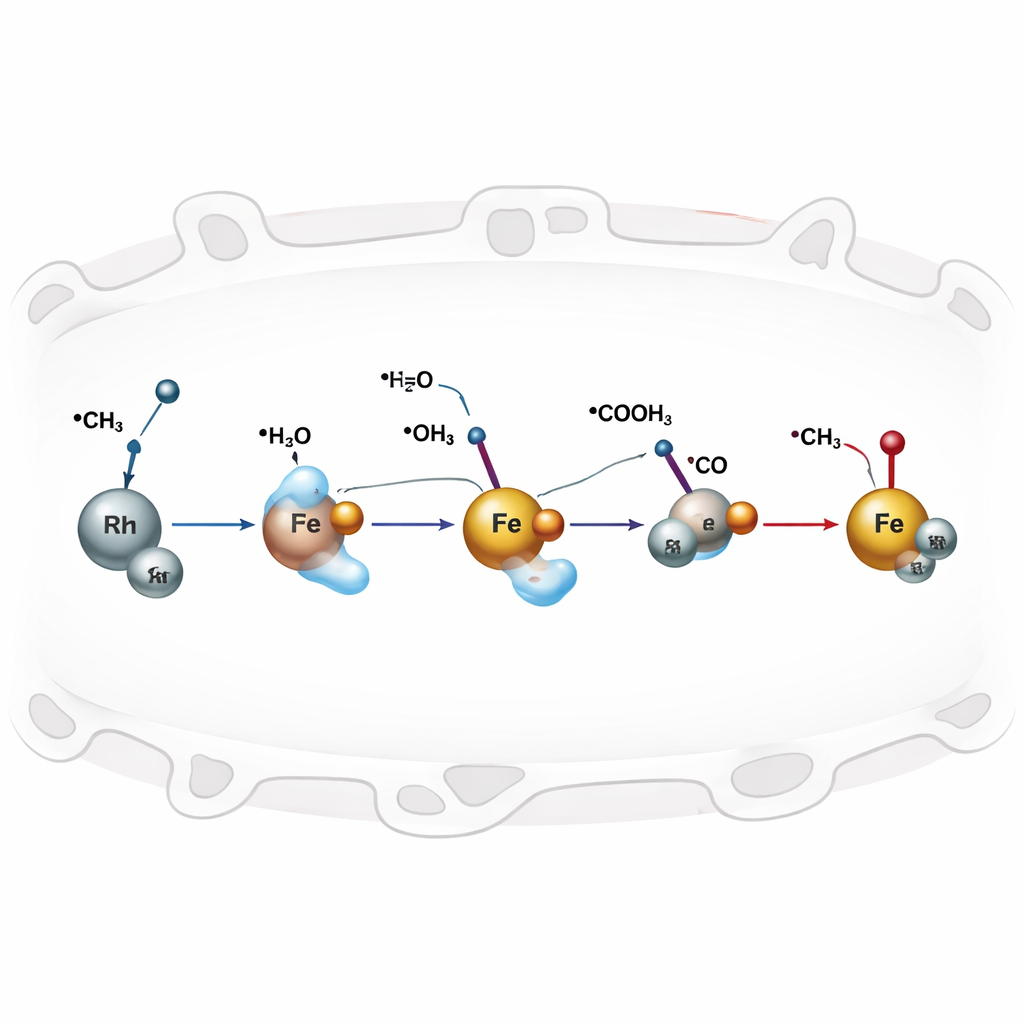
Bringing the Pieces Together in Confined Spaces
The key step is where the methane‑derived radical and the carbon‑monoxide‑derived radical meet inside the narrow zeolite pores. The study’s experiments and computer simulations indicate that these two fragments join directly to form acetic acid much more easily than any route that would first bind neutral carbon monoxide to the methyl group. The confined spaces and acidity of the zeolite help guide and stabilize the crucial encounter, while the spatial separation of rhodium and iron ensures that methane activation and water splitting happen in parallel rather than competing. By avoiding a slower, multi‑step route that passes through hydrogen peroxide, the catalyst sidesteps major energy losses that have hampered earlier systems.
What This Means for Cleaner Chemical Production
In everyday terms, the researchers have built a tiny chemical assembly line inside a mineral, where one type of metal clips a piece off methane and another type rips water apart, then the fragments are snapped together with carbon monoxide to form acetic acid. This “radical decoupling” strategy allows methane to be upgraded in one step under moderate conditions, using oxygen and water rather than harsh additives. While more work is needed to scale the approach and curb side‑reactions such as carbon monoxide burning to carbon dioxide, the study points to a promising path for turning natural gas—and potentially other light hydrocarbons—into higher‑value products more efficiently and with a smaller environmental footprint.
Citation: Zhang, H., Lewis, R.J., Dugulan, A.I. et al. Direct oxidative carbonylation of methane to acetic acid via high-valent iron-oxo mediated water activation. Nat Commun 17, 3644 (2026). https://doi.org/10.1038/s41467-026-70339-w
Keywords: methane conversion, acetic acid, heterogeneous catalysis, zeolite catalysts, natural gas valorization