Clear Sky Science · en
Bioinspired nanofluidic iontronic device with integrated photoreceptor and photosynaptic functions
Seeing with Light and Ions
Most of what we know about the world comes through our eyes. Inside the eye, light is turned into tiny electrical signals that the brain can understand. This study shows how to build an artificial device that imitates this trick of nature. Instead of relying only on electrons, like in regular electronics, it uses flowing ions in liquid—more like living cells do. The result is a small, light‑controlled system that can both sense images and start to process them, hinting at future artificial retinas and smarter cameras.
Borrowing Ideas from the Eye
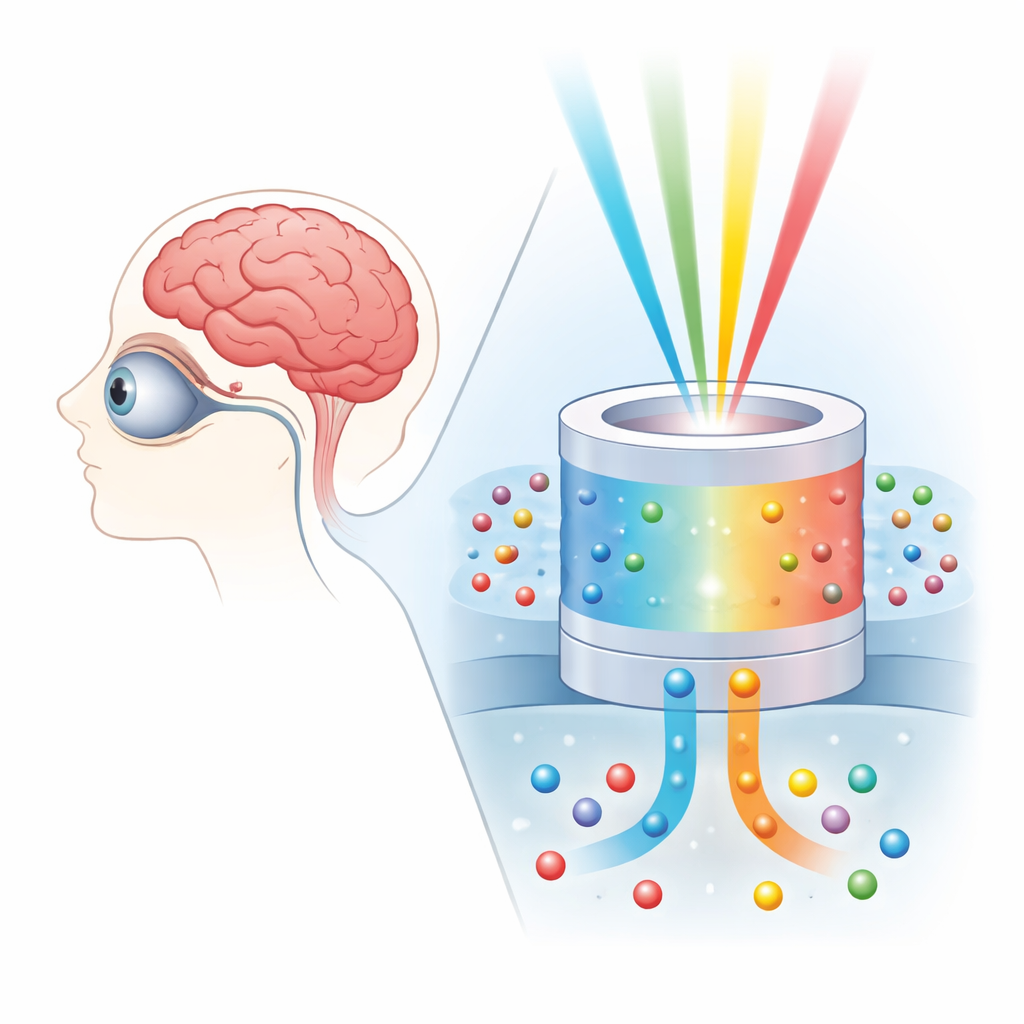
In the human retina, specialized cells catch light and convert it into electrical signals, while neighboring connections adjust and store parts of the visual scene, helping with tasks like motion detection and pattern recognition. The new device copies both roles within one tiny structure. It is built from a hollow carbon nanotube lined with a layer of molybdenum disulfide, forming a coaxial, tube‑within‑a‑tube architecture. When this hollow fiber sits between two salt‑water reservoirs, ions can move through its inner channel, somewhat like charged particles crossing a cell membrane.
Turning Light into Ion Flow
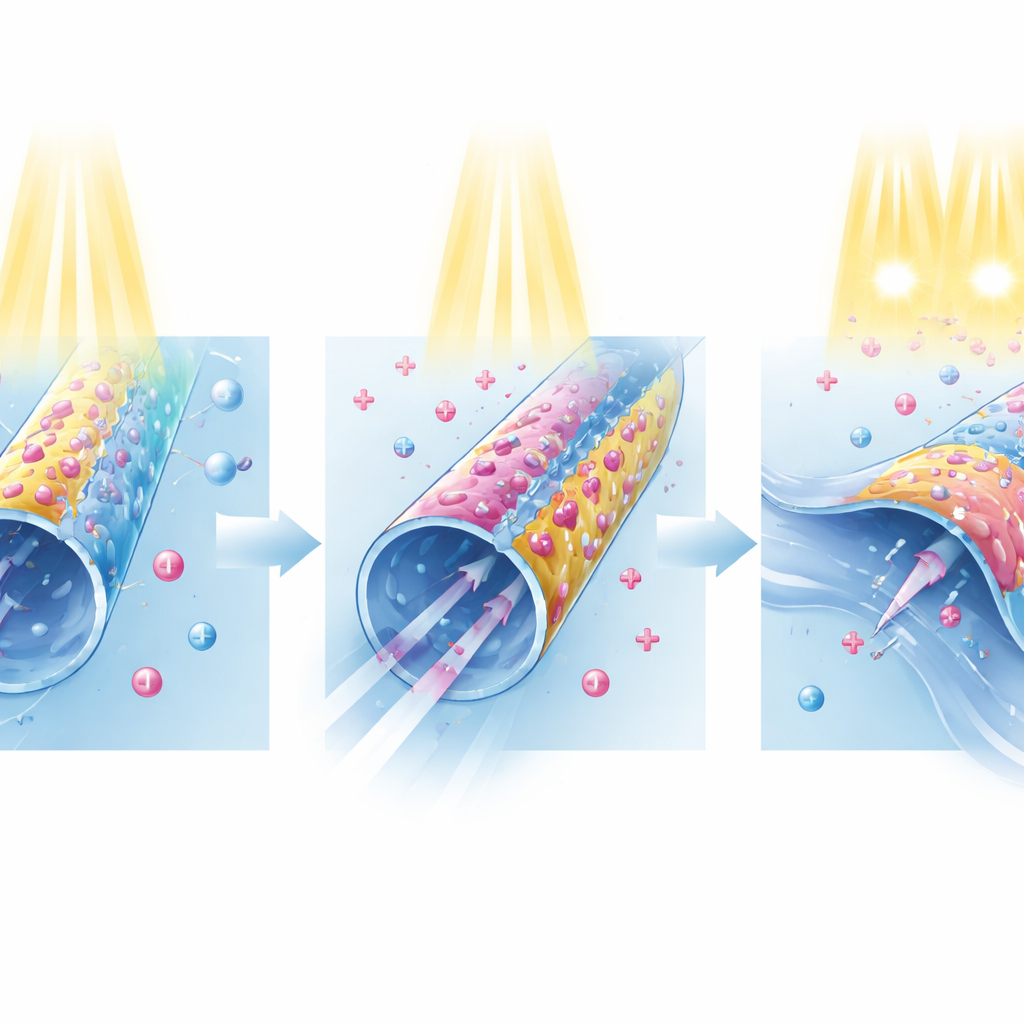
The heart of the design is how it turns incoming light into a directed flow of ions. When light shines on the nanotube, electrons shift from the inner molybdenum disulfide layer toward the surrounding carbon layer. This internal charge separation creates an uneven electric landscape along the wall of the tube. Because the tube’s surface is naturally negatively charged, it tends to attract positively charged ions and repel negative ones. Under one‑sided illumination, this imbalance pushes certain ions preferentially in one direction, generating a measurable ion current without needing an applied voltage. Experiments and computer simulations confirm that this effect comes from light‑driven charge separation and not from simple heating.
Acting Like a Light Sensor
When the device is wired with just two terminals and no extra voltage, it behaves like a fast light sensor—similar to the eye’s photoreceptor cells. The ion current responds quickly when the light switches on and off, and its strength depends on both the color and brightness of the light. Shorter‑wavelength light, such as violet and blue, produces stronger responses, closely matching how efficiently the nanotube structure absorbs those colors. As the brightness increases or the salt concentration and ion type change, the ion flow can be tuned over a wide range. In performance, the device produces larger ion currents than many earlier light‑driven nanofluidic systems, showing that the engineered nanotube interface is particularly effective at steering ions with light.
Behaving Like a Tiny Learning Circuit
By adding a third electrical connection and applying a voltage, the same structure starts to mimic the behavior of synapses—the adjustable junctions between nerve cells. Under pulsed light, the ion current does not simply switch on and off; it shows memory‑like traces that last after the light is gone. Closely spaced pulses produce a stronger second response than the first, echoing “short‑term plasticity” in biology. Longer or more frequent light trains convert this temporary strengthening into a more durable change, similar to “long‑term plasticity” associated with learning. Depending on how the light and voltage are programmed, the device can gradually respond more efficiently, as if it were practicing and improving over repeated visual experiences.
From Simple Sensing to Smart Vision
The team went beyond basic measurements and used arrays of these devices to perform vision‑like tasks. Arranged around a circle and driven at different voltages, the devices respond differently when light arrives from various directions. Feeding these ion‑based signals into artificial neural networks allows the system to recognize the orientation of patterns with high accuracy and even distinguish detailed features such as fingerprint ridges. In plain terms, a single, light‑guided ion channel can both see and begin to interpret what it sees. This integrated sensing‑and‑processing approach could one day support machine‑vision hardware that works more like the human eye—compact, adaptive, and ready to interface directly with biological tissue.
Citation: Liu, W., Duan, L., Zhang, X. et al. Bioinspired nanofluidic iontronic device with integrated photoreceptor and photosynaptic functions. Nat Commun 17, 3523 (2026). https://doi.org/10.1038/s41467-026-70337-y
Keywords: artificial retina, nanofluidics, iontronic device, neuromorphic vision, light-driven ion transport