Clear Sky Science · en
Molecular fence Cu-based catalyst for CO2 hydrogenation to CO with high activity and durability
Turning a Greenhouse Gas into a Useful Ingredient
Carbon dioxide is often seen only as a climate villain, but it is also a carbon-rich raw material. If we can efficiently turn CO2 into useful chemicals using clean hydrogen, we could both lower emissions and create sustainable fuels. This study reports a new copper-based catalyst that behaves like a microscopic “molecular fence,” converting CO2 into carbon monoxide (a key ingredient of synthetic fuels) with very high speed and remarkable long-term stability, even under harsh conditions.
A Tiny Factory Inside a Mineral Cage
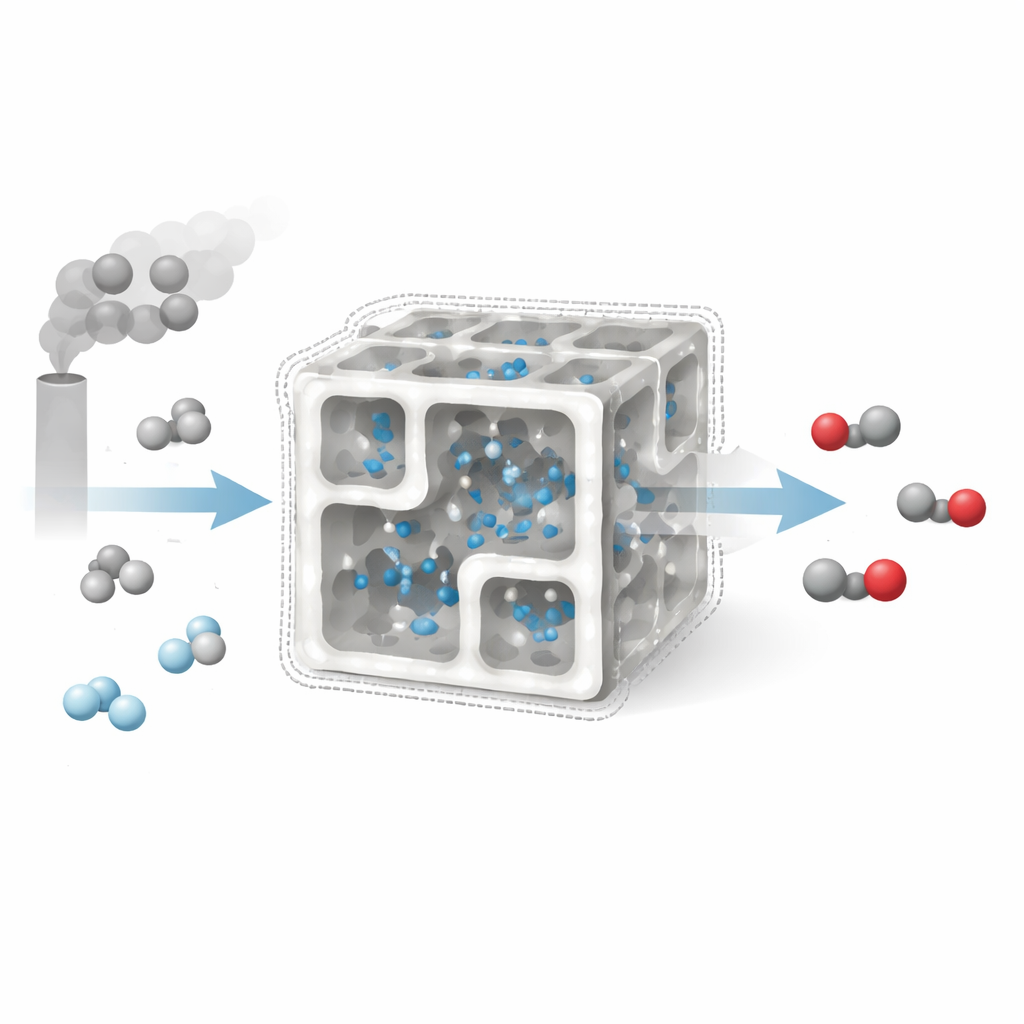
The researchers work with a well-known mineral-like material called a zeolite, which has an orderly network of tiny channels. They grow this zeolite, a modified form of mordenite, directly around clusters of copper atoms. During growth, the structure tightens so that the openings in the channels shrink to about the size of a hydrogen molecule, but remain smaller than a CO2 molecule. In effect, the copper clusters end up locked inside a rigid, porous shell. This design means that hydrogen can reach the copper, while CO2 is held and activated on the outside surface of the zeolite rather than touching the metal directly.
A Protective Fence That Sorts the Traffic
Because the openings in the zeolite are so small, they act as a molecular sieve. Hydrogen, being tiny, can slip through and reach the encapsulated copper, where it is split into highly reactive hydrogen fragments. CO2, being slightly larger, cannot pass through the same openings. Instead, it is captured on special sites near sodium ions on the outer part of the zeolite. There, CO2 is bent and partially charged, making it easier to transform. This physical separation of where hydrogen is activated and where CO2 is held is the heart of the “molecular fence” idea: gas molecules are sorted by size and function before they ever meet.
How the Hidden Copper Does the Hard Work
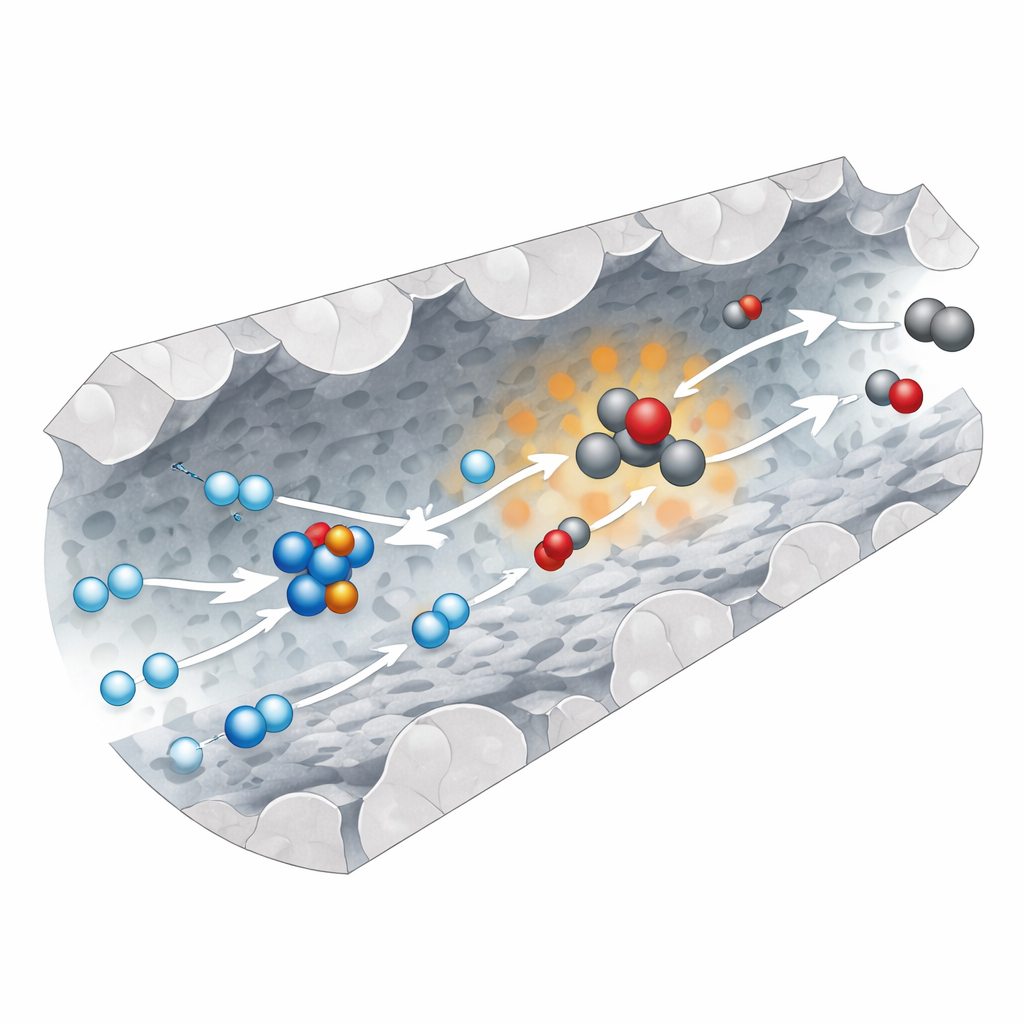
Inside the zeolite, the copper is not present as large particles, but mostly as very small clusters tightly bonded to oxygen. The constrained environment creates many “vacancies,” or missing copper atoms, which turn out to be especially good at splitting hydrogen. When hydrogen enters the channels, it breaks apart on these clusters into positively and negatively charged fragments. These fragments then move through the zeolite network, often hitching a ride on water molecules produced during the reaction. In this way, the catalyst shuttles reactive hydrogen from the hidden metal clusters to the CO2-rich regions at the channel mouths, where CO2 is reduced along a pathway involving a formate-like intermediate and ultimately released as CO and water.
Staying Active When Others Wear Out
Most copper catalysts that convert CO2 to carbon monoxide eventually fail because the copper particles clump together at high temperature, or because copper atoms drift and regroup in a process called Ostwald ripening. The molecular fence in this design stops both problems. The rigid zeolite cage prevents copper from migrating and merging into larger, less active chunks, while also keeping CO2 and CO from sticking directly to copper and forming mobile copper–carbon complexes. Tests show that the new catalyst maintains nearly the maximum possible CO2 conversion and almost perfect selectivity to CO over more than a month of continuous high-temperature operation, outperforming many existing copper-based systems.
Why This Matters for Future Clean Fuels
For non-specialists, the key message is that careful “architectural” control at the atomic scale can transform how a familiar metal like copper behaves. By tucking copper clusters inside a size-selective mineral framework, the team created a catalyst that not only converts CO2 to a valuable fuel building block extremely efficiently, but also resists the slow degradation that usually plagues such systems. This molecular fence approach could be extended to other metals and reactions, offering a general route to robust catalysts that turn waste gases into useful products while standing up to industrial conditions.
Citation: Su, W., Jia, X., Deng, X. et al. Molecular fence Cu-based catalyst for CO2 hydrogenation to CO with high activity and durability. Nat Commun 17, 3552 (2026). https://doi.org/10.1038/s41467-026-70333-2
Keywords: CO2 hydrogenation, copper catalyst, zeolite, reverse water-gas shift, syngas production