Clear Sky Science · en
Built-in tandem catalysis in hierarchical pores for efficient vinyl chloride production
Turning Everyday Plastics into a Cleaner Story
Vinyl chloride is the building block of PVC, the hard plastic found in pipes, window frames, and countless household products. Making this chemical at industrial scale is energy-hungry and still often relies on toxic mercury-based catalysts. This study introduces a new, smarter catalyst that fits three different reaction steps into one tiny, sponge-like particle. By carefully arranging metals inside pores of different sizes, the researchers nearly eliminate leftover starting material, run for thousands of hours, and sidestep mercury — offering a more efficient and cleaner way to make a material our modern world depends on.
Why Making Vinyl Chloride Is So Tricky
Industry usually makes vinyl chloride from oil-derived ethylene or from coal-based acetylene, each route with its own drawbacks in cost, energy use, and pollution. A promising alternative mixes both worlds: it couples ethylene dichloride with acetylene in a single overall reaction that releases heat. But under the hood this process actually consists of two opposite steps: breaking ethylene dichloride apart needs heat, while adding hydrogen chloride to acetylene releases heat. Trying to do both on the same kind of active site in one reactor is like trying to boil and freeze water in the same pot. On top of that, the desired product, vinyl chloride, sticks to catalyst surfaces just as strongly as the leftover acetylene, clogging the reaction and making it very hard to use up the last traces of acetylene safely.
Building a Tiny 3-Stage Factory Inside One Particle
To solve this, the team designed a “built-in assembly line” inside a piece of porous carbon. This carbon looks like a sponge with three nested scales of pores: large channels (macropores), mid-sized tunnels (mesopores), and tiny cavities (micropores). Using a clever liquid-filling strategy driven by capillary forces, they selectively placed different metal combinations into each pore size. Ruthenium went into the largest pores to handle the first step: stripping hydrogen chloride from ethylene dichloride to form vinyl chloride and hydrogen chloride gas. A mix of copper and ruthenium occupied the middle-sized pores, while a gold–ruthenium combination settled in the smallest pores. Each zone was chosen because it holds onto acetylene and vinyl chloride to just the right degree at that stage of the reaction. 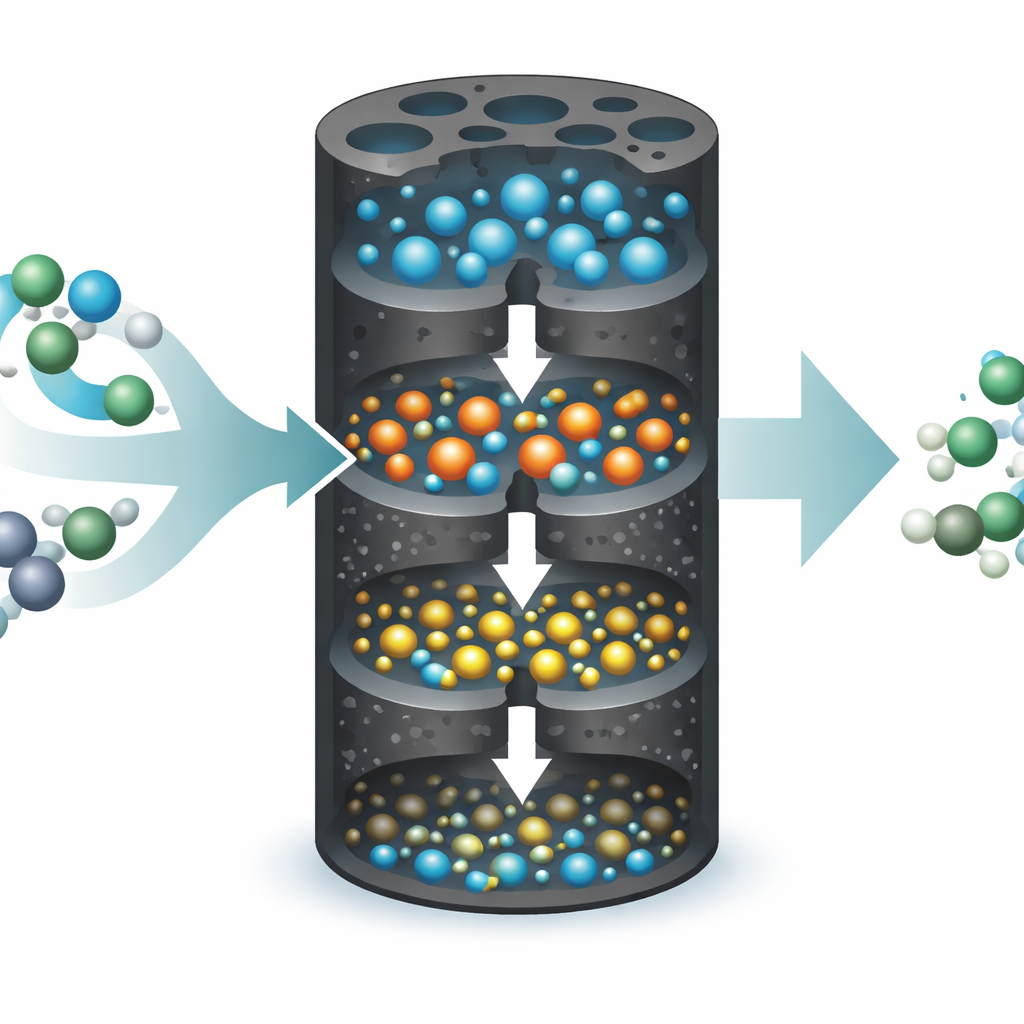
How the Three Steps Work Together
Gas molecules naturally flow from the big pores at the outside of the particle toward the smaller pores deeper inside. In the macropores, ruthenium sites eagerly grab ethylene dichloride and break it apart, turning it almost completely into vinyl chloride and hydrogen chloride and releasing short-lived hydrogen and chlorine fragments. These fragments and any remaining acetylene then move into the mesopores, where copper–ruthenium sites are especially good at letting the radicals add onto acetylene, pushing it toward vinyl chloride with a modest energy cost. Finally, in the tight micropores, gold–ruthenium sites excel at the last step: classical addition of hydrogen chloride to any surviving acetylene. Advanced calculations show that, at each pore level, the preferred pathway has the lowest energy barrier, so the reaction naturally “chooses” the right channel at the right place without outside control. 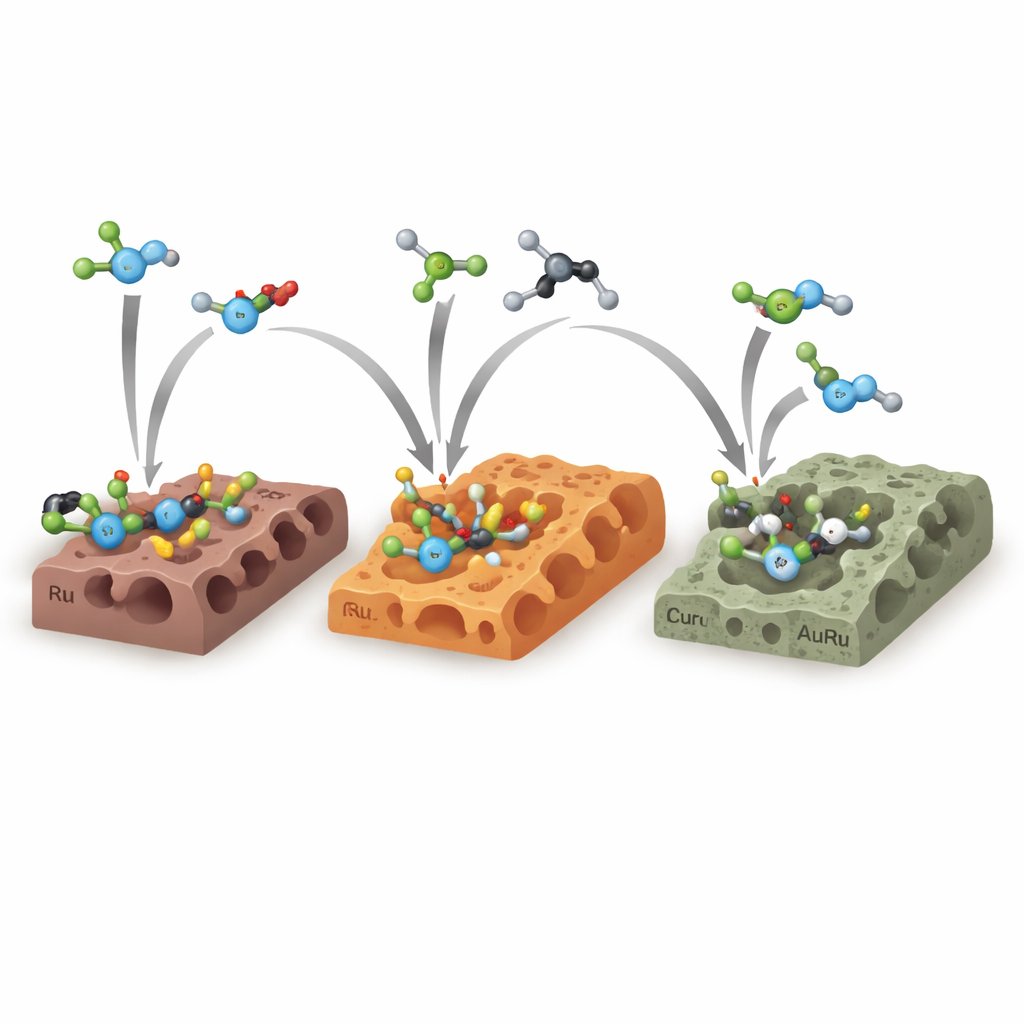
Performance That Pushes the Limits
Because the three reaction roles are separated in space but still only nanometers apart, crucial intermediates like hydrogen and chlorine fragments do not have to travel far before reacting. This reduces their chance to recombine wastefully or form carbon deposits that would poison the catalyst. Experiments in flow reactors showed that the new material converts about 99.3% of acetylene — practically the thermodynamic limit — while keeping vinyl chloride selectivity above 99.5%. It maintains this performance for roughly 1,200 hours on a test line using extremely low precious-metal loadings. Compared with a traditional mercury-based setup, the new system can cut catalyst-related costs per ton of product by more than 16%, while avoiding the health and environmental risks associated with mercury.
What This Means Beyond One Plastic
In simple terms, the researchers turned a single grain of catalyst into a mini chemical plant with three coordinated zones, each doing what it does best in the right order. This approach tames a difficult multi-step reaction, squeezes out nearly all of the leftover acetylene, and keeps the catalyst working for a very long time. Beyond vinyl chloride, the same design philosophy — using hierarchical pores and “custom” active sites matched to each stage — could guide the creation of new one-particle tandem catalysts for other complex chemical processes, potentially making a range of industrial products cleaner, safer, and more energy-efficient.
Citation: Wang, B., Li, X., Yue, Y. et al. Built-in tandem catalysis in hierarchical pores for efficient vinyl chloride production. Nat Commun 17, 3633 (2026). https://doi.org/10.1038/s41467-026-70329-y
Keywords: vinyl chloride, tandem catalysis, porous carbon, acetylene hydrochlorination, hierarchical pores