Clear Sky Science · en
Reaction-induced modification of Co nanoclusters driven by Co-Mn interfacial sites to control selectivity in CO2 hydrogenation
Turning a Climate Problem into a Useful Building Block
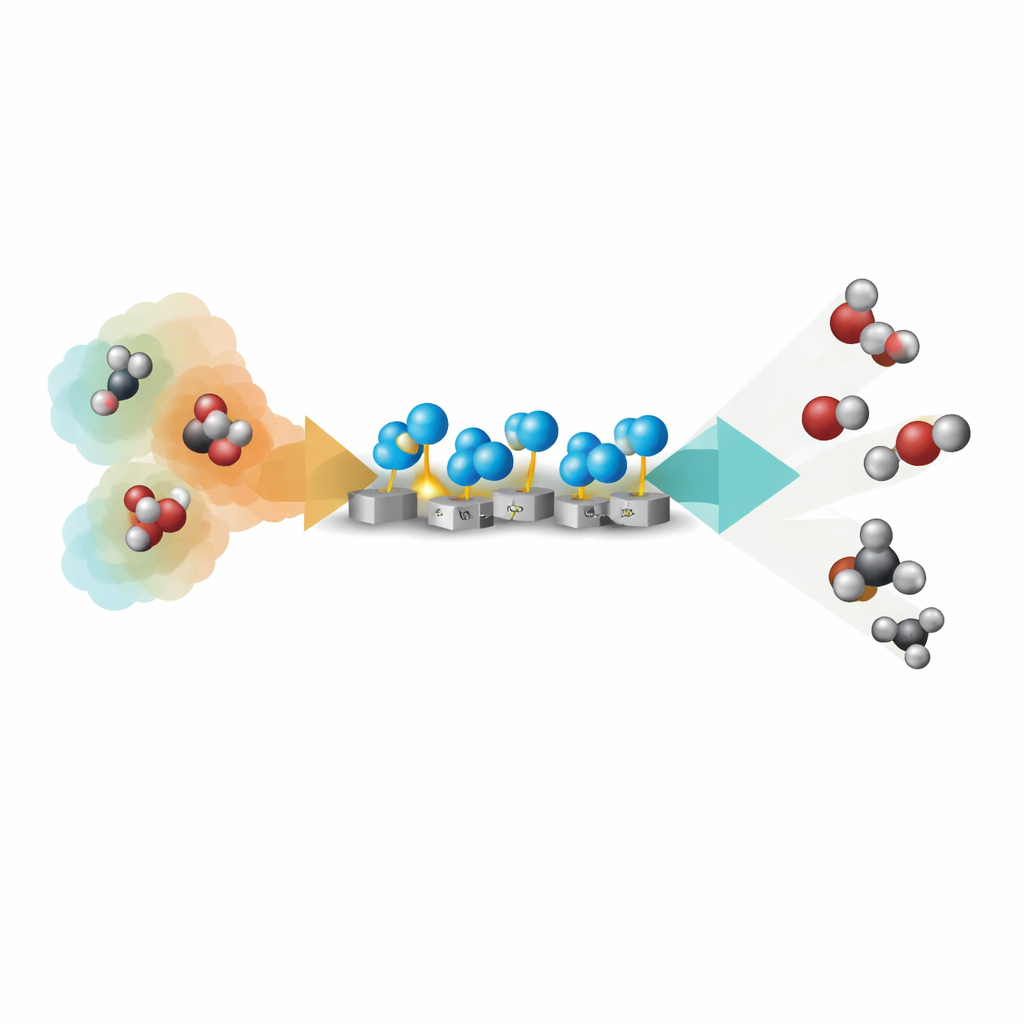
Carbon dioxide is a major greenhouse gas, but it is also a potential raw material for making fuels and chemicals. In industry, tiny particles of cobalt metal are already used to turn simple gases into valuable products. This study shows how the same kind of cobalt particles can be gently reshaped by the reaction itself so that, instead of turning carbon dioxide mainly into methane (a fuel and strong greenhouse gas), they switch to making mostly carbon monoxide—an important starting point for many cleaner chemical processes.
Why Tiny Metal Particles Matter
Modern chemical plants rely on metal nanoparticles—clusters of a few thousand atoms—to speed up reactions that would otherwise be too slow. For cobalt, the size and surface structure of these particles strongly influence what products are formed when carbon-containing gases react with hydrogen. Larger cobalt particles tend to favor making methane, while smaller ones are better for making carbon monoxide and more complex molecules. Traditionally, chemists try to lock in the “right” structure before the reaction starts, but under real operating conditions these particles can change, which often hurts performance.
A Catalyst That Rebuilds Itself Under Reaction
The researchers studied a catalyst made of very small cobalt clusters dispersed on a manganese oxide support, containing only 2% cobalt by weight (called 2Co/MnOx). During carbon dioxide hydrogenation—a reaction mixing CO2 with hydrogen—this material behaved in a surprising way. At first, it produced a mixture of methane and carbon monoxide. Over several hours, however, the same catalyst gradually shifted to producing almost only carbon monoxide, boosting the ratio of CO to methane from less than 1 to more than 13, while keeping overall activity high. This shift did not occur when the cobalt loading was higher or lower, or when other common supports like silica or titania were used, pointing to a special combination of cobalt amount and manganese oxide support.
How Invisible Carbon Layers Steer the Reaction
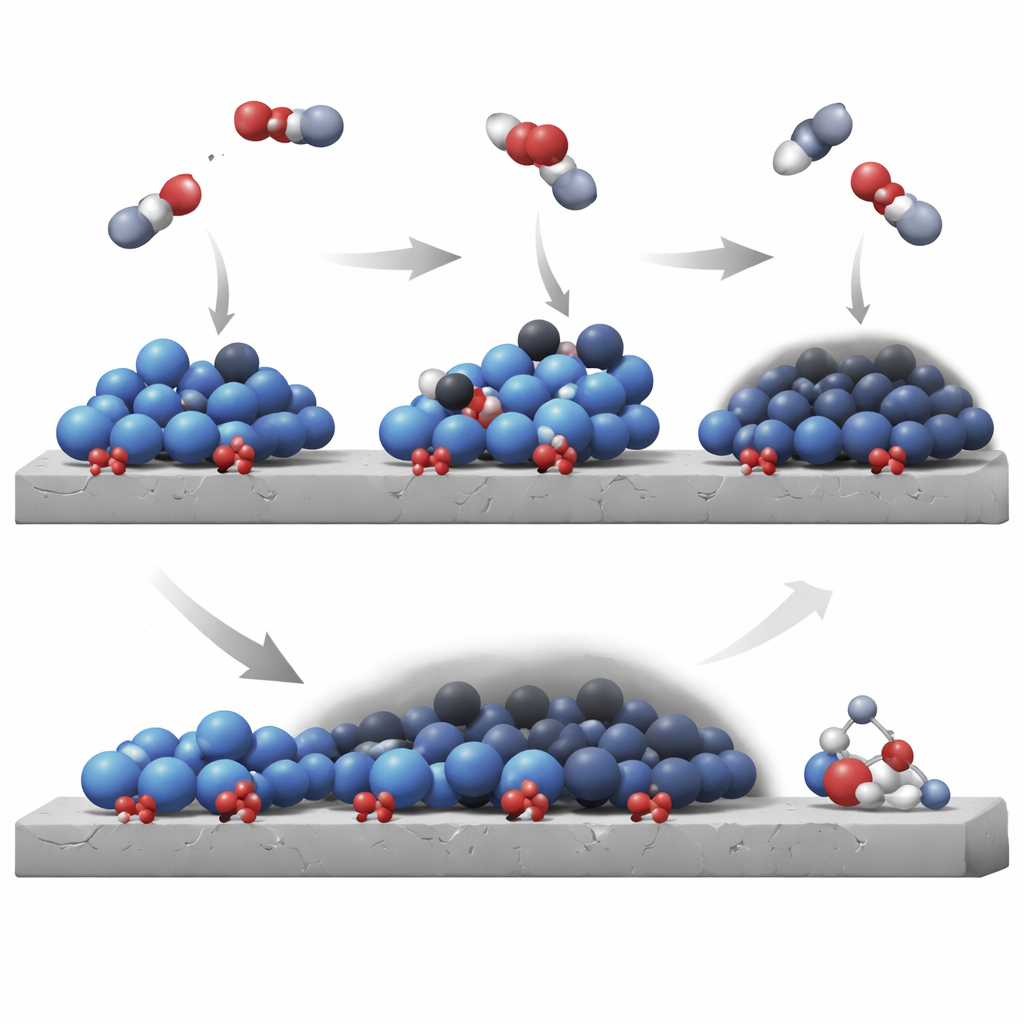
To find out what changed, the team combined multiple techniques that probe the catalyst surface during and after reaction. They saw no major growth in cobalt particle size and no formation of cobalt carbide, a known phase that can alter selectivity. Instead, temperature-programmed experiments revealed that carbon atoms, produced when carbon monoxide splits, gradually built up on the cobalt clusters as thin, graphitic-like layers. These layers did not block access to the metal entirely, but they did weaken how strongly the surface could hold and hydrogenate carbon monoxide. As a result, carbon monoxide was more likely to leave the surface as product rather than being further converted into methane.
The Special Role of the Cobalt–Manganese Boundary
The key to forming these beneficial carbon layers lies at the boundary where cobalt touches manganese oxide. Manganese oxide has a strong affinity for oxygen, while cobalt has a strong affinity for carbon. At their interface, incoming carbon monoxide molecules can attach in a “bridging” fashion that connects cobalt, carbon, oxygen, and manganese in a single unit. Both experiments and computer simulations showed that this configuration makes it easier to snap the carbon–oxygen bond in carbon monoxide: carbon atoms migrate over the cobalt cluster, while oxygen atoms stay on the manganese oxide and are quickly removed by reacting with more CO or with hydrogen. This steady supply and removal of carbon and oxygen puts the system into a dynamic balance where a controlled amount of carbon stays on cobalt, gradually reshaping its surface.
Guiding Reactions by Tuning the Atmosphere
The study also reveals that the gas mixture itself is a powerful design tool. Pretreating the catalyst with carbon monoxide or carbon-dioxide–containing gases reliably triggered the structural change and the selectivity shift, whereas hydrogen alone or methane-rich mixtures did not. Raising the cobalt loading changed how readily hydrogen could remove carbon from the surface, slowing the buildup of the helpful carbon layer. These observations support a picture in which the final “working” structure of the catalyst is not fixed during manufacturing but is instead sculpted on the fly by the interplay between the gas environment and the metal–oxide interface.
From Greenhouse Gas to Flexible Feedstock
In practical terms, this work shows that a carefully chosen cobalt-on–manganese-oxide catalyst can transform carbon dioxide into a carbon monoxide–rich stream in a stable and controllable way, without forming unwanted, inactive cobalt carbide or fully encapsulating the metal. For a general audience, the key message is that by letting the reaction itself gently rearrange the catalyst—depositing just enough carbon in just the right place—chemists can tilt the outcome toward more useful products. This concept of reaction-induced surface engineering could help design future catalysts that turn waste CO2 into versatile building blocks while avoiding excessive methane formation.
Citation: Kang, H., Cao, R., Zhang, Y. et al. Reaction-induced modification of Co nanoclusters driven by Co-Mn interfacial sites to control selectivity in CO2 hydrogenation. Nat Commun 17, 3604 (2026). https://doi.org/10.1038/s41467-026-70328-z
Keywords: CO2 hydrogenation, cobalt nanoclusters, catalyst selectivity, manganese oxide interface, reverse water-gas shift