Clear Sky Science · en
Selective control of prefrontal neural timescales by parietal cortex
How the brain keeps thoughts brief or long-lasting
Every moment, your brain must decide what deserves a quick glance and what should be held in mind a little longer. A sudden flash of color might grab your eyes for a split second, while a road sign you need to follow must stay in focus. This study explores how two brain regions work together to set these different “attention windows,” revealing how one area of the brain can lengthen or shorten how long signals echo in another.
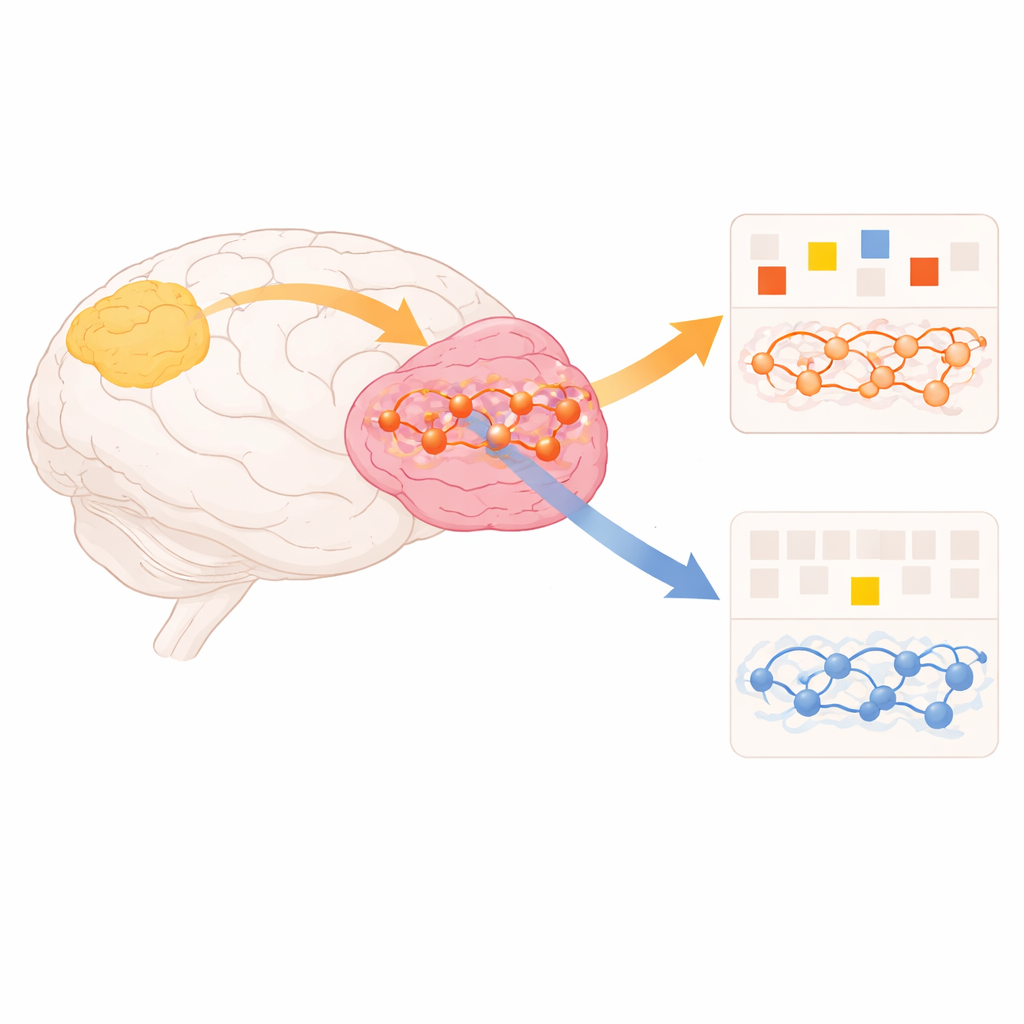
Two kinds of timing in a key attention hub
The researchers focused on the frontal eye field (FEF), a part of the primate brain that helps steer eye movements and visual attention, and its partner region, the posterior parietal cortex (PPC). Using tiny electrodes in two rhesus monkeys, they recorded electrical spikes from hundreds of FEF neurons while the animals calmly stared at a screen. Sometimes a single colored square appeared; other times, one standout square was surrounded by many distractors, creating a classic “pop-out” effect. Before the stimulus came on, the team measured how long each neuron’s spontaneous activity remained similar to its own recent past—a property known as its intrinsic timescale.
Fast responders and steady watchers
When they plotted these intrinsic timescales, the FEF neurons fell into two clear groups. One group showed very short timescales, on the order of a few tens of milliseconds, meaning their activity flickered rapidly. The other group had timescales about four times longer, indicating more slowly changing, stable activity. These two types were not only mathematically distinct; they were also arranged differently in depth, with short-timescale neurons found closer to the cortical surface and long-timescale neurons deeper down. This suggested that the FEF contains at least two circuit motifs, tuned for very different temporal roles.
What fast and slow neurons actually do
The team then asked how these timing properties relate to what the neurons “care about” during visual tasks. Short-timescale neurons responded more strongly, though not earlier, when a single stimulus appeared inside their preferred visual location compared with outside it. They also produced brisk, transient boosts when a pop-out item appeared. Long-timescale neurons, in contrast, were better at carrying a steady signal about which location was most visually important over several hundred milliseconds, especially in the pop-out condition. When many neurons were analyzed together using decoding techniques, populations of fast neurons excelled at briefly pinpointing where a stimulus appeared, whereas populations of slow neurons were superior at maintaining information about salient items and discriminating their exact location over time.
Turning down parietal input reshapes timing and attention
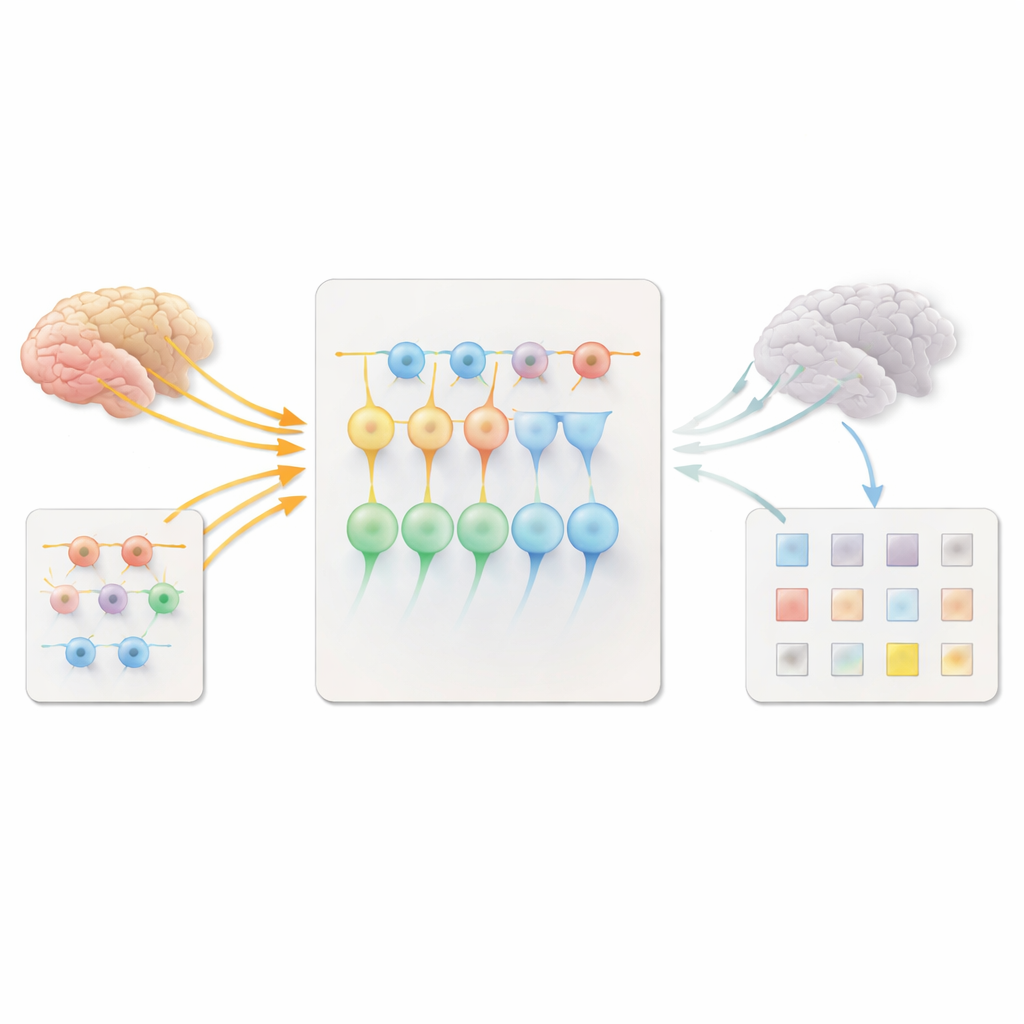
To test whether PPC input actively shapes these timing patterns, the researchers temporarily cooled parts of the PPC, silencing its activity without damaging tissue. Under this manipulation, the intrinsic timescales of FEF neurons became longer overall: activity changed more slowly, as if the local circuitry had been shifted into a more sluggish mode. This effect was especially strong for the fast group, whose timescales increased far more than those of the already-slow neurons. At the same time, the clear link between a neuron’s timescale and how well it signaled visual salience largely broke down. In particular, the ability of long-timescale neurons to carry a stable, high-fidelity signal about pop-out items was sharply weakened, especially during later, sustained periods of the response.
Why this matters for attention and thought
Taken together, the findings show that the brain’s “attention network” does not operate with a single clock. Instead, the FEF houses two interwoven sets of neurons: one specialized for rapid, flexible responses and another for slower, more persistent priority signals. The PPC helps tune both sets—by feeding in fast-changing information that keeps short-timescale neurons agile, and by supporting the long-timescale neurons that hold onto what matters. When PPC input is removed, FEF activity slows and the stable tracking of salient stimuli deteriorates. For a lay observer, this means that our ability to quickly notice something and then keep it in mind depends on a finely balanced dialogue between brain regions that set how long neural echoes last.
Citation: Soyuhos, O., Zirnsak, M., Chaudhuri, R. et al. Selective control of prefrontal neural timescales by parietal cortex. Nat Commun 17, 3687 (2026). https://doi.org/10.1038/s41467-026-70326-1
Keywords: visual attention, frontal eye field, posterior parietal cortex, neural timescales, salience