Clear Sky Science · en
Interfacial configurational entropy tuning strategy enabling liquid alloys for efficient depolymerization of polyolefin waste
Why turning old plastics into new matters
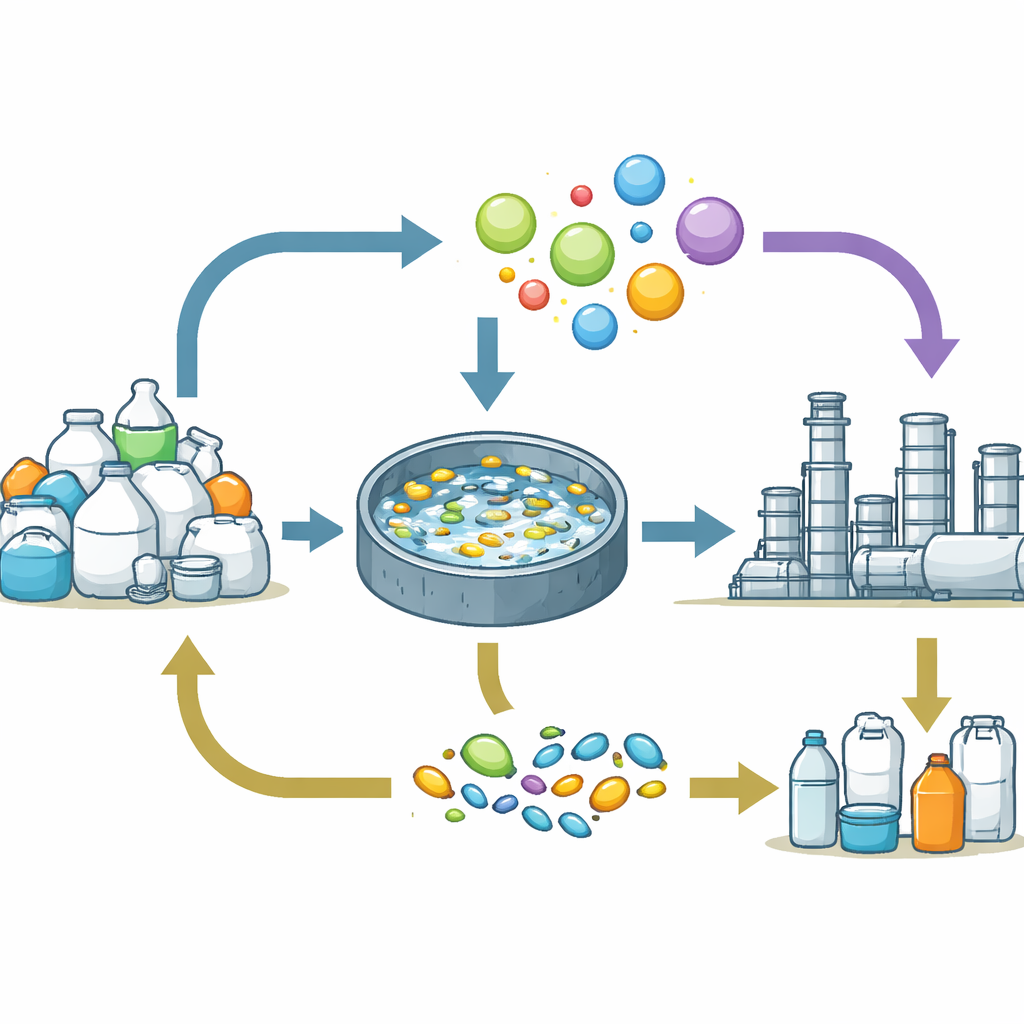
Mountains of discarded plastic are piling up around the world, and most of it is made from tough materials called polyolefins, found in packaging, bottles, and many everyday products. These plastics are so durable that they resist breaking down, and less than 10 percent is currently recycled. This study introduces a new way to melt these stubborn plastics back into small building blocks that can be used again, potentially closing the loop between plastic waste and new products.
A new way to unlock stubborn plastics
Traditional recycling often chops and remolds plastic, which downgrades quality and works only for clean, single-type items. Chemical recycling, by contrast, aims to break plastics down to their original molecular ingredients. For polyolefins like polyethylene and polypropylene, this is especially difficult because their carbon–carbon and carbon–hydrogen bonds are very stable and usually require extreme conditions to break. The authors tackle this challenge by focusing on a special liquid metal mixture that acts as a catalyst, helping these bonds snap in a controlled way at practical conditions.
Designing a smart liquid metal catalyst
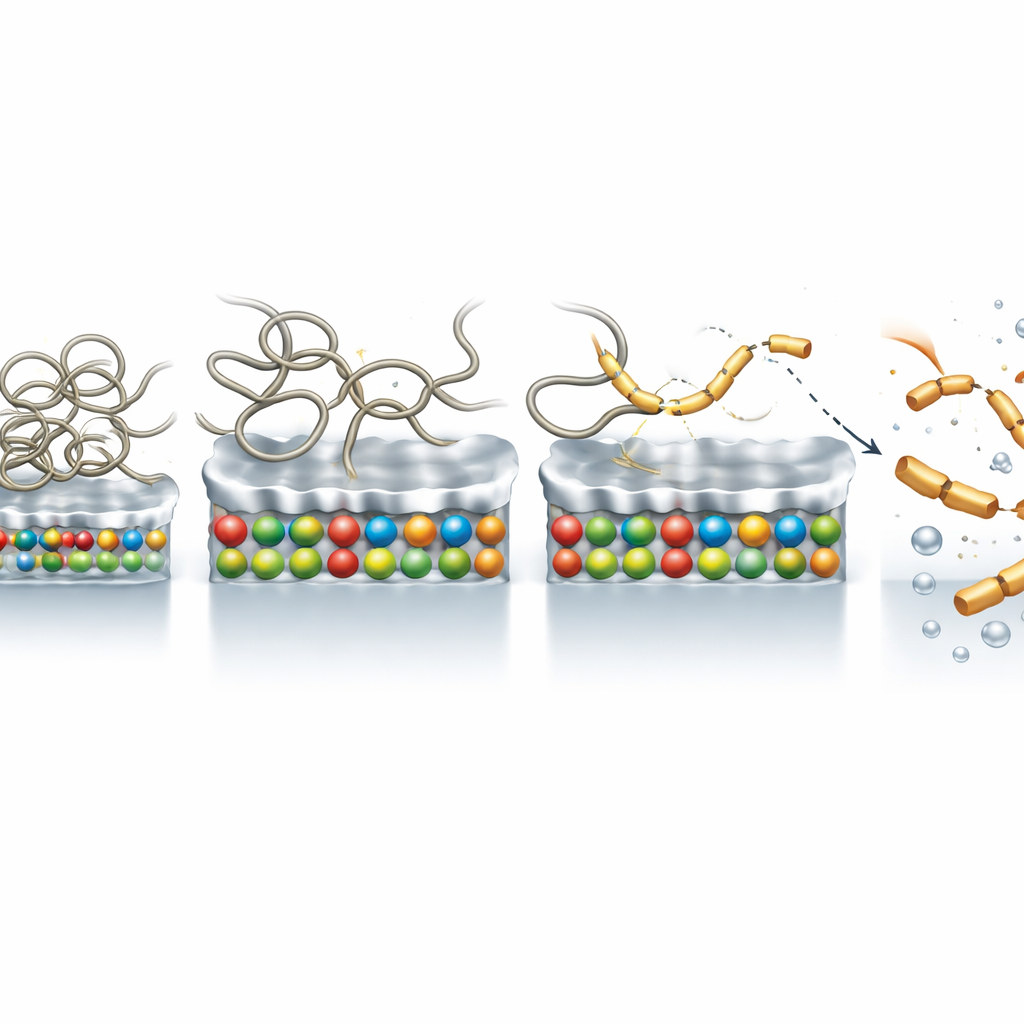
The team created a liquid alloy made from gallium, indium, nickel, and tin that is molten at operating temperatures and electrically conductive. By carefully choosing and combining these elements, they tuned the “configurational entropy” at the interface—the degree of atomic mixing and disorder where the liquid metal meets the solid plastic. This increased disorder lowers the interfacial energy and draws nickel atoms, which are responsible for breaking chemical bonds, to the surface. Tin further reduces surface tension so the plastic spreads better over the liquid metal, enlarging the contact area and exposing more active sites.
How the alloy breaks plastic chains
Advanced measurements and computer simulations reveal that tin and nickel at the alloy’s surface form paired sites with uneven charge, where nickel is slightly electron-rich and tin slightly electron-poor. These sites are especially good at grabbing hydrogen atoms along a plastic chain, creating charged “hot spots” that then split at a specific position known as the beta site. Instead of random chopping, this pathway favors formation of short, valuable gases called light olefins. Experiments tracking reaction products show that these desired molecules appear at lower temperatures and in higher amounts when the new alloy is used, confirming the proposed reaction route.
Fast, efficient recycling of real-world waste
To make the process practical, the researchers heated the liquid alloy with induction coils, which rapidly and uniformly warm the catalyst itself rather than the whole reactor. This sharply reduces reaction time and limits unwanted side reactions such as over-cracking to methane or soot. Using this setup, the gallium–indium–nickel–tin alloy converted polypropylene into light olefins with a space-time yield of 181.5 millimoles per gram of catalyst per hour and nearly 80 percent selectivity—outperforming the best existing methods, even those that rely on added co-reactant gases and high pressures. The same approach worked well on many different plastics, mixtures of polymers that are normally difficult to separate, and even dirty post-consumer items like food packaging and toothpaste tubes, all without prior sorting or washing.
Solar-powered plastics-to-building-blocks loop
Going beyond laboratory tests, the team built an outdoor system powered by rooftop solar panels. Electricity from the panels drives the induction heater, which in turn keeps the liquid alloy at operating temperature inside a vacuum heat-pipe reactor. Shredded mixed plastic waste is continuously fed in, and light olefin gases are collected from the outlet. Over 120 hours of daytime operation, the system steadily produced about 52.8 liters of light olefins per hour with more than 70 percent selectivity, while the catalyst remained stable and reusable. The overall energy demand was calculated at 3.8 kilowatt-hours per kilogram of produced light olefins.
What this could mean for everyday life
In simple terms, this work shows that a carefully engineered liquid metal can act like a smart, self-renewing “molecular scissors” that turns mixed, dirty plastic trash back into clean chemical building blocks using only heat and electricity. Because the process works at atmospheric pressure, needs no extra reactant gas, handles unsorted real-world waste, and can run on solar power, it points toward a future where plastic bags, bottles, and packaging are not dead-end garbage but feedstock for new materials in a circular economy.
Citation: Xu, C., Yan, H., Wang, P. et al. Interfacial configurational entropy tuning strategy enabling liquid alloys for efficient depolymerization of polyolefin waste. Nat Commun 17, 3852 (2026). https://doi.org/10.1038/s41467-026-70325-2
Keywords: plastic recycling, polyolefin depolymerization, liquid alloy catalyst, light olefins, solar-powered chemical process