Clear Sky Science · en
Metal-organic framework-confined Co3O4 for humidity-immune ozone decomposition
Why cleaner air matters at home and outdoors
Ozone high in the atmosphere protects us from the Sun’s harsh rays, but near the ground this same gas becomes a harmful air pollutant. It can irritate lungs, strain the heart, damage crops, and often peaks during hot, humid days when many people are outdoors. This study explores a new type of material that quietly breaks down ozone in air without creating new toxins and, crucially, keeps working even when the air is very humid, making it attractive for both city smog control and indoor air cleaning devices.

A sneaky pollutant in everyday air
At street level, ozone forms when car exhaust and industrial fumes react in sunlight. Indoors, printers, copiers, and some disinfection lamps can also release ozone. Because the gas is fairly stable at the low concentrations found in real air, it lingers long enough to harm health. Current cleanup methods often rely on metal oxide powders that help ozone fall apart into ordinary oxygen. Yet these powders lose their power as soon as water vapor, which is always present in air, sticks to their surfaces and blocks the active spots where ozone would normally react.
A porous shelter for tiny cleaners
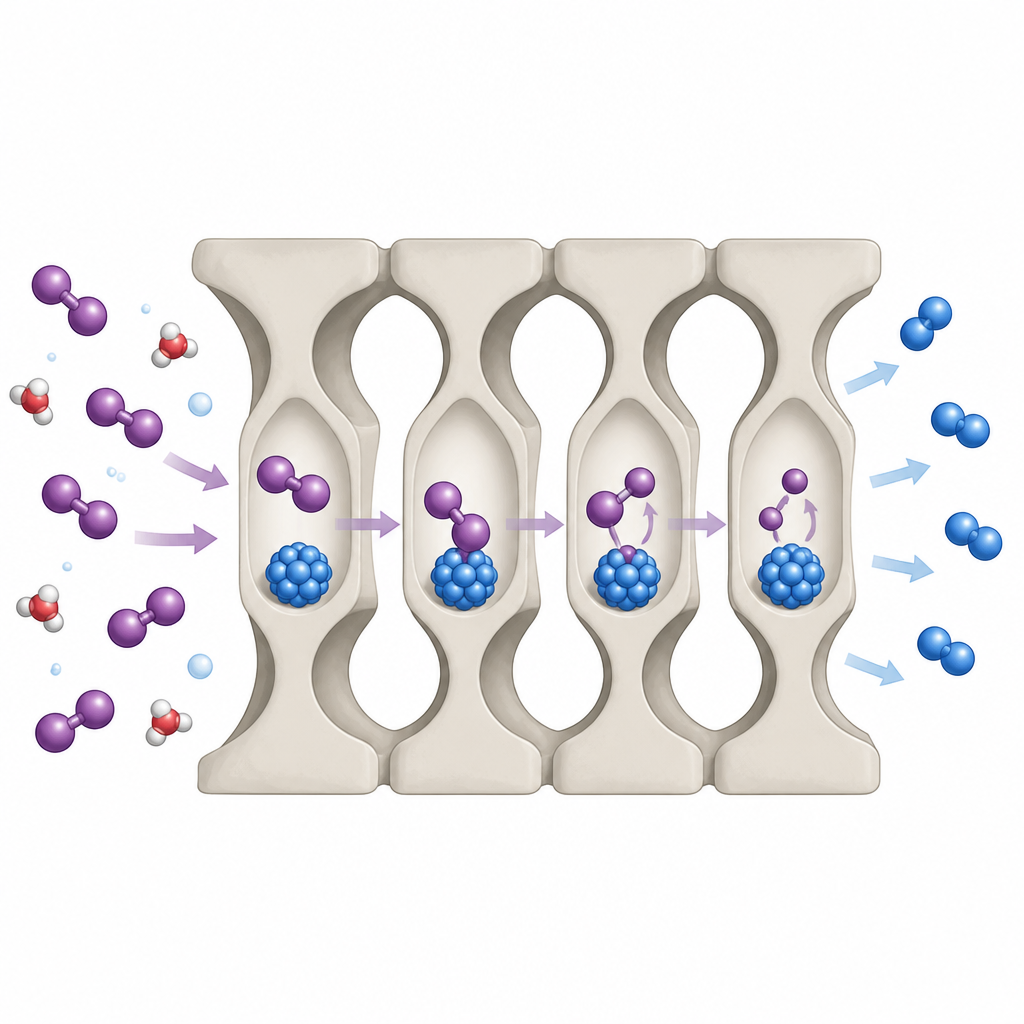
The researchers tackled this problem by building “nanoreactors” in which extremely small particles of metal oxides are tucked inside the tiny chambers of a porous crystal known as a metal–organic framework. Their chosen framework, called PCN-333(Fe), looks at the nanoscale like an ordered honeycomb of cages and channels. Using a combined ultrasound and microwave treatment, they guided cobalt oxide or nickel oxide particles to form directly inside these cages rather than on the outside surface. Electron microscopy and other structural tests confirmed that the framework kept its shape, while the metal oxide particles stayed ultra-small, evenly spread, and fully enclosed within the pores.
How the material handles humid, polluted air
When they tested these composites in a flowing stream of air containing a realistic 40 parts per million of ozone, the cobalt-based version stood out. A material with about 30 percent cobalt oxide by weight maintained 100 percent removal of ozone for more than 120 hours across a wide humidity range from dry to nearly saturated air. In contrast, the bare cobalt oxide and the empty framework each lost activity quickly, especially at high humidity. The protected catalyst also kept working as temperatures cycled between cool and warm conditions and under challenging conditions chosen to mimic summer smog events in eastern China. Similar benefits were seen when nickel oxide was confined in the same framework, pointing to a general strategy rather than a one-off trick.
A hidden relay that drives the reaction
To understand why this confined system worked so well in damp air, the team used surface-sensitive spectroscopy and computer simulations. They found that water is not simply a nuisance that blocks the surface; instead, it donates hydrogen atoms that shuttle back and forth between the iron centers of the framework and the cobalt oxide clusters. As ozone molecules land near these sites, hydrogen helps form short-lived peroxide and superoxide species that quickly break apart into oxygen gas. This hydrogen relay lowers the energy barriers for key steps, speeds up the release of oxygen from the catalyst, and helps restore the active sites, all while the framework structure prevents water from drowning the reactive spots.
What this means for cleaner air solutions
In simple terms, the study shows that hiding tiny catalyst particles inside a well-designed porous host can turn humidity from a problem into a helper. The best-performing material steadily converts ozone into ordinary oxygen over long periods, even in hot, wet air that would normally shut down standard catalysts. By revealing how the hydrogen relay at the interface between the metal oxide and the framework keeps the reaction moving, the work offers a recipe for building future filters and coatings that remove ozone and possibly other pollutants in the complex, ever-changing air we actually breathe.
Citation: Lou, Y., Han, Y., Li, T. et al. Metal-organic framework-confined Co3O4 for humidity-immune ozone decomposition. Nat Commun 17, 4299 (2026). https://doi.org/10.1038/s41467-026-70324-3
Keywords: ozone decomposition, air pollution, catalyst, metal-organic framework, humidity tolerance