Clear Sky Science · en
Synergistic aluminum dual-atom sites and nickel nanoclusters for acetylene selective hydrogenation
Turning a Tiny Impurity into a Big Opportunity
Modern plastics and many everyday products start with ethylene, a simple gas made in huge volumes. Yet the ethylene that comes out of crackers is contaminated with a small amount of acetylene, a troublemaker that must be removed without wasting the valuable ethylene. This study presents a new way to clean acetylene from ethylene using an efficient, low-cost catalyst built from aluminum and nickel, potentially making plastic production cheaper, cleaner, and less dependent on rare precious metals.
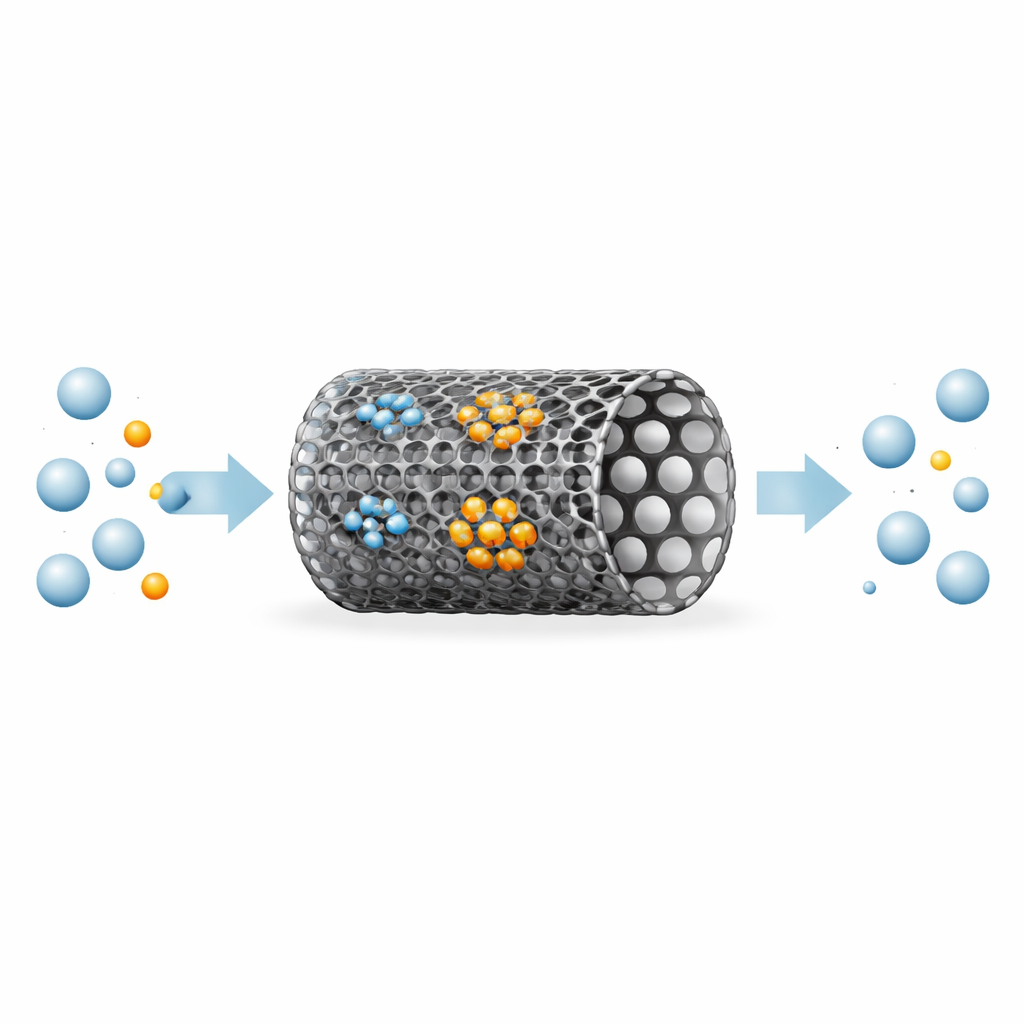
Why Cleaning Acetylene Is So Hard
In industrial plants, ethylene streams contain about 1% acetylene. That sounds minor, but even this trace impurity can poison downstream polymerization catalysts used to make polyethylene. The challenge is to convert acetylene into ethylene without going too far and turning ethylene into ethane, or allowing the molecules to link together into heavy, coke-like deposits that foul reactors. Traditional catalysts based on palladium do this job well but rely on expensive precious metals and still struggle with a trade-off: better acetylene conversion usually means worse selectivity to ethylene and faster buildup of unwanted carbon deposits.
Using Aluminum in a New Way
Aluminum oxides are common supports for catalysts but are generally considered passive scaffolds rather than active players, especially in hydrogenation reactions. The authors overturn this assumption by showing that atomically dispersed aluminum sites—specifically, aluminum atoms paired into closely spaced “dual-atom” sites anchored on nitrogen-doped carbon nanotubes—can directly catalyze the conversion of acetylene to ethylene. These aluminum dimers bind acetylene in a gentle, side-on fashion that favors formation of ethylene and discourages further hydrogenation to ethane or polymerization to heavier products. However, on their own these Al sites struggle to split hydrogen efficiently, so they work only at relatively high temperatures.
Pairing Aluminum Dimers with Nickel Clusters
To combine strength with precision, the researchers engineered a catalyst that brings two types of active sites into close proximity: aluminum dual-atom sites and tiny nickel nanoclusters, both housed within carbon nanotubes. A vapor-based “solid-transformation plus gas-adsorption” method first creates stable Al dimers and then deposits small nickel clusters nearby. Advanced microscopy and X-ray spectroscopy confirm that aluminum remains in dual-atom form and does not simply alloy with nickel, while nickel persists as metallic clusters a few nanometers across. Electronic signatures reveal charge exchange between the two components, hinting that they influence each other’s reactivity without merging into a single phase.
How the Synergy Works at the Molecular Level
Experiments tracking molecules on the catalyst surface, combined with quantum-chemical calculations, show a clear division of labor. Nickel clusters specialize in cutting hydrogen molecules into highly reactive hydrogen atoms. These atoms move—or “spill over”—from nickel onto neighboring aluminum dimers. The aluminum sites, in turn, bind acetylene in a side-on arrangement and guide it through a sequence of hydrogen additions that stops at ethylene, which is weakly held and can easily desorb. On conventional nickel surfaces, both acetylene and ethylene bind too strongly, making over-hydrogenation to ethane and carbon buildup much more likely. Kinetic studies demonstrate that the combined Al–Ni system lowers the energy barrier for acetylene hydrogenation, reduces sensitivity to hydrogen pressure, and suppresses unwanted side reactions.
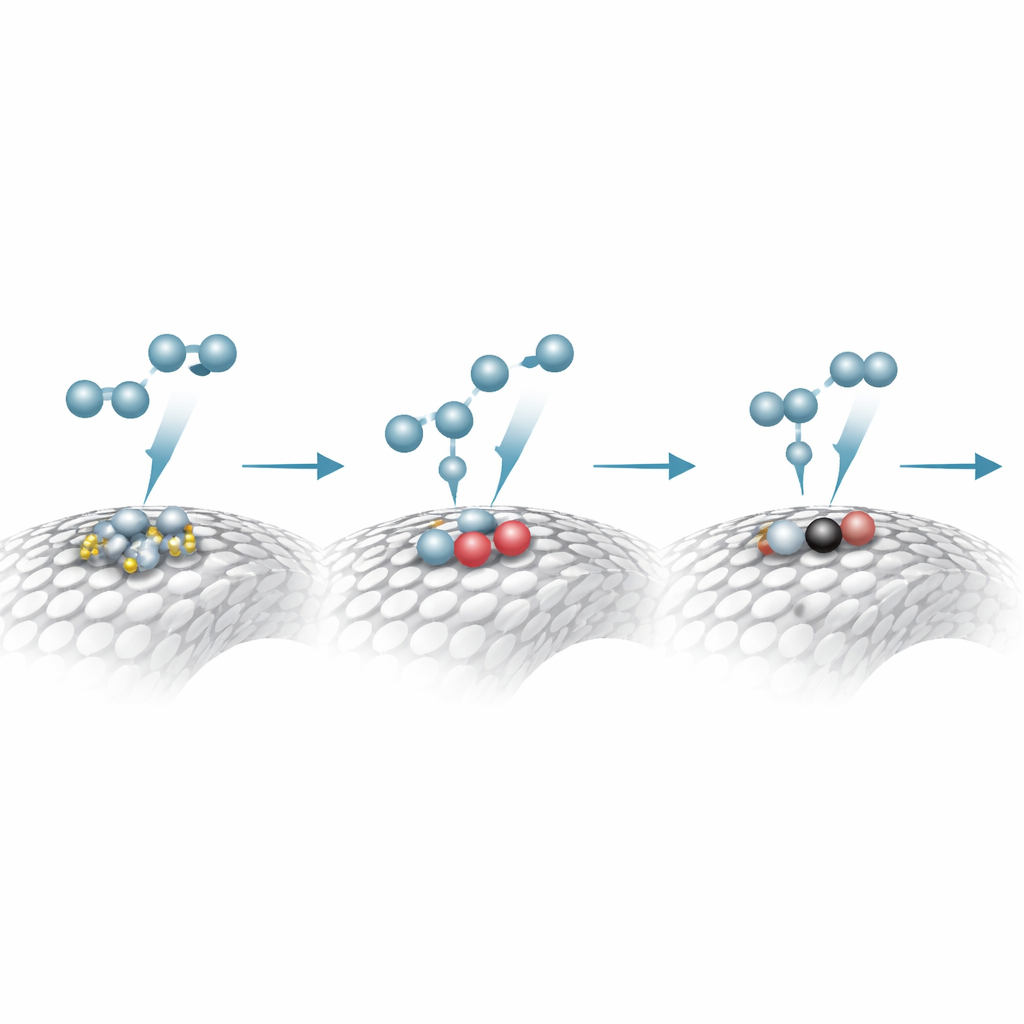
Performance, Stability, and Industrial Promise
Under realistic operating conditions with excess hydrogen and a large amount of background ethylene, the dual-site Al–Ni catalyst converts almost all acetylene at relatively low temperatures while maintaining about 90% selectivity to ethylene. It also shows a significantly lower activation energy and a higher reaction rate than comparable nickel-only catalysts, despite using modest metal loadings. Perhaps most strikingly, the catalyst remains stable for at least 100–150 hours of continuous operation, resisting the coke formation that rapidly degrades many nickel systems and even matching or surpassing the performance of some precious-metal catalysts reported in the literature.
A New Design Blueprint for Smarter Catalysts
To a non-specialist, the key message is that the authors have taught a usually “silent” ingredient—aluminum—to actively steer a difficult reaction, while letting nickel handle the brute-force job of splitting hydrogen. By precisely arranging these two types of sites side by side, they break the usual compromise between efficiency and selectivity in cleaning acetylene from ethylene. This concept of combining dual-atom sites with metal nanoclusters could inspire a new generation of affordable, finely tuned catalysts for other important chemical processes.
Citation: Liu, Y., Yu, H., Li, M. et al. Synergistic aluminum dual-atom sites and nickel nanoclusters for acetylene selective hydrogenation. Nat Commun 17, 3542 (2026). https://doi.org/10.1038/s41467-026-70323-4
Keywords: acetylene hydrogenation, ethylene purification, dual-atom catalysts, nickel nanoclusters, synergistic catalysis