Clear Sky Science · en
Ultra-efficient physical field computing by complex-valued network quantization
Why shrinking smart models matters
Many of the invisible technologies around us—wireless networks, medical scanners, and holographic displays—depend on waves. Accurately simulating and controlling these waves is crucial, but doing so with today’s artificial intelligence tools can be painfully slow and power-hungry. This study shows how to dramatically shrink and speed up a special class of AI models that work directly with wave information, without sacrificing the fine details needed for sharp images and reliable signals.
Waves, numbers, and hidden structure
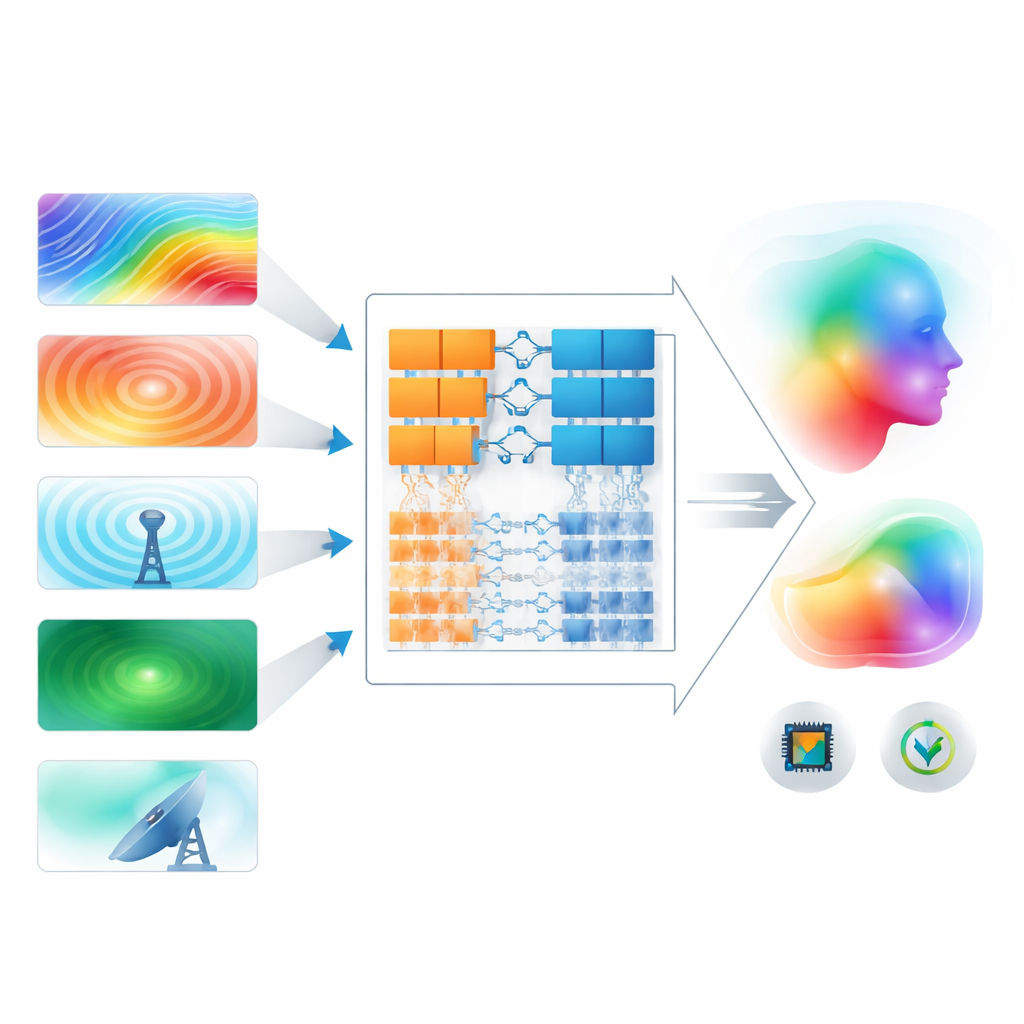
Light, sound, and radio waves all carry two pieces of information: how strong they are and how their peaks line up in space and time. Mathematicians bundle these together as “complex numbers,” which naturally describe patterns like interference and vibration. Complex-valued neural networks take advantage of this by operating directly on these paired quantities, making them powerful tools for tasks ranging from hologram generation to radar and acoustic analysis. But there is a catch: running such models at full numerical precision is expensive in memory, computation, and energy, which limits their use in portable devices and real-time systems.
Why standard shortcuts break wave information
A popular way to slim down AI models is called quantization—storing each weight and activation using only a few bits instead of full-precision numbers. For ordinary, real-valued networks this works very well. However, most existing methods treat the real and imaginary parts of complex numbers as if they were unrelated channels. That ignores the tight coupling between strength and alignment in wave-based systems. The result is that rounding errors in each part no longer cancel or match up, scrambling the delicate phase relationships that determine how waves add or cancel. In practical terms, this can inject non-physical noise, blur holographic images, and degrade the performance of systems like synthetic aperture radar.
A smarter way to round complex waves
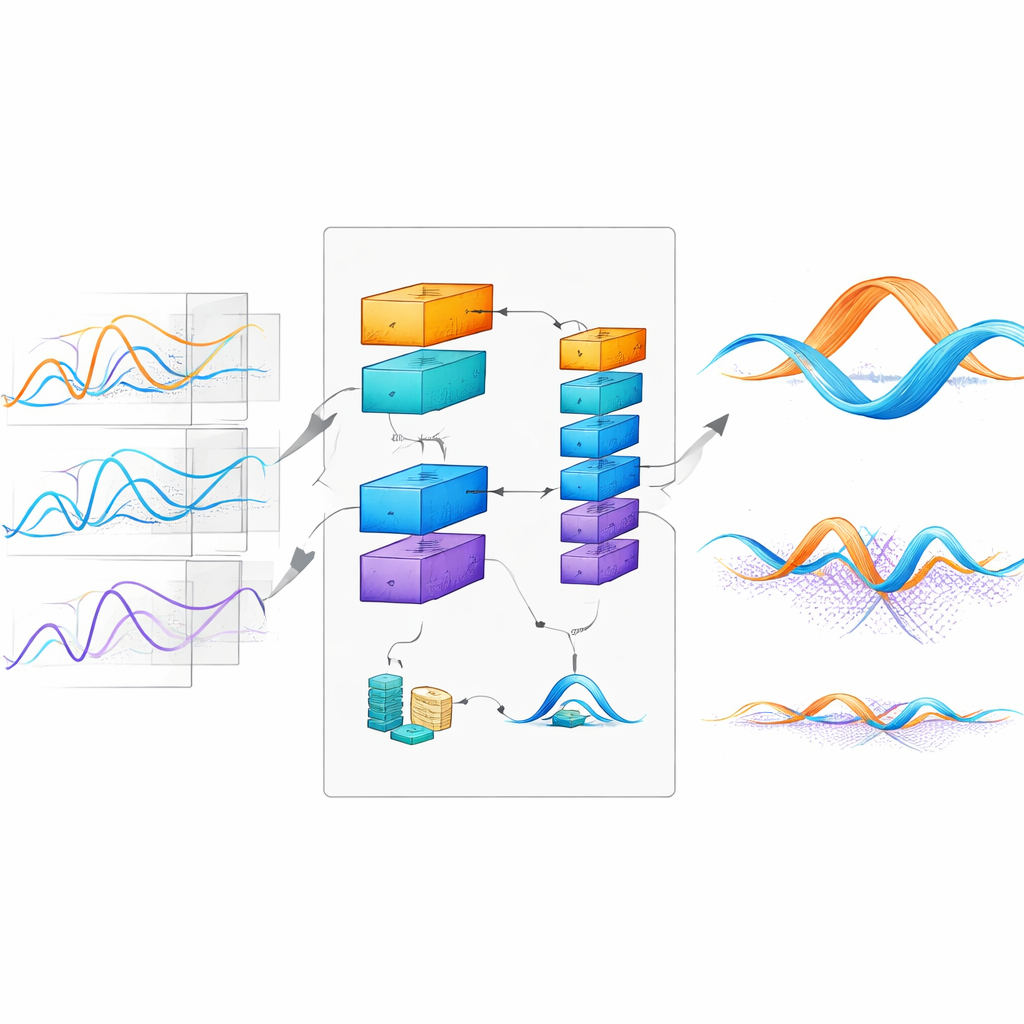
The authors propose a new strategy that keeps the two halves of each complex number “aware” of each other during compression. Their framework jointly quantizes the real and imaginary components so that rounding errors are shaped to preserve both the size and direction of the combined complex value. They also introduce an adaptive scheme that decides, layer by layer, how many bits are actually needed. Layers that directly touch physical wavefields keep higher precision, while deeper layers that operate on more abstract features can safely use fewer bits. A training procedure with two stages first learns the ideal bit-width pattern across the network and then retrains the model using those choices to recover accuracy.
Sharper holograms with a fraction of the cost
To put their idea to the test, the team builds an ultra-low-bit network for computer-generated holography, a notoriously sensitive application where tiny numerical errors can cause speckle and artifacts. Their design includes a phase generator, a module to convert complex wavefields into phase-only holograms, and a compensator that reduces ringing artifacts from imperfect optical models. Trained with a loss function that evaluates the propagated light field, not just pixel differences, the system directly penalizes errors that would matter in a real optical setup. Compared with a leading hologram network called HoloNet, the new model produces higher-quality reconstructions—about 4 decibels better in a standard image-quality measure—while cutting computation by roughly 99 percent and memory use by nearly three orders of magnitude. Optical experiments with two- and three-dimensional holograms confirm that the compressed model still delivers clean, speckle-reduced images in the lab.
Beyond holograms: audio, wireless, and radar
The benefits are not limited to optics. The authors test their quantized complex-valued networks on three other wave-based tasks: recognizing speakers from audio signals, classifying wireless modulation modes, and identifying targets in synthetic aperture radar data. In each case, the quantized complex model achieves accuracy close to, or better than, full-precision baselines, while slashing the number of bit operations and memory needs by around 80–90 percent. On both desktop processors and an Android smartphone, the approach yields large speedups over earlier holography networks, showing that sophisticated wave-based AI models can run efficiently at the edge rather than only in powerful data centers.
What this means for future wave technologies
By respecting the special structure of complex numbers instead of treating their parts separately, this work offers a practical recipe for building lightweight, efficient AI tools that still honor the physics of waves. The proposed quantization scheme lets complex-valued networks keep the subtle phase information that underpins sharp holograms, clean audio, reliable wireless links, and precise radar images, while drastically reducing their computational footprint. As a result, high-fidelity physical field computing becomes more compatible with mobile devices and embedded systems, opening the door to portable holographic displays, smarter sensors, and energy-efficient scientific instruments that all rely on waves.
Citation: Geng, Z., Li, Z., Zhou, M. et al. Ultra-efficient physical field computing by complex-valued network quantization. Nat Commun 17, 3762 (2026). https://doi.org/10.1038/s41467-026-70319-0
Keywords: complex-valued neural networks, model quantization, computer-generated holography, wave-based signal processing, edge AI