Clear Sky Science · en
Sub-micron-resolution temperature mapping of Zn negative electrode for flow batteries
Why cooler batteries matter for clean energy
As more solar panels and wind turbines feed electricity into the grid, we need large, safe, and affordable batteries to store that energy for when the sun isn’t shining and the wind isn’t blowing. Zinc-based flow batteries are promising candidates: they are relatively inexpensive, use abundant materials, and are safer than many lithium systems. But a hidden problem inside these batteries—tiny metal spikes and invisible hot spots—can drastically shorten their lives. This study shows how mapping temperature at microscopic scales and using a clever liquid metal electrode can tame these issues and push zinc flow batteries closer to real-world deployment. 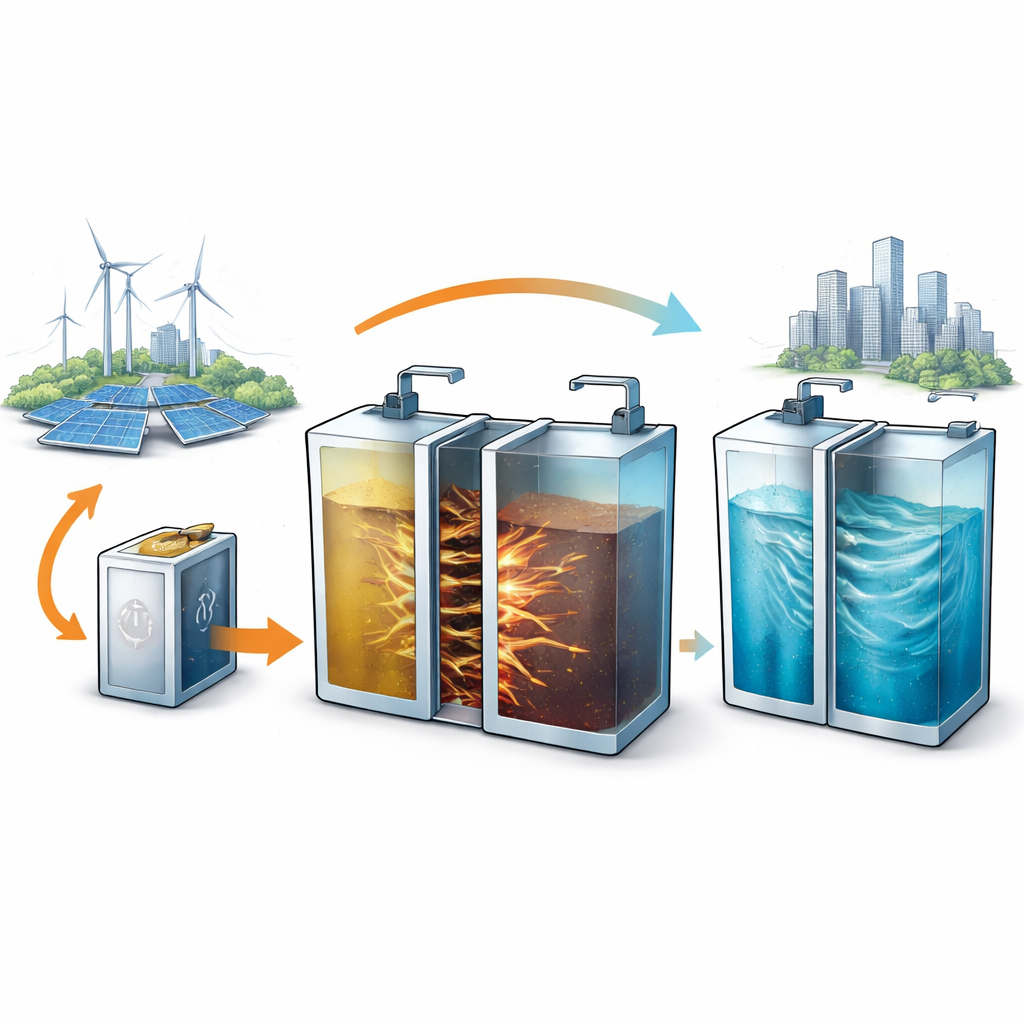
The problem with growing metal spikes
Zinc flow batteries store energy by repeatedly plating zinc metal onto a negative electrode and then dissolving it back into a liquid during discharge. In practice, this process is far from smooth. The zinc often deposits unevenly and grows into needle-like structures called dendrites. These spikes can pierce the separator between the battery’s two sides, causing short circuits, wasted zinc, and ultimately failure. The problem becomes worse when the battery is pushed hard—charged to a high state of charge or run at high current—exactly the conditions needed for practical, high-energy storage.
Hidden hot spots inside working batteries
The researchers suspected that tiny variations in temperature on the electrode surface help drive this uneven zinc growth, but existing tools only measure temperature at the scale of whole cells, not micrometers. To see what was really happening, they built a specialized microscope that uses nanodiamonds as local thermometers. These nanodiamonds contain quantum defects that change their behavior with temperature, allowing the team to map temperature with sub-micron resolution and high sensitivity while the battery is operating. In a simple zinc–zinc test cell, they watched as zinc dendrites formed and caused short circuits. Right after these events, they saw sharp, localized temperature spikes—hot spots that then spread across the electrode, closely tracking the growth and spread of dendrites.
Spreading the heat with better materials
Armed with this insight, the team simulated how different electrode materials handle heat. Substrates with higher thermal conductivity spread heat more effectively, reducing temperature gradients and leading to more uniform zinc deposition. But there was a catch: as a thick layer of zinc built up, the overall thermal behavior became dominated by zinc itself, weakening the benefit of the original substrate. The authors concluded that simply choosing a better solid backing isn’t enough; what’s needed is a way to continuously move heat away from the reaction zone during operation.
A flowing liquid metal that drinks up zinc
To solve this, the researchers turned to a gallium–indium liquid metal that stays fluid at room temperature and conducts heat extremely well. In their design, this liquid metal replaces the usual solid negative electrode in a zinc–bromine flow battery. As the battery charges, zinc ions from the electrolyte are reduced at the interface and immediately dissolve into the liquid metal, forming a smooth liquid alloy instead of solid spikes. Because the metal is both thermally conductive and flowable, it rapidly carries heat away and evens out temperature differences. Experiments and simulations show that this liquid metal electrode keeps the interface nearly isothermal, prevents dendrite formation, reduces corrosion and side reactions, and can reversibly store and release large amounts of zinc over many cycles. 
What this means for future energy storage
When the team built full zinc–bromine flow batteries with the liquid metal electrode, the improvements were striking. The cells ran stably for more than 2400 hours at high state of charge, achieved a large cumulative discharge capacity, and maintained high efficiency compared with conventional designs that fail much sooner. In everyday terms, the work shows that carefully managing tiny hot spots and turning a solid, spiky zinc layer into a smooth liquid alloy can dramatically extend battery life. This approach could make zinc-based flow batteries more reliable and economical for grid-scale storage, helping to smooth out renewable power and support a cleaner, more resilient energy system.
Citation: Wang, S., Gao, Y., Wang, S. et al. Sub-micron-resolution temperature mapping of Zn negative electrode for flow batteries. Nat Commun 17, 3510 (2026). https://doi.org/10.1038/s41467-026-70318-1
Keywords: zinc flow batteries, liquid metal electrode, thermal hotspots, dendrite suppression, grid energy storage