Clear Sky Science · en
CD8+ T cell loss induces autoinflammation in inborn errors of cell death
When the Body’s Defenders Fuel the Fire
Some children suffer from mysterious bouts of high fever, rashes, swollen lymph nodes, and gut inflammation that return again and again. Doctors know these flare ups come from an overactive immune system, but not always why. This study uncovers how a rare fault in a key immune switch makes certain white blood cells die too easily, which in turn pushes other immune cells to flood the body with inflammatory signals.
A Rare Family Illness Offers Clues
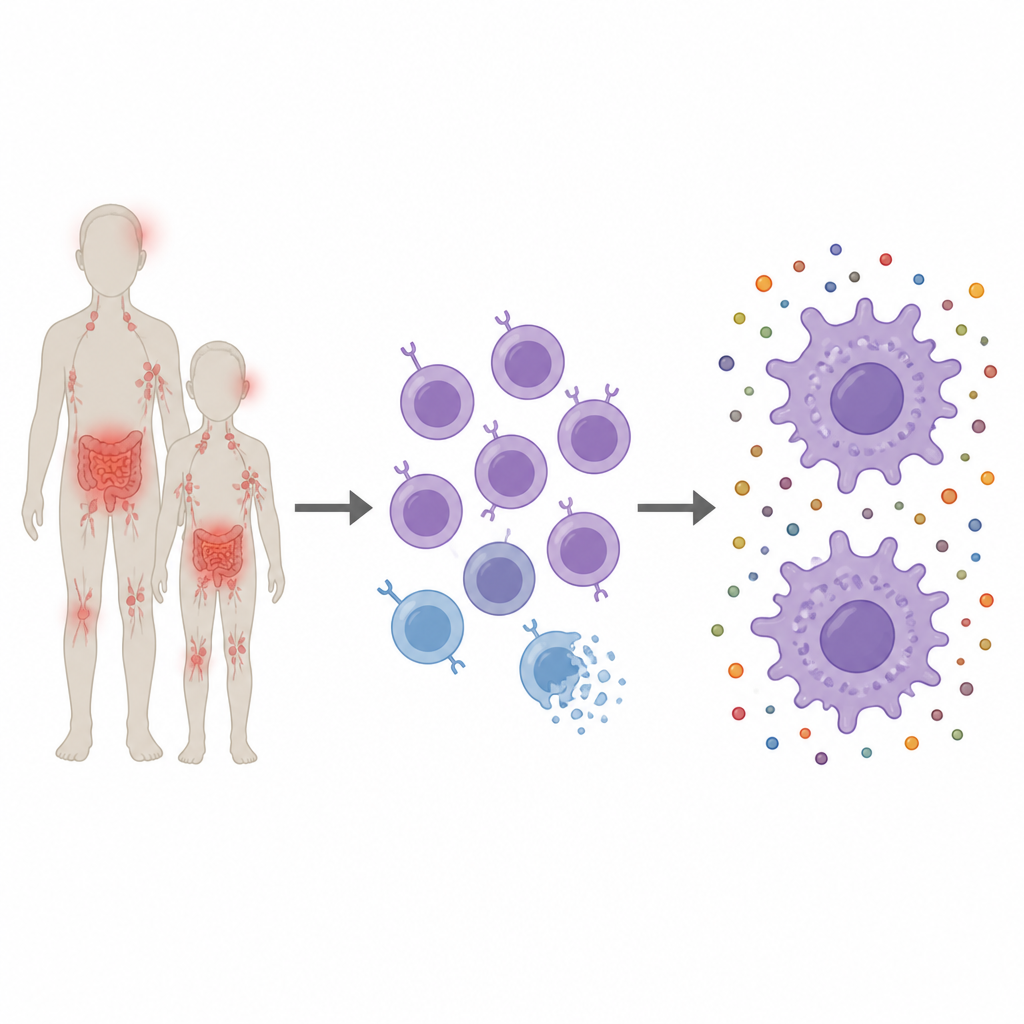
Researchers followed two siblings who developed recurrent fevers, skin rashes, enlarged lymph nodes, and painful colitis early in life. Standard tests did not reveal infections or classic autoimmune disease. Genetic analysis pointed to a gene called RIPK1, which helps decide whether immune cells survive, activate, or die. Both children had inherited two different faulty versions of RIPK1, one from each parent, while their parents each carried only a single faulty copy and were healthy. This pattern showed that the illness was tied to a recessive change in this cell death control gene.
How a Broken Switch Kills Key T Cells
RIPK1 normally helps balance cell survival and safe removal of cells that are no longer needed. In the siblings, both RIPK1 variants made cells unusually sensitive to dying when exposed to common immune signals. Lab tests on patients’ skin cells and immune cells showed more cell death and higher activation of the RIPK1 pathway. Among all blood cell types, CD8 T cells – a subset that normally hunts down infected or abnormal cells – were especially fragile. These cells showed strong signs of programmed death, leading to a loss of CD8 T cells and a strikingly high CD4 to CD8 T cell ratio in the blood.
From Dying T Cells to a Wave of Inflammation
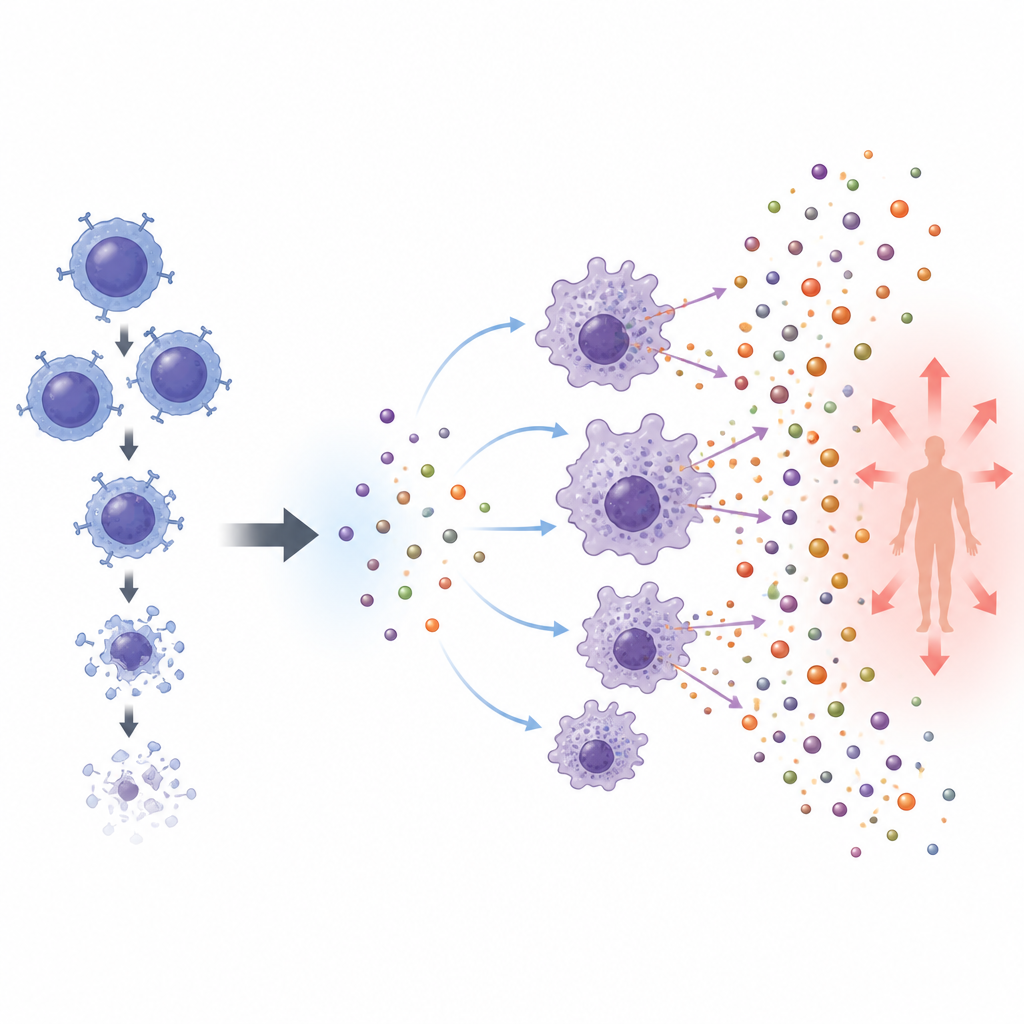
To understand how the loss of CD8 T cells leads to whole body inflammation, the team mapped gene activity cell by cell and ran mixed cell culture experiments. They found that as CD8 T cells became overactivated and then died, they released large amounts of two powerful messenger proteins, TNF and interferon gamma. Neighboring monocytes and macrophages, another class of immune cells, were highly sensitive to these signals. When exposed to T cells from the patients, these myeloid cells pumped out high levels of inflammatory cytokines such as IL 1 beta, IL 6, and more TNF, creating a self reinforcing cycle of inflammation even without infection.
Testing the Mechanism in Mice and Other Patients
The researchers engineered mice so that only their CD8 T cells carried the human RIPK1 faults. Those mice showed higher blood levels of inflammatory cytokines, confirming that unstable CD8 T cells alone can drive systemic inflammation. The team also studied people with other cell death related disorders, including patients with different RIPK1 mutations and with loss of a protein called SHARPIN. These individuals showed the same pattern of increased RIPK1 activity, signs of CD8 T cell damage, and a raised CD4 to CD8 ratio, suggesting that CD8 T cell loss is a shared feature across several related autoinflammatory diseases.
A New Treatment Strategy That Calms the Storm
Because TNF and interferon gamma formed the critical bridge between dying T cells and overactive myeloid cells, the team tested medicines that block these signals. The two siblings were first treated with drugs that block IL 6 or TNF alone, which eased some symptoms but did not fully control their disease or gut problems. When doctors combined a TNF blocking antibody with a JAK inhibitor that dampens interferon signaling, fevers stopped, colitis resolved, and blood markers of inflammation returned to normal for more than a year. In cell culture, directly blocking both TNF and interferon gamma almost completely shut down cytokine production by macrophages.
What This Means for Patients and Families
This work shows that in certain inherited inflammatory diseases, the problem begins when CD8 T cells die too readily and spill danger signals that push other immune cells into a state of constant alarm. A simple blood measure, the CD4 to CD8 T cell ratio, together with signs of RIPK1 overactivity, could help doctors recognize this pattern. Most importantly, the findings point to combined blocking of TNF and interferon linked pathways as a rational way to break the harmful conversation between T cells and myeloid cells, offering targeted relief for patients with these rare but severe conditions.
Citation: Dai, J., Jin, T., Su, G. et al. CD8+ T cell loss induces autoinflammation in inborn errors of cell death. Nat Commun 17, 4402 (2026). https://doi.org/10.1038/s41467-026-70317-2
Keywords: autoinflammatory disease, RIPK1, CD8 T cells, cytokines, TNF and interferon gamma