Clear Sky Science · en
Large megathrust earthquakes in cold mantle wedge corners under lawsonite blueschist facies
Why Deep Earthquakes Matter
Most people picture earthquakes breaking the Earth’s crust shallow beneath our feet. But some of the planet’s most powerful quakes actually rip through rocks more than 30 miles down, where temperatures and pressures are extreme. This article explores why unusually large earthquakes can happen so deep in certain subduction zones—where one tectonic plate dives beneath another—and shows that a particular kind of transformed seabed sediment may hold the key.
Where Big Quakes Usually Stop
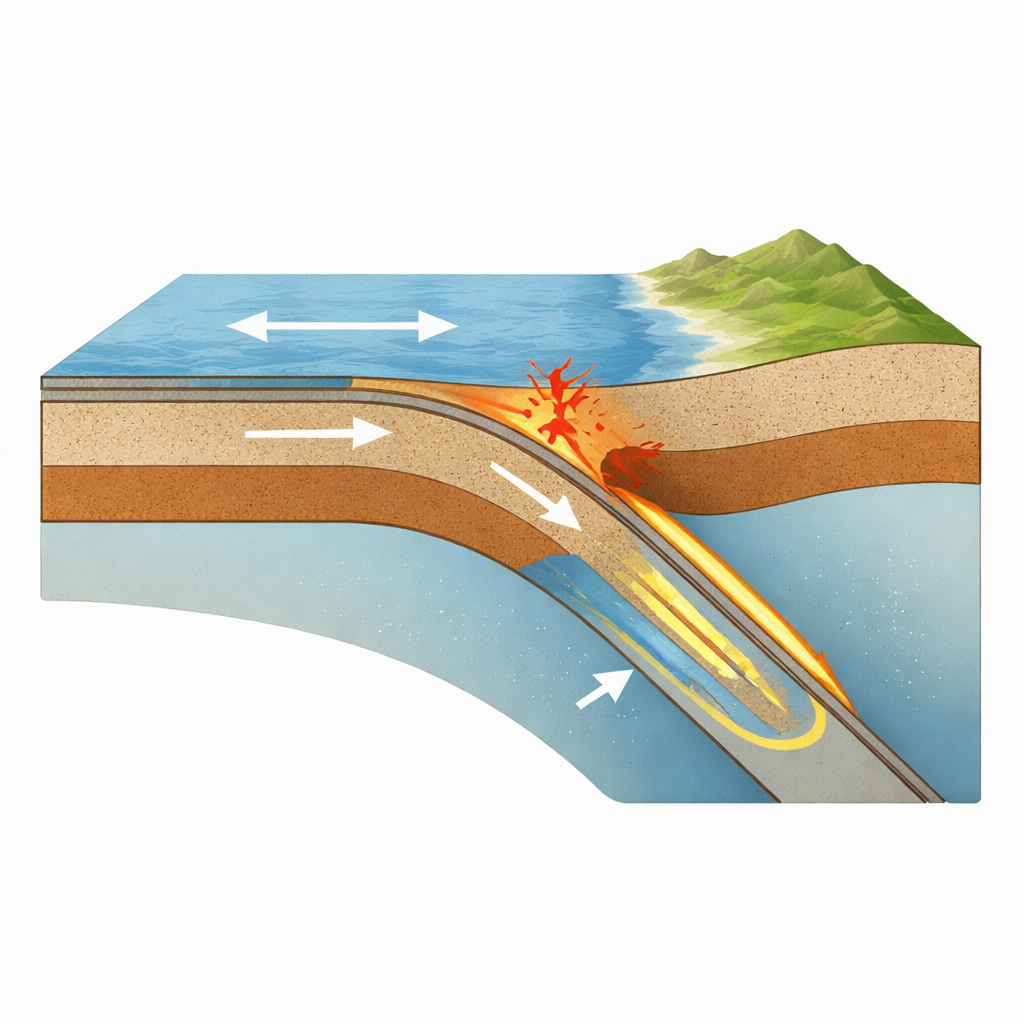
In many well‑studied subduction zones, such as off Japan or the Pacific Northwest, large “megathrust” earthquakes tend to occur only down to a certain depth. Below roughly 350 °C or near the boundary between Earth’s crust and mantle, rocks usually deform too smoothly to generate major ruptures. Instead of sudden breaks, they slowly creep or host weak, rumbling events called slow slips and tremors. This depth limit has shaped how scientists estimate the size of future earthquakes and tsunamis.
A Puzzle in Cold Subduction Zones
Yet several recent quakes defy this rule. The 2021 magnitude 8.1 Kermadec earthquake and deep magnitude‑7 events beneath northern Chile and the Japan Trench ruptured far below the usual stopping point, inside a region called the mantle wedge corner. These areas sit where the descending plate bends beneath the overlying mantle, in relatively cold subduction zones where rocks are transformed into low‑temperature “blueschist” types. The frequent deep quakes there suggest that, under the right conditions, parts of the deep plate interface can behave in a surprisingly brittle, earthquake‑friendly way.
A Closer Look at Transformed Seafloor Sediment
To probe this behavior, the authors tested a rock called metagreywacke—a common type of subducted seabed sediment that has been squeezed and heated into the lawsonite blueschist “facies,” or metamorphic state. They took a sample from Santa Catalina Island in California, where ancient subduction has brought such rocks back to the surface. Microscopic analysis showed a mixture of quartz, feldspar, and fragments rich in minerals like lawsonite, chlorite, and amphibole, consistent with conditions of roughly 330 °C and depths around 37 kilometers in a cold subduction setting. This makes the sample a realistic stand‑in for material now being carried down in modern cold slabs such as Kermadec and the Japan Trench.
How the Rock Fails Under Stress
In the lab, the team crushed the metagreywacke into a fine powder, placed it between blocks of stronger rock, and sheared it under controlled temperature, pressure, and water conditions. By suddenly changing the sliding speed and tracking how resistance evolved, they could tell when the material tended to slide smoothly versus when it became unstable—an essential ingredient for earthquakes. At low temperatures, the material mostly strengthened as it was forced to slide faster, a sign of stable behavior. As temperatures rose into the lawsonite blueschist range under modest normal stress, it shifted into a “velocity‑weakening” regime, where faster sliding reduces resistance and promotes runaway slip. At even higher pressures and temperatures, the material began to flow more ductilely, reducing its tendency to break in a brittle fashion.
Connecting the Lab to Real Faults
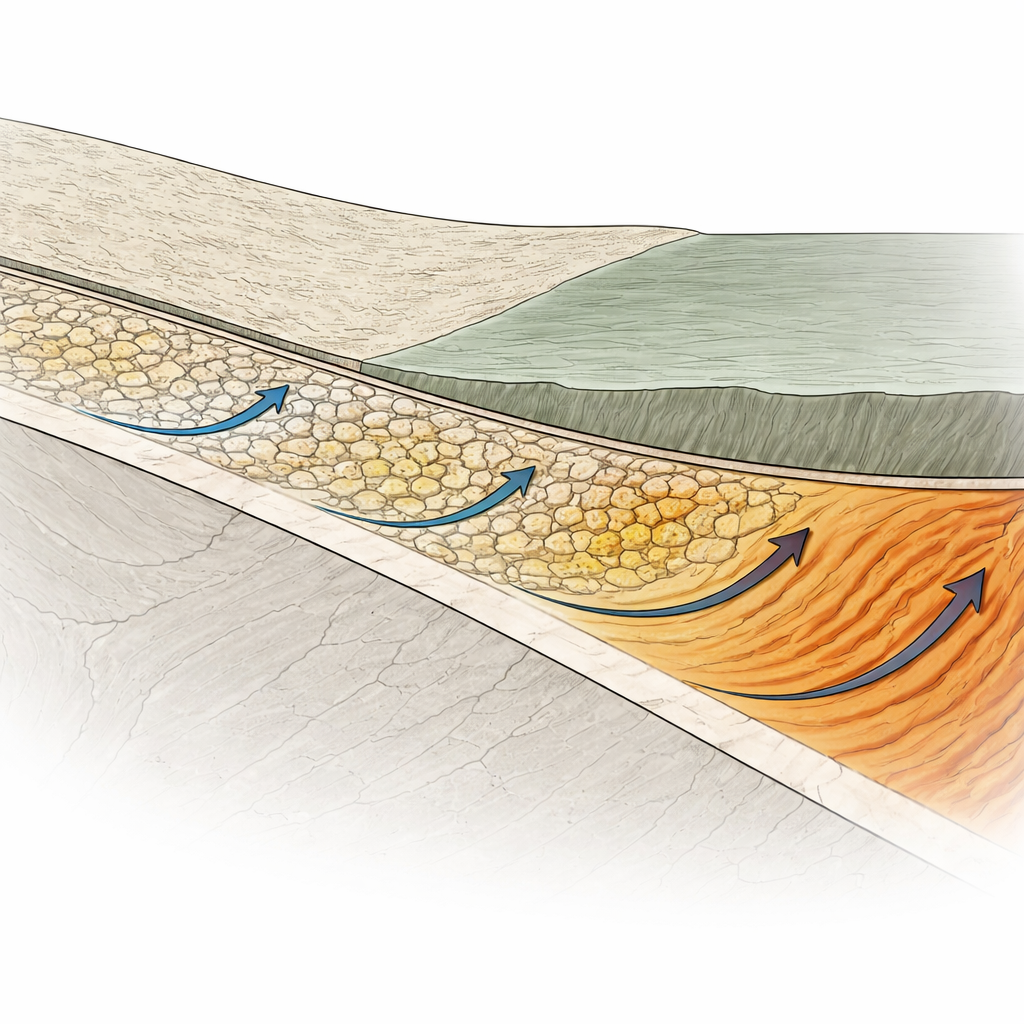
Using these measurements, the authors built a friction model that captures how this sedimentary rock responds across a wide span of depths, temperatures, and slip speeds. They then applied the model to realistic temperature and pressure profiles for the Kermadec subduction zone and the Japan Trench. The calculations suggest that, along the plate interface where lawsonite‑bearing metasediment is present, a broad depth band remains in the unstable, velocity‑weakening state even below the crust‑mantle boundary. Numerical earthquake‑cycle simulations using this rock behavior produce repeating deep ruptures with sizes and depths comparable to observed events in Japan and Kermadec, implying that such rocks can indeed host large megathrust earthquakes in the mantle wedge corner.
What This Means for Earthquake Risk
For non‑specialists, the key message is that the depth limit of big subduction earthquakes is not fixed solely by temperature or by entering the mantle. It also depends strongly on which rocks line the plate boundary and how those rocks have been altered during subduction. In cold zones where lawsonite‑rich metasediments form a continuous layer along the interface, conditions favor brittle, unstable slip over a much greater depth range than previously assumed. This means that some trenches may be capable of producing unexpectedly deep and powerful earthquakes, and that understanding the buried rock types along plate interfaces is essential for more accurate seismic hazard assessments.
Citation: Zhang, H., Barbot, S., Yang, Z. et al. Large megathrust earthquakes in cold mantle wedge corners under lawsonite blueschist facies. Nat Commun 17, 4007 (2026). https://doi.org/10.1038/s41467-026-70315-4
Keywords: subduction megathrust, deep earthquakes, lawsonite blueschist, mantle wedge, fault friction