Clear Sky Science · en
Phosphorylation of WDR48 by phototropins drives starch degradation to promote stomatal opening
How Light Helps Leaves Breathe
Plants constantly balance the need to take in carbon dioxide for photosynthesis with the risk of losing too much water. They do this using tiny adjustable pores on their leaves called stomata. This study reveals a previously unknown molecular switch that helps these pores open quickly when leaves are exposed to blue light, fine‑tuning how plants respond to changing daylight and potentially informing future efforts to breed crops that use water more efficiently.
The Tiny Valves on Leaf Surfaces
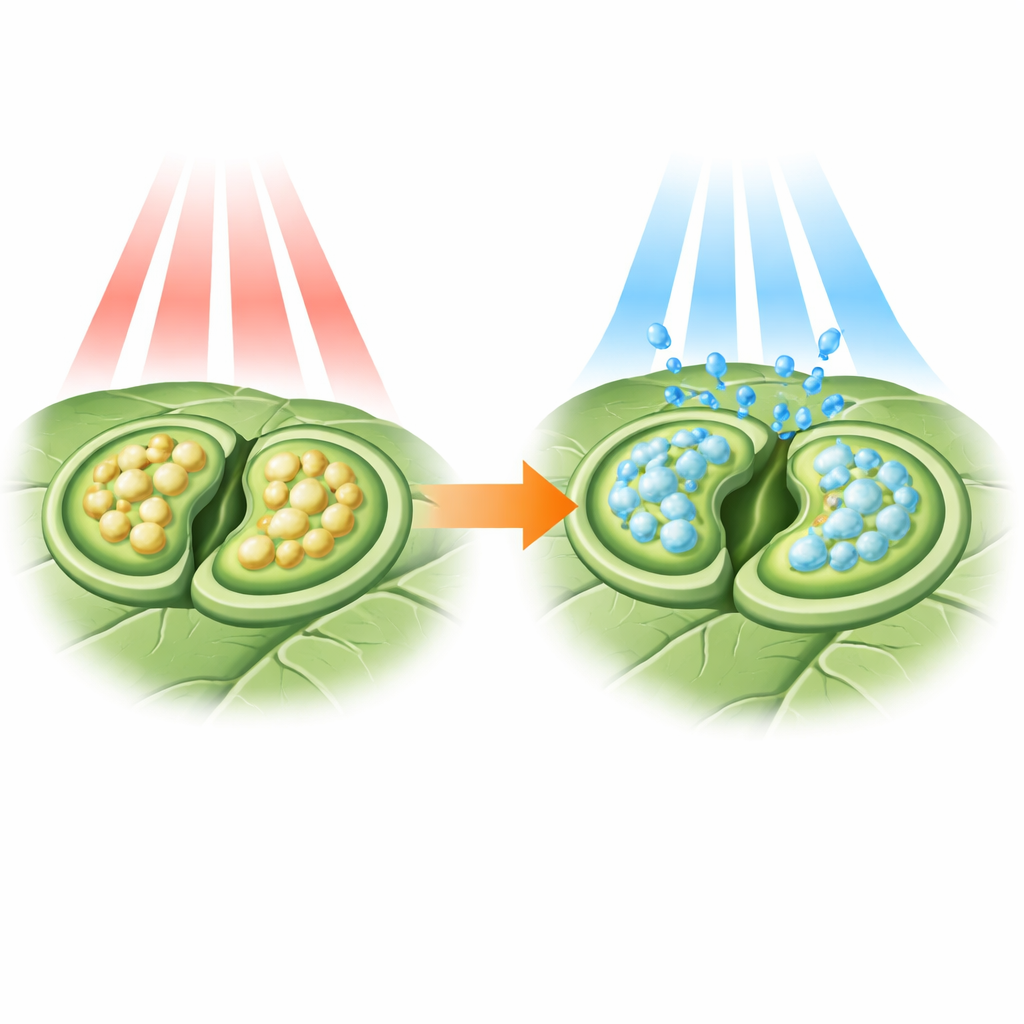
Each stoma is formed by a pair of curved guard cells that can swell or relax to widen or narrow the pore between them. When the pore is open, carbon dioxide enters for photosynthesis, but water vapor also escapes. Light is one of the main cues that tells guard cells when to open. Red light, which drives photosynthesis, and blue light, which is sensed by dedicated light receptors, both influence this decision. Intriguingly, guard cells open more when plants receive both colors together than when they receive either alone, suggesting that distinct light signals are combined inside the cells.
Starch as a Hidden Energy Reserve
Inside guard cells sit many chloroplasts, the green organelles best known for capturing light energy. These chloroplasts also stockpile starch, a compact form of stored sugar. Earlier work showed that under red light, guard cells build up starch, while a burst of blue light causes that starch to be broken down into smaller sugars. These sugars help balance the cell’s internal chemistry and provide building blocks for negatively charged molecules that accompany potassium ions as they flow into the cell. The combined movement of ions and water makes guard cells swell, forcing the stomatal pore open. Yet until now, scientists did not know how blue light was linked so directly to the rapid breakdown of starch.
Finding a New Light‑Sensitive Switch
The researchers used a phosphoproteomics approach—a broad survey of proteins whose activity is controlled by the addition of small phosphate tags—to search for new players in blue‑light signaling in the model plant Arabidopsis. They compared guard cells from normal plants with cells lacking the two main blue‑light receptors, phototropin 1 and 2. One protein, called WDR48, stood out because it gained a phosphate tag at a specific position only in response to blue light and only when phototropins were present. Plants engineered to lack WDR48 could still activate known blue‑light pathways that turn on an ion pump in the cell membrane, but they failed to break down starch or fully open their stomata under blue light, revealing that WDR48 is essential for this branch of the response.
How WDR48 Works with Blue Light Receptors
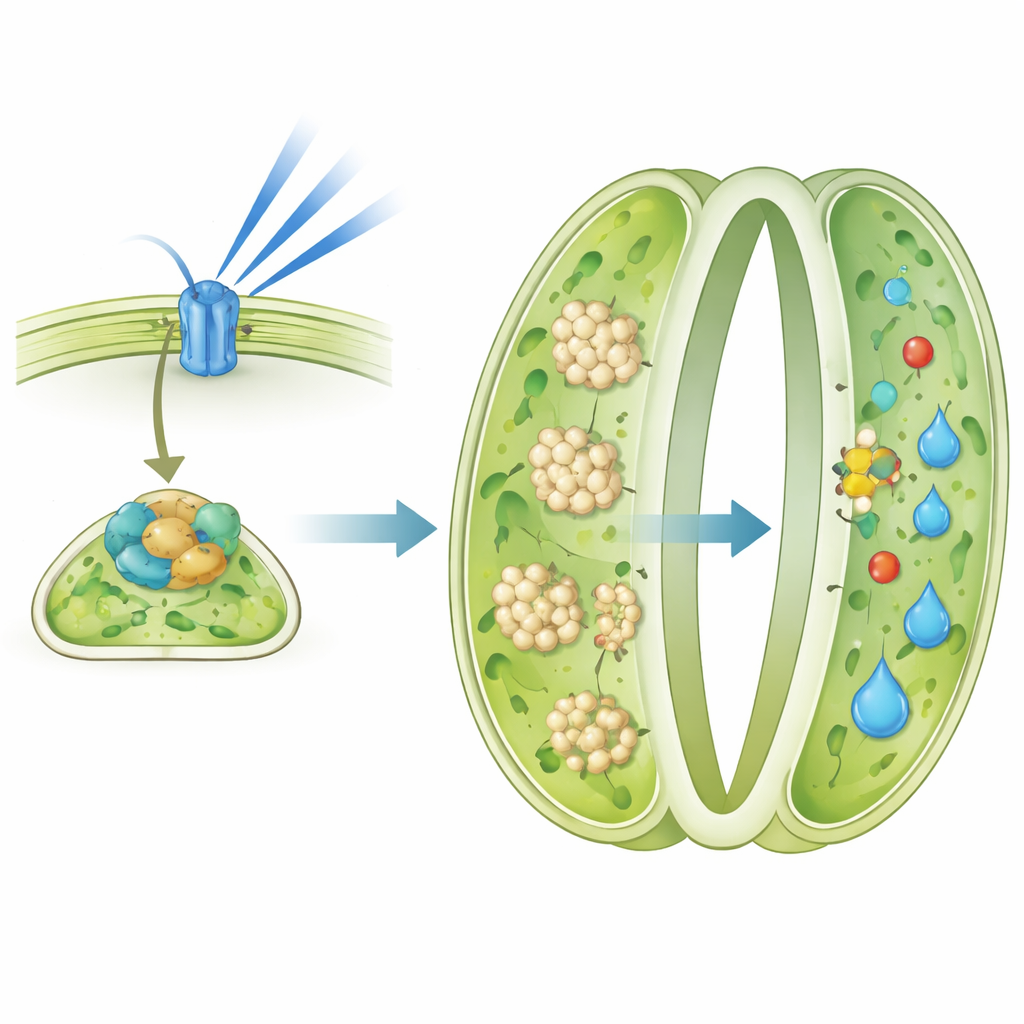
Further experiments showed that phototropins physically interact with WDR48 and can directly add a phosphate group to it in a test‑tube system, confirming that WDR48 is a direct target of these light receptors. Under the microscope, WDR48 was found at the guard cell membrane and around chloroplasts, the very place where starch is stored. By creating precise versions of WDR48 that could not be phosphorylated, or that mimicked being permanently phosphorylated, the team showed that this modification at a single amino acid is required for starch breakdown and rapid stomatal opening in response to blue light. Importantly, WDR48 forms a pathway that is distinct from, but works alongside, another blue‑light route controlled by a protein called BLUS1, which activates the plasma‑membrane proton pump needed to drive ion uptake.
Two Paths Converging on One Pore
The study proposes a simple but powerful model. Red light encourages guard cells to build up starch through photosynthesis, stocking the pantry. When blue light arrives, it activates phototropins, which simultaneously turn on BLUS1 to energize ion transport and phosphorylate WDR48 to trigger starch degradation in guard‑cell chloroplasts. Only when both processes occur together do starch reserves rapidly convert into useful solutes and the pore opens fully. For non‑specialists, the key message is that plants rely on a finely tuned two‑step light control system—one that charges the cellular “battery” and one that spends it—to open their microscopic valves at just the right time, balancing growth with water conservation.
Citation: Yamauchi, S., Fuji, S., Ikuta, H. et al. Phosphorylation of WDR48 by phototropins drives starch degradation to promote stomatal opening. Nat Commun 17, 3601 (2026). https://doi.org/10.1038/s41467-026-70314-5
Keywords: stomatal opening, blue light signaling, guard cell starch, phototropins, plant water use