Clear Sky Science · en
Dual engineering of thermodynamics and kinetics in covalent organic frameworks for separation
Why cleaning up look‑alike chemicals matters
Many chemicals that power modern life have nearly identical twins—molecules with the same formula but slightly different atom arrangements. These "isomers" can behave very differently in the body and the environment, so separating them cleanly is vital for safer medicines, plastics, and drinking water. This study introduces a smart filtering material that tackles the problem from two directions at once: how strongly it grabs target molecules and how quickly it lets them move, leading to cleaner, faster separations of troublesome halogen‑containing chemicals.
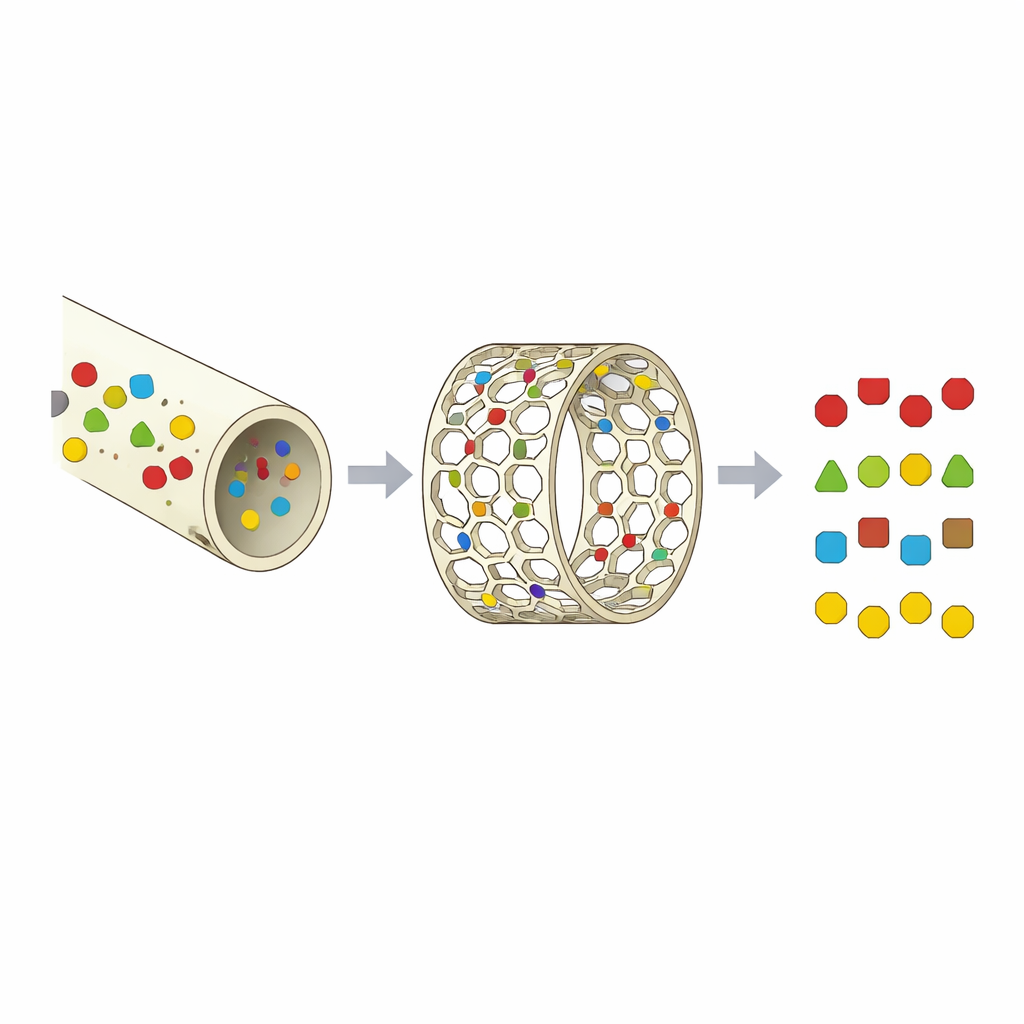
A new kind of porous building block
The work centers on covalent organic frameworks, or COFs—crystalline, sponge‑like solids made by linking organic molecules into precise two‑ or three‑dimensional patterns. Because their pores, shapes, and chemical groups can be tuned almost like Lego pieces, COFs have emerged as promising materials to coat the inside of chromatography columns, the workhorses used in labs to separate chemical mixtures. Up to now, most efforts have focused on tweaking the chemistry of COFs so they "prefer" certain molecules, but have largely ignored how the physical structure affects how fast molecules travel through them. The authors set out to design a COF that improves both this chemical preference and the flow behavior at the same time.
Hollow tubes with a fluorine twist
The researchers created a special COF called HTpBPa‑F by building tubular particles whose walls contain many trifluoromethyl (CF3) groups and whose centers are hollow. The fluorine‑rich groups are strongly electron‑withdrawing, which makes the framework more polar and able to engage in specific attractions with halogenated isomers. At the same time, these groups strengthen how the layers of the framework stack, which encourages the growth of hollow tubes through a process known as Ostwald ripening, where small crystals dissolve and redeposit on larger ones until a shell‑like structure forms. For comparison, they also made a solid fluorinated COF with the same composition but no hollow core, and a fluorine‑free COF, to tease apart the roles of chemistry and structure.
Proving the structure and testing performance
Using X‑ray diffraction, electron microscopy, and gas‑adsorption measurements, the team confirmed that the hollow fluorinated COF was highly ordered, had a large internal surface area, and formed tubular particles with empty interiors, while the control materials were solid. They then grew thin, even coatings of each COF inside narrow glass capillaries to make three types of gas chromatography columns. When challenged with a range of halogenated isomers—chlorinated and fluorinated aromatics, small chlorinated olefins, and brominated and chlorinated alkanes—the hollow fluorinated column cleanly separated every mixture into distinct peaks with high resolution and efficiency. In contrast, the solid fluorinated column produced overlapping or tailing peaks, and the fluorine‑free column often failed to separate the isomers at all. Even a widely used commercial column struggled with some of the same mixtures that the new material handled with ease.
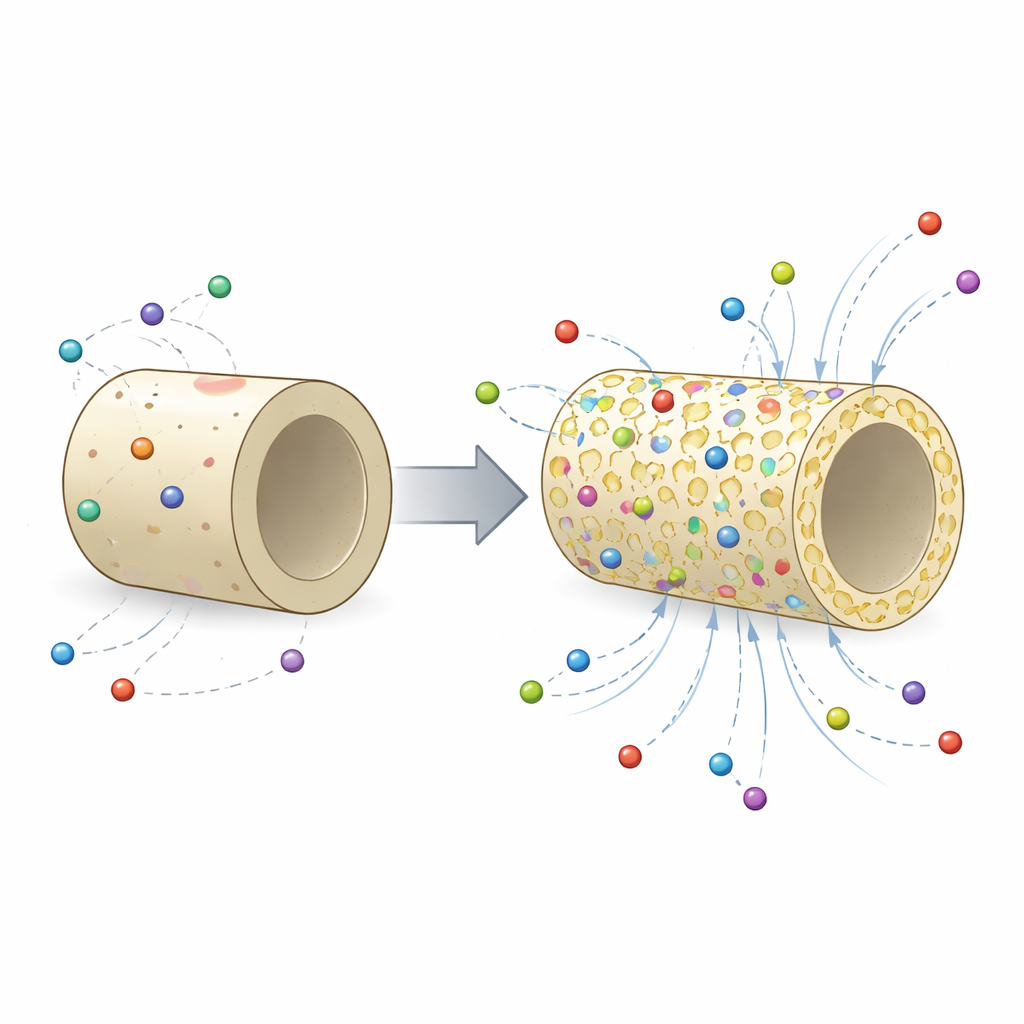
How stickiness and speed work together
To understand why the new column works so well, the authors analyzed both the thermodynamic "stickiness" of isomers to the COFs and the kinetic "traffic" of molecules moving through the pores. Calculations showed that adding CF3 groups strengthens several types of non‑covalent interactions—subtle attractions such as C–H to ring contacts, stacking between aromatic rings, and dipole–dipole forces—especially with certain isomer geometries. This boosts the differences in how strongly the isomers bind, which is key for selective separation. At the same time, chromatographic measurements and molecular dynamics simulations revealed that molecules diffuse much more rapidly in the hollow COF than in the solid one, because the thin walls and inner void shorten travel paths and lower resistance to mass transfer. Together, stronger but still reversible interactions and faster diffusion give sharp, well‑resolved peaks without excessive delay.
Why this matters for real‑world monitoring
Beyond performance, the hollow fluorinated columns proved robust and reliable: they withstood repeated heating cycles up to typical gas‑chromatography temperatures and maintained nearly unchanged efficiency and retention behavior over months of use and across multiple batches. For non‑specialists, the key message is that the authors have shown a practical route to tailor both what a separation material prefers and how quickly it works, using a single, rationally designed porous framework. This dual tuning strategy could be extended to other families of pollutants, pharmaceuticals, and industrial intermediates, paving the way for more precise monitoring and cleaner production of chemicals that look alike but act very differently.
Citation: Rao, ZR., Ran, XQ., Li, ZQ. et al. Dual engineering of thermodynamics and kinetics in covalent organic frameworks for separation. Nat Commun 17, 3896 (2026). https://doi.org/10.1038/s41467-026-70311-8
Keywords: covalent organic frameworks, gas chromatography, halogenated isomers, porous materials, chemical separation