Clear Sky Science · en
Optical control of the cardiac rhythm with photoswitchable NaV1.5 channel blockers
Using Light to Steady a Troubled Heart
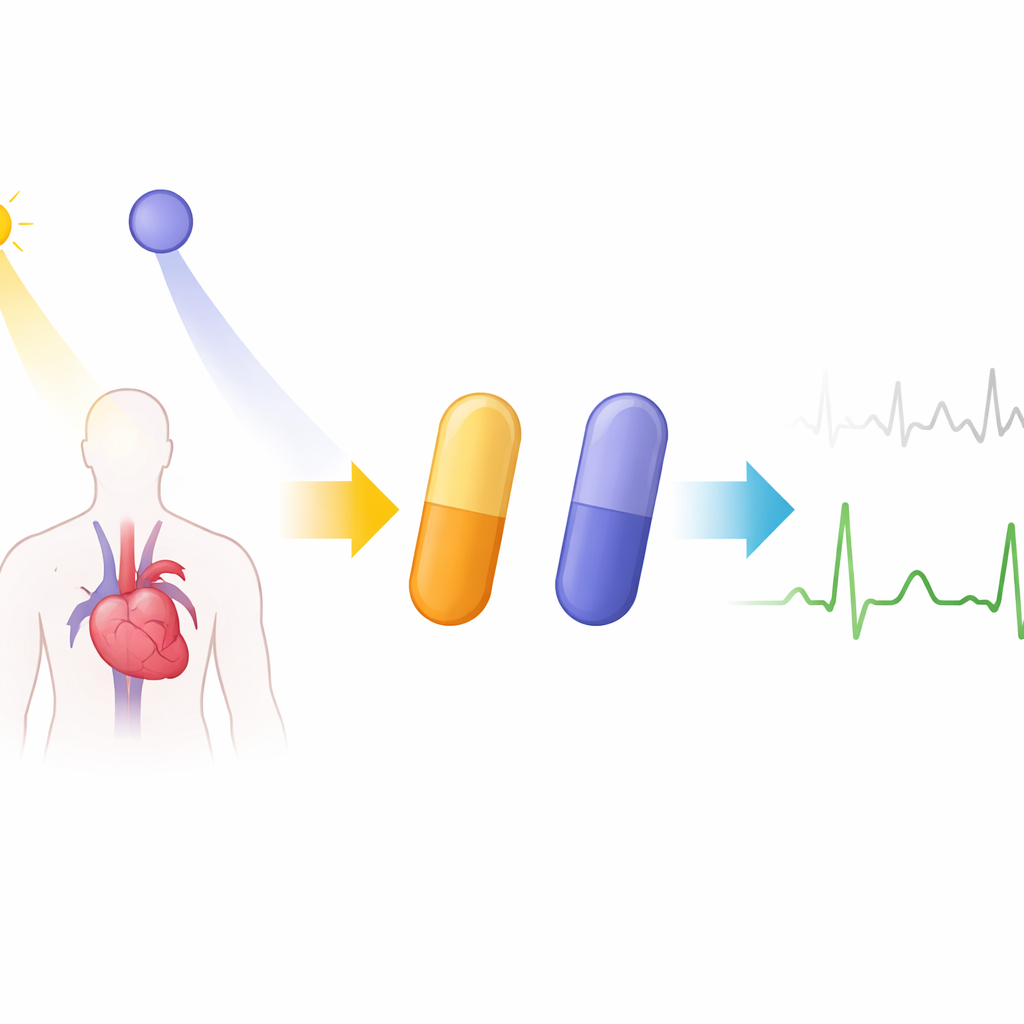
Irregular heartbeats can be dangerous and difficult to treat because the drugs that calm the heart often disturb other parts of the body. This study introduces a way to use light, rather than more drug, to dial heart activity up or down with great precision. The researchers redesigned a classic heart medicine so that it turns “on” or “off” when exposed to different colors of light, allowing them to control heartbeat in cells and living animals almost like flipping a switch.
A Long-Used Drug with Serious Limits
For decades, doctors have used a drug called quinidine to treat dangerous rhythm problems of the heart. Quinidine works by blocking a key protein, NaV1.5, that lets sodium ions rush into heart cells and trigger each electrical beat. But quinidine is blunt rather than precise: it also blocks other channels, including one called hERG that is vital for resetting the heartbeat, and it sticks to receptors in the brain and gut. These off-target actions can slow the heart too much, disturb its electrical recovery, and cause nausea, diarrhea, ringing in the ears, and other side effects. Because of these risks, quinidine’s role in modern cardiology has shrunk, even though the need for safer rhythm control remains high.
Turning Quinidine into a Light Switch
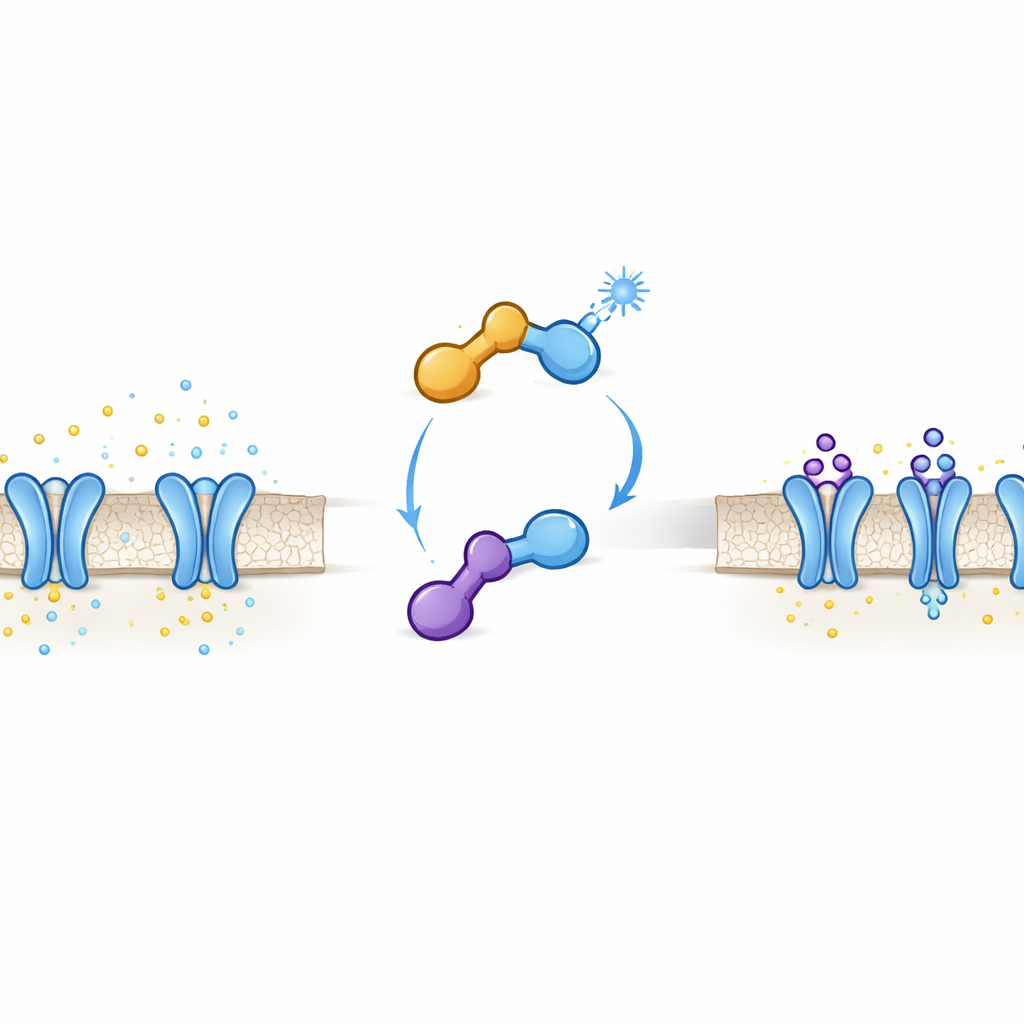
The team set out to keep quinidine’s helpful action on NaV1.5 while making it more selective and controllable. They first modified its structure by adding extra ring-shaped fragments that improved how tightly it fit inside the sodium channel. Building on this, they attached a special light-sensitive unit called an azobenzene group, creating a family of “photoswitchable” quinidine-like molecules. These new compounds can flip between two shapes: a relaxed form in the dark or under blue light, and a bent form under ultraviolet light. In laboratory tests, one standout molecule—named azo-Q2a—blocked NaV1.5 only weakly in its relaxed shape but about seven times more strongly in its bent, light-activated shape. The switching happened quickly and could be repeated many times, giving researchers fine, reversible control over the channel.
Precision Aiming at the Heart’s Sodium Gate
Beyond simple strength, azo-Q2a showed a striking preference for the heart channel it was designed to hit. At working doses, the light-activated form robustly blocked NaV1.5 but barely touched related sodium channels found in nerves and muscles. It also had only modest effects on other key heart channels that shape the electrical signal, including the hERG channel that quinidine notoriously disrupts. In heart muscle cells from rats, shining the activating light in the presence of azo-Q2a sharply reduced sodium currents and slowed the rapid upstroke of the electrical pulse, while leaving potassium currents largely unchanged. When the light color was switched back, the sodium current recovered, demonstrating true on-demand control of the heart’s main “start” signal.
Seeing the Drug in Place and Testing It in Living Fish
To understand why azo-Q2a behaves so selectively, the researchers used cryo–electron microscopy to capture a three-dimensional image of NaV1.5 with the light-activated molecule lodged inside. The structure, resolved at near-atomic detail, showed azo-Q2a sitting in the central cavity of the channel’s pore, surrounded by oily amino acids that cradle its quinidine core and its light-sensitive tail. Two particular building blocks of the protein, Val405 and Phe1760, formed key contacts; when these were altered, azo-Q2a lost much of its potency. Finally, the team moved beyond dishes of cells and into zebrafish larvae, whose transparent bodies let light reach the heart easily. In these tiny animals, soaking them in azo-Q2a left heart rate unchanged in the dark. A brief pulse of activating light slowed the heartbeat significantly, and switching to the opposite color restored it—an optical dial for heart rhythm. In a stress model where a drug drove the heart into fast beating, light-activated azo-Q2a could bring the rate back down.
A New Way to Tame Dangerous Heart Rhythms
Put simply, this work turns an old, often troublesome drug into a smart tool that can be steered with light. Azo-Q2a keeps quinidine’s ability to calm overactive heartbeats but adds much better focus on the main cardiac sodium channel and a built-in “remote control” through different wavelengths of light. While its current activation wavelengths and animal tests are only a first step, the structural map of how azo-Q2a grips NaV1.5 offers a blueprint for designing next-generation medicines. In the future, such light-guided drugs might allow doctors and researchers to correct faulty heart rhythms only where and when needed, reducing side effects while gaining unprecedented precision over the heartbeat.
Citation: Liu, S., Guan, W., Li, Z. et al. Optical control of the cardiac rhythm with photoswitchable NaV1.5 channel blockers. Nat Commun 17, 3723 (2026). https://doi.org/10.1038/s41467-026-70305-6
Keywords: cardiac arrhythmia, sodium channels, optopharmacology, photoswitchable drugs, heart rhythm control