Clear Sky Science · en
Multicomponent solid-solution alloy negative electrode for Li-metal batteries
Why this new battery material matters
From electric airplanes to long-range cars, many future technologies depend on safer, lighter batteries that can store more energy. Lithium metal has long been seen as a dream battery material because it can hold far more charge than today’s graphite anodes, but in practice it forms needle-like spikes called dendrites that can shorten battery life and even cause short circuits. This study introduces a new type of lithium-rich metal foil that tackles these long-standing problems, bringing high-energy lithium metal batteries a step closer to real-world use.

The problem with today’s lithium metal batteries
Conventional lithium metal electrodes promise record-breaking capacity, but to keep them from failing quickly, engineers are forced to use extra lithium and limit how much of it is actually used in each cycle. That means only about one-third to one-half of lithium’s theoretical capacity is realized in practice. Worse, as lithium plates back onto the surface during charging, it tends to grow in uneven, tree-like structures. These dendrites waste active lithium, lower efficiency, and can pierce the separator inside a cell. As a result, most demonstrations either sacrifice energy density to extend lifetime, or achieve high energy only for a small number of cycles—far from what is needed for aircraft or commercial vehicles.
A lithium-rich alloy that behaves differently
The researchers designed a new negative electrode made mostly of lithium—about 90 percent by weight—mixed with small amounts of four other metals: cadmium, silver, magnesium, and aluminum. Rather than forming separate particles or brittle compounds, these elements mix into a single, uniform solid-solution alloy. Microscopy and spectroscopy show that all five elements are evenly distributed down to nanometer scales, and that this uniformity is preserved even after many charge–discharge cycles. The alloy can be made as long metal foils by standard heating and rolling techniques already used in industry, with thicknesses from tens to hundreds of micrometers so it can be matched to different cathode loadings in practical cell designs.
How the alloy tames lithium growth
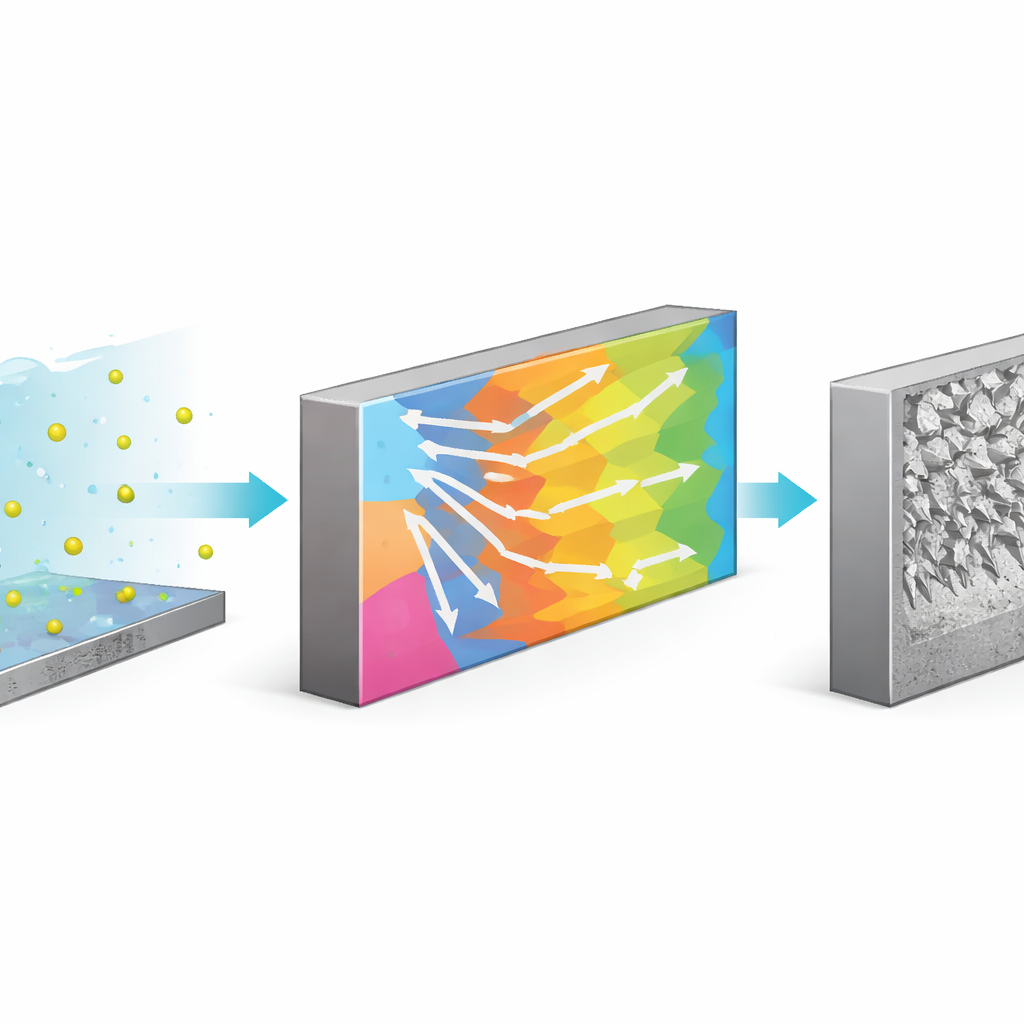
In this alloy, lithium does not simply pile up on the surface when the battery charges. Instead, lithium atoms formed at the interface diffuse rapidly into the interior of the foil. Measurements and simulations indicate that this multicomponent structure creates many low-energy pathways for lithium motion, giving a diffusion rate higher than that of pure lithium metal. At the same time, repeated cycling gradually reorients the lithium inside the alloy so that a crystal surface known as the (110) facet dominates, which is thermodynamically more favorable for smooth lithium insertion. Together, fast inward transport and this preferred surface orientation suppress the formation of surface dendrites and reduce unwanted side reactions with the electrolyte.
Performance in realistic battery cells
Because lithium is used so efficiently inside the alloy, a thin 30-micrometer foil can reversibly deliver about 3,100 milliampere-hours per gram—around 89 percent of the lithium it contains—while remaining dendrite-free. The team built ampere-hour-scale pouch cells pairing this alloy anode with a high-energy nickel-rich cathode similar to those used in modern electric vehicles. These cells achieved a specific energy of 385 watt-hours per kilogram, counted for the entire pouch cell, and retained 82 percent of their capacity after 600 cycles under demanding conditions with limited electrolyte. The alloy also supported high-rate charging and discharging, and worked well in lithium–sulfur cells with very high cathode loadings, suggesting broad compatibility with next-generation cathode chemistries.
What this means for future batteries
To a non-specialist, the key message is that the authors have turned lithium from a fragile, spike-forming metal surface into a stable, lithium-rich sponge that soaks up and releases lithium smoothly from within. By carefully mixing multiple metals into a single, uniform phase, they created a foil that keeps lithium moving inward, protects against dendrite growth, and uses most of its lithium content rather than wasting it. Because the material can be produced using familiar rolling processes and integrated into pouch cells that already reach several hundred watt-hours per kilogram with long life, it offers a realistic path toward safer, lighter, and more durable lithium metal batteries in future aircraft, vehicles, and other high-demand applications.
Citation: Wang, J., Zhu, J., Cai, Y. et al. Multicomponent solid-solution alloy negative electrode for Li-metal batteries. Nat Commun 17, 3958 (2026). https://doi.org/10.1038/s41467-026-70301-w
Keywords: lithium metal batteries, high-entropy alloy anode, dendrite suppression, high energy density, solid-solution electrode