Clear Sky Science · en
Compact mid-infrared fiber probe for in vivo multi-compound monitoring demonstrated using ex vivo human skin
Why tiny light probes in skin matter
Doctors and scientists increasingly want to watch the body’s chemistry change in real time, especially for small molecules like sugar, alcohol and lactate that reveal how organs are coping with disease, injury or treatment. Today’s tools can be slow, bulky, or require enzymes that wear out. This article describes a matchstick-thin fiber-optic probe that uses invisible mid‑infrared light to read several of these chemical signals at once, without dyes or reagents, and shows how it can work in realistic human skin tissue.
Looking for better chemical “vital signs”
Glucose, lactate and ethanol act like chemical vital signs for the brain and body. Abnormal glucose and lactate levels can signal trouble after traumatic brain injury, in diabetes, or during sepsis, while ethanol affects both brain function and how the body processes these fuels. Measuring them together over time would give clinicians a much clearer picture of a patient’s metabolic state. Existing methods, such as microdialysis, slowly pull fluid out of tissue for later analysis and therefore miss rapid changes, while electrochemical sensors rely on fragile enzymes and can foul when proteins or cells coat their surfaces. Newer optical implants have shown promise but are relatively large and require surgery, limiting their use.
Reading molecules with mid‑infrared light
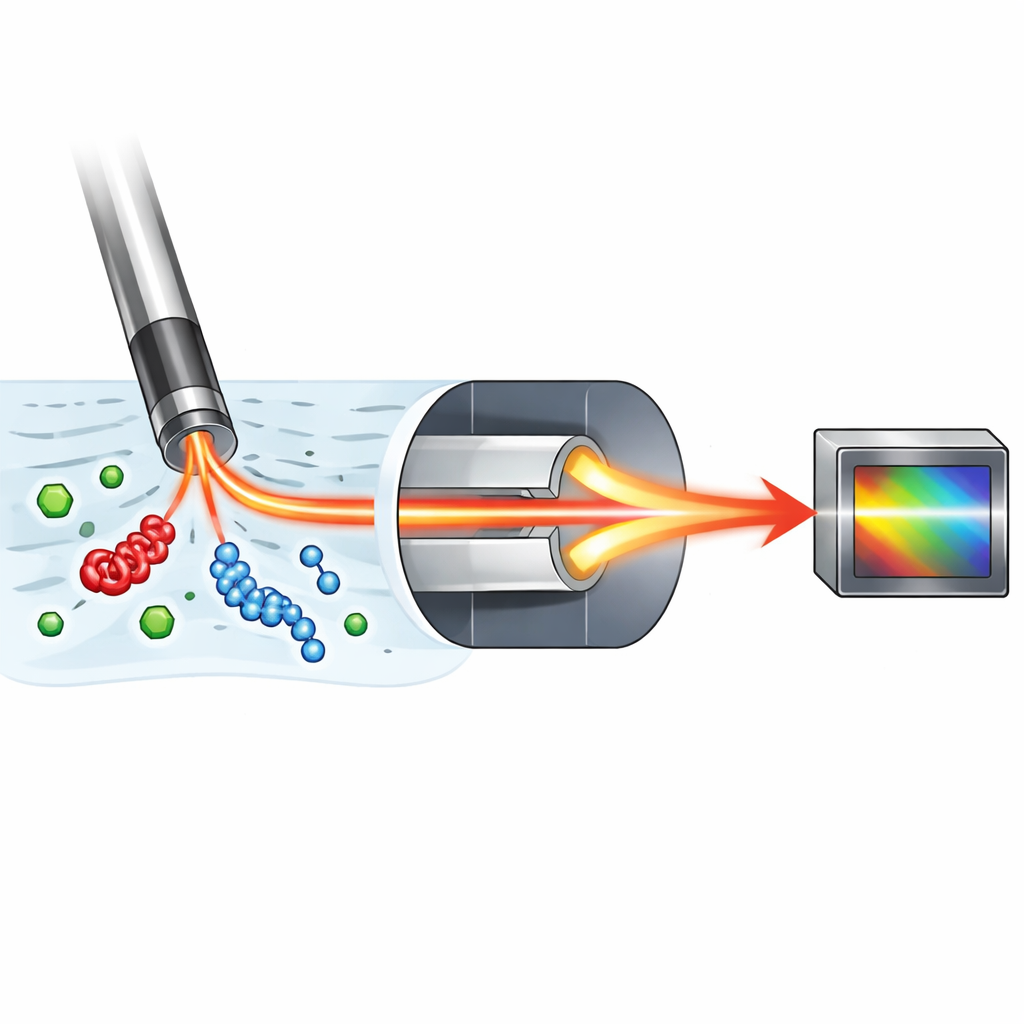
Instead of chemistry on a chip, the authors use chemistry’s own “voices” in the mid‑infrared. In this part of the spectrum, each molecule absorbs light at a distinct set of frequencies, like a barcode made of vibrations in its chemical bonds. The team first measured how ethanol, glucose and lactate absorb mid‑infrared light in a fluid that mimics the body’s cerebrospinal fluid. They confirmed that each has recognizable peaks and built calibration curves linking the height of these peaks to concentration, with detection limits around one thousandth of a mole per liter—sensitive enough for medically relevant ranges. This established that mid‑infrared light alone could, in principle, tell these three compounds apart in watery, salt-rich environments similar to tissue.
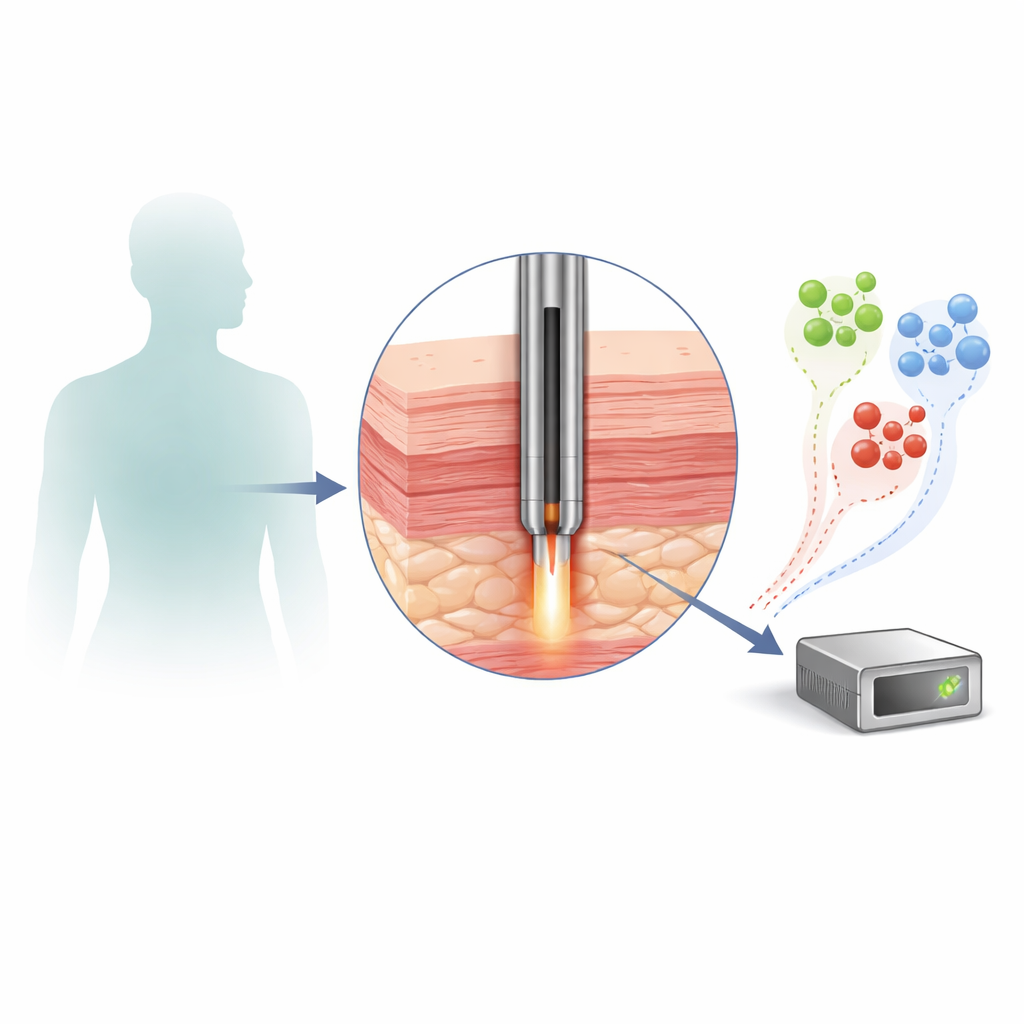
A pencil‑thin probe for living tissue
The core of the work is a compact “transflection” fiber probe just 1.1 millimeters across, small enough to slip into tissue with minimal damage. Two silver‑halide fibers sit tip‑to‑tip inside a tiny plastic tube: one delivers and collects light, while the other is coated with gold to act as a mirror. Light exits the angled tip of the first fiber, crosses a microscopic gap, reflects from the mirror, and returns along the same path. That gap, only about 63 micrometers long, is the sensing region. The tube is wrapped in a thin semi‑permeable membrane that lets small molecules like ethanol, glucose and lactate seep in but keeps out larger proteins and cells, reducing fouling and improving biocompatibility. When coupled to a powerful quantum cascade laser, this setup actually achieves better detection limits than a benchtop infrared spectrometer, even though the latter has higher intrinsic sensitivity, because the laser provides an exceptionally clean, intense beam.
Untangling mixtures and tracking changes
Real tissues contain many molecules at once, so the team tested whether their probe could separate signals from mixed solutions of ethanol, glucose and lactate. Because the infrared “barcodes” overlap, they used mathematical peak deconvolution: the measured spectrum is fit as a sum of known peak shapes for each compound. From the fitted peak heights, they could recover each concentration with only a few percent error, showing that reliable multi‑compound analysis is possible, albeit with somewhat higher uncertainty than when each molecule is measured alone. They then placed the probe into realistic human abdominal skin samples sustained on culture medium. In one test, they compared ethanol levels measured in the skin by their fiber probe to those from a standard microdialysis probe plus gas chromatography. The optical probe followed the rise and plateau of ethanol in tissue with much finer time resolution and slightly higher apparent concentrations, likely because it does not remove fluid or suffer from evaporation losses.
Designing for safety and real‑world use
To move toward use in living patients, the authors examined practical issues: response time, membrane effects and material safety. Adding the protective membrane roughly doubled the time the probe needed to respond to a change in glucose concentration, but it still captured 90% of the change in under a minute—fast enough for the relatively slow shifts in glucose, lactate and ethanol seen in most clinical scenarios. They also immersed the probe in pure water for a week and measured the tiny amount of silver ions released from the fiber. Levels stayed far below known thresholds for cell toxicity, and the membrane further reduces any direct contact with tissue. The main remaining hurdle is the bulky mid‑infrared laser and optics; shrinking these into a portable system is highlighted as a key engineering challenge.
What this means for future patient care
The study shows that a very small mid‑infrared fiber probe can simultaneously track multiple important chemical markers in human‑like skin, in real time, without drawing fluid or using expendable chemicals. While still at a laboratory stage, this approach points toward future bedside devices that could sit quietly inside tissue and continuously report on local metabolism during brain injury care, sepsis treatment, or intensive monitoring of alcohol and glucose effects. In simple terms, the work moves us closer to a new kind of “chemical stethoscope” that listens directly to the body’s molecules using light.
Citation: Lee, TA., Hutter, T. Compact mid-infrared fiber probe for in vivo multi-compound monitoring demonstrated using ex vivo human skin. Nat Commun 17, 3665 (2026). https://doi.org/10.1038/s41467-026-70300-x
Keywords: mid-infrared fiber probe, metabolite monitoring, glucose and lactate sensing, ethanol in tissue, microdialysis alternative