Clear Sky Science · en
Single droplet displacement infrared action spectroscopy
Why tiny droplets matter
Water droplets smaller than the width of a human hair behave differently from a glass of water, yet they fill our atmosphere and underlie technologies like spray-based chemical analysis. This study introduces a new way to listen in on the molecules inside a single levitated droplet by watching how it moves when it absorbs invisible infrared light, opening a window onto chemistry that happens in airborne particles and laboratory microdroplets.
A new way to watch a single droplet
The researchers developed a technique they call Single Droplet Displacement Infrared Action Spectroscopy, or SiDDIRAS. They trap a charged microdroplet, about 8 micrometers across, between four metal rods in an electrodynamic balance that holds it steady using electric forces while keeping the surrounding air at controlled humidity. A tunable infrared laser then shines through the droplet at different colors of invisible light. When the droplet absorbs strongly at a particular color, it warms slightly, loses a bit of water as vapor, becomes lighter, and shifts upward in the trap. By recording how far the droplet moves for each color of infrared light, the team reconstructs a spectrum that reveals what is happening to specific molecules inside that single droplet. 
Listening to a molecular “tuning fork”
To test SiDDIRAS, the authors filled a droplet with water and two salts: sodium chloride (table salt) and sodium azide. The azide ion acts like a molecular tuning fork whose infrared vibration shifts when its surroundings change. In ordinary water, its vibration appears at one frequency; as the salt environment becomes more crowded and ions pair up, that vibration shifts toward higher frequency and its peak broadens. The team first measured these changes in bulk solutions with standard infrared instruments, then compared them with the spectrum from the single suspended droplet.
Finding hidden crowding inside the droplet
The SiDDIRAS spectrum of the single droplet showed the azide vibration shifted by about 5 inverse centimeters and broadened compared with a regular solution, clear signs that ions inside the droplet are packed more tightly than in a saturated bulk sample. The spectrum also revealed a subtle combination band of water motions that had moved to lower frequency, consistent with a heavily disturbed network of hydrogen bonds in the crowded salty environment. Using additional measurements of how droplet size and refractive index change with humidity, the researchers estimated that the droplet contained about 6.1 moles per liter of sodium ions and 2.9 moles per liter of azide, meaning it stayed liquid even while holding more dissolved salt than bulk water normally can.
Peeking into molecular structure and forces
To understand what this crowding means on the molecular scale, the team performed quantum chemical calculations of a sodium–azide ion pair in the presence and absence of water molecules. The models show that adding just a few water molecules bends the azide ion and redistributes electrical charge across the pair, which helps explain the observed frequency shifts without invoking strong chemical bonding. The study also carefully rules out other possible causes for the spectral changes, such as strong electric fields at the droplet surface or uneven composition during the rapid cycles of evaporation and condensation driven by the laser.
New doors for studying airborne chemistry
SiDDIRAS works with straightforward optics, avoids contact between droplets and solid surfaces, and can reach very fine spectral resolution simply by scanning the laser. In this first demonstration, it proves sensitive enough to detect both strong and weak vibrational features in a single microdroplet and to diagnose when that tiny droplet becomes supersaturated with salt. The authors argue that the same approach can be extended to droplets containing biological molecules or light-absorbing dyes, and to questions about how electric charge and surface structure influence reactions in airborne particles. 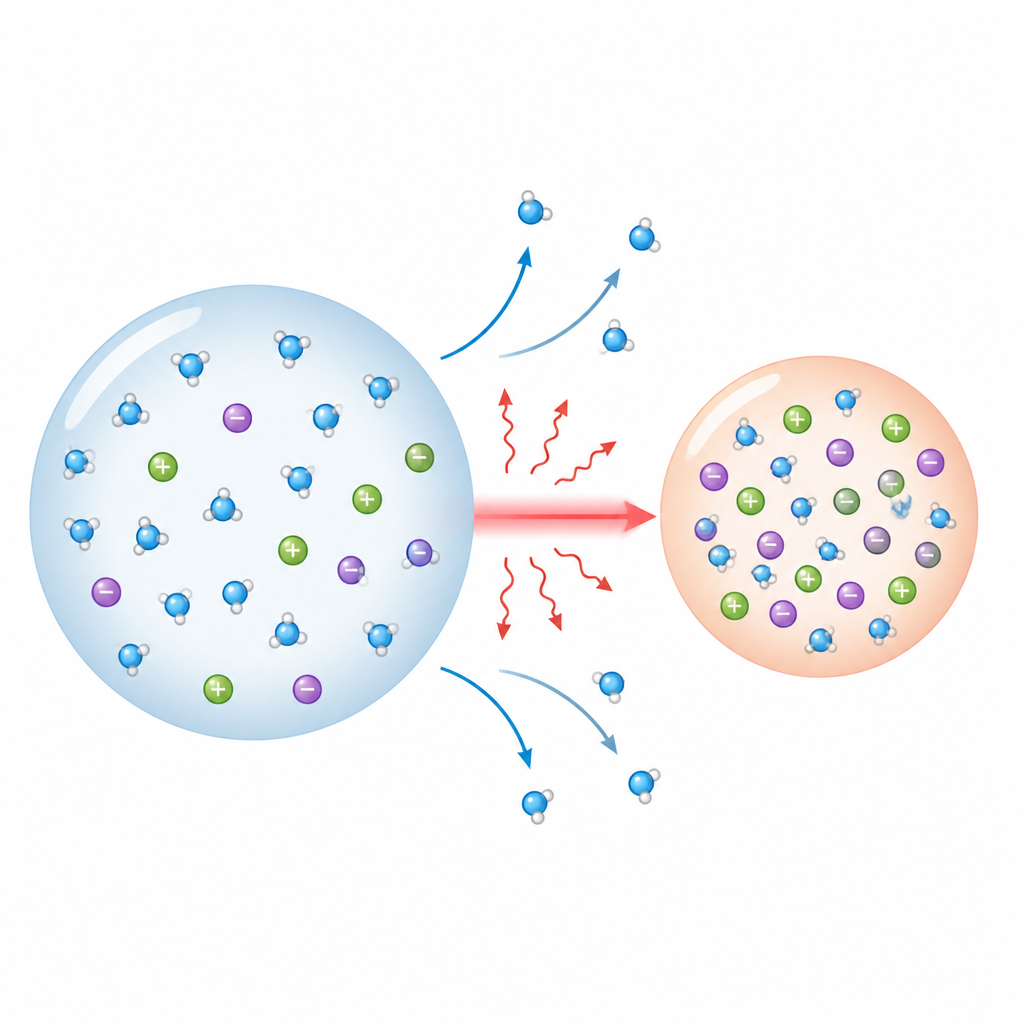
What this means for everyday science
In plain terms, this work shows that scientists can now “weigh” how a single microscopic droplet responds to infrared light and, from its motion, deduce how tightly packed and structurally distorted the water and dissolved ions inside it are. That capability should improve our understanding of chemistry in atmospheric aerosols and sprayed droplets used in analysis and synthesis, where reactions can proceed differently from those in bulk liquids. SiDDIRAS adds a powerful, contact-free microscope for vibrational signals to the toolkit for exploring the hidden life of tiny droplets that influence both technology and climate.
Citation: Khuu, T., Rayaluru, M., Young, B. et al. Single droplet displacement infrared action spectroscopy. Nat Commun 17, 4486 (2026). https://doi.org/10.1038/s41467-026-70299-1
Keywords: microdroplet chemistry, infrared spectroscopy, aerosol particles, electrodynamic balance, supersaturated solutions