Clear Sky Science · en
Mode hopping via nonlinear magnon-magnon coupling in a synthetic antiferromagnet
Why tiny magnetic waves matter
Inside magnets, there are ripples known as spin waves—collective wiggles of countless atomic magnets moving together. These ripples, or “magnons,” can carry and process information using far less energy than today’s electronics. This study shows that in a specially engineered magnetic material, these magnons can suddenly jump between two very different vibrational states when pushed hard enough, much like a light switch snapping between on and off. That kind of abrupt, controllable jump is exactly the kind of behavior needed for future ultra-fast, low‑power information technology.
A magnetic sandwich with two voices
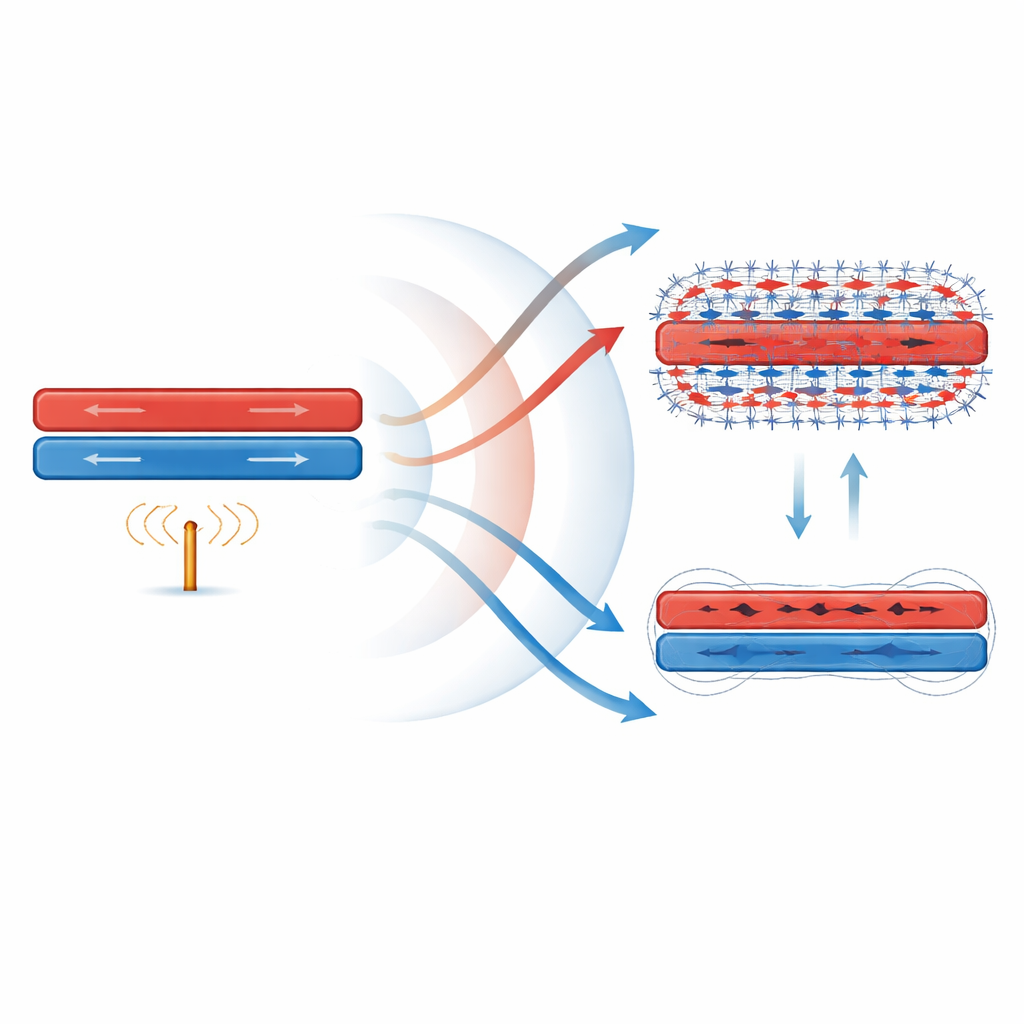
The researchers work with a “synthetic antiferromagnet,” essentially a magnetic sandwich made of two ultra-thin magnetic layers separated by a spacer so that their tiny magnetic moments point in opposite directions. This structure naturally supports two main ways the magnons can move. In one, the two layers wobble out of step with each other, producing a higher‑frequency vibration called the optic mode. In the other, they wobble together in step, creating a lower‑frequency acoustic mode. By applying a carefully oriented magnetic field and sending in radio‑frequency (RF) signals through tiny on‑chip antennas, the team can launch spin waves and watch how these two modes interact and mix.
Pushing waves into a new regime
At low RF power, the behavior of the spin waves is fairly tame and predictable. As the magnetic field is varied, the two modes avoid crossing in frequency, forming a characteristic “anticrossing” pattern that signals strong coupling between them. But when the researchers crank up the RF power, the picture changes dramatically. Above a certain threshold, the overall resonance frequency shifts downward, and the anticrossing gap between the modes gradually closes. These changes reveal that the system is moving into a nonlinear regime where the usual simple rules no longer apply, and where different types of magnons—standing waves confined under the antennas and traveling waves moving along the strip—start exchanging energy strongly.
Sudden jumps and magnetic memory
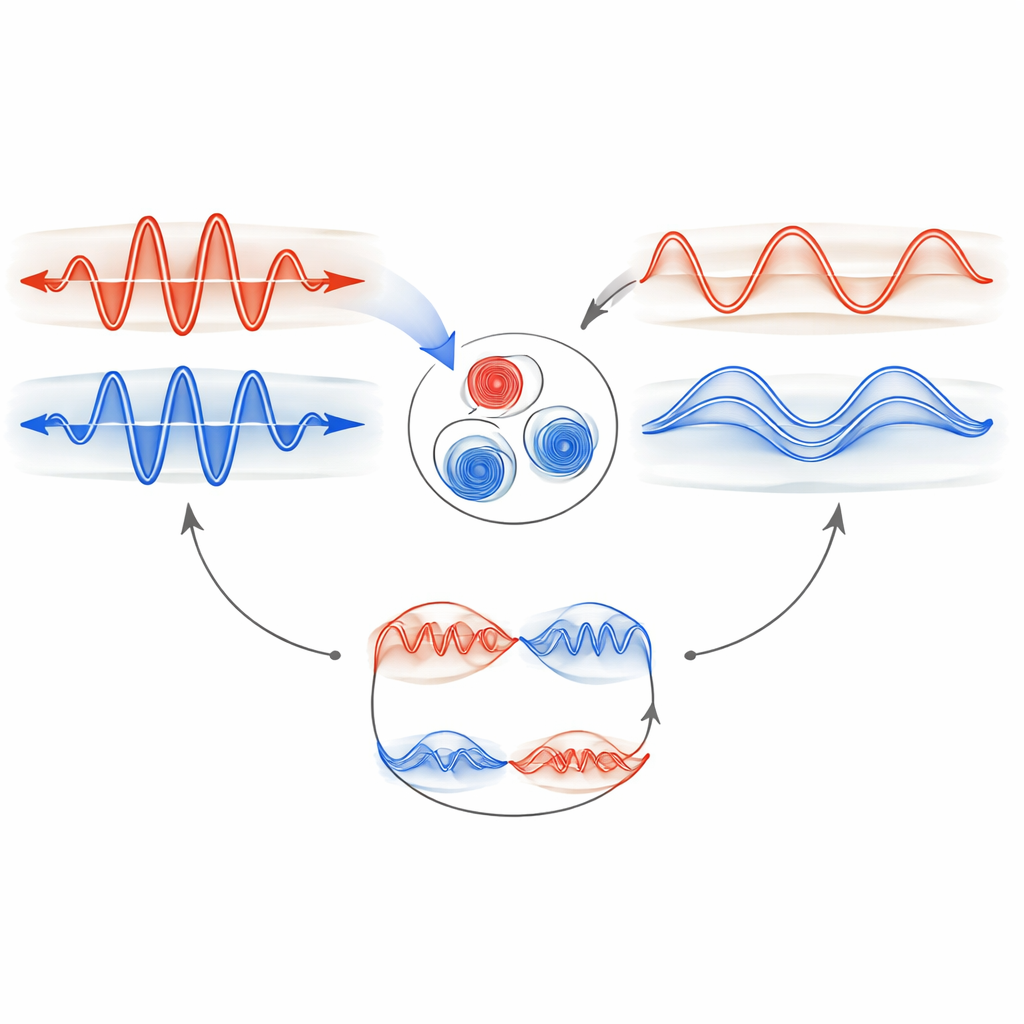
The most striking effect appears once that power threshold is exceeded: the system begins to “mode hop.” As the magnetic field is swept, the high‑frequency optic mode suddenly jumps into the low‑frequency acoustic mode, with frequency changes as large as 5 gigahertz—far bigger than seen in earlier magnonic devices. When the field is swept back the other way, the jump happens at a different field value. This mismatch, known as hysteresis, means the system remembers how it got to its current state. The authors show that this behavior can be understood as a three‑magnon process: one high‑frequency magnon effectively splits into two lower‑frequency magnons when a simple resonance condition is met. Because both traveling and standing magnons are present, there are many allowed ways for this splitting to occur, which widens the field range over which mode hopping and hysteresis appear.
Theory, simulations, and a new control knob
To make sense of these observations, the team builds a minimalist theoretical model that includes four key magnon types: acoustic and optic magnons, each in both standing and traveling forms. In the model, increasing RF power boosts the conversion of traveling magnons into standing ones, giving these standing magnons a kind of “gain” that is balanced by nonlinear damping. Solving the equations shows that, beyond a critical gain, the system naturally jumps between acoustic‑dominated and optic‑dominated states and develops hysteresis, in close agreement with the measurements. Micromagnetic simulations back up this picture by directly showing how the population shifts from traveling to standing magnons as the drive grows stronger. Together, experiment, theory, and simulation reveal a new regime of strongly nonlinear magnon dynamics in synthetic antiferromagnets.
From fundamental waves to future switches
For non‑specialists, the main message is that the authors have shown how to make tiny waves inside a magnet abruptly jump between two “voices” in a controlled, repeatable way, with a built‑in memory of their past. Because the frequency jump is so large and can be triggered simply by adjusting the RF power or magnetic field, this effect could be harnessed as a fast on‑chip frequency converter, a logic element, or a switch that turns coupling between different signal pathways on and off. In other words, these nonlinear magnon jumps transform an exotic quantum‑like wave phenomenon into a practical tool for future low‑energy information processing technologies.
Citation: You, M., Song, M., Seo, J.S. et al. Mode hopping via nonlinear magnon-magnon coupling in a synthetic antiferromagnet. Nat Commun 17, 3842 (2026). https://doi.org/10.1038/s41467-026-70298-2
Keywords: magnonics, synthetic antiferromagnet, spin waves, nonlinear dynamics, frequency switching