Clear Sky Science · en
Perovskite solar cells with enhanced thermal fatigue resistance under extreme temperature cycling
Solar power that can handle harsh heat and cold
Solar cells destined for high-altitude drones or satellites must endure frantic swings between blazing sunlight and deep cold. Metal halide perovskite solar cells are light and highly efficient, but their layered structure can crack and peel under such punishment. This study shows how tailored molecules can act like microscopic shock absorbers inside these cells, greatly improving their ability to survive extreme temperature cycling without sacrificing performance.
Why promising solar cells still break down
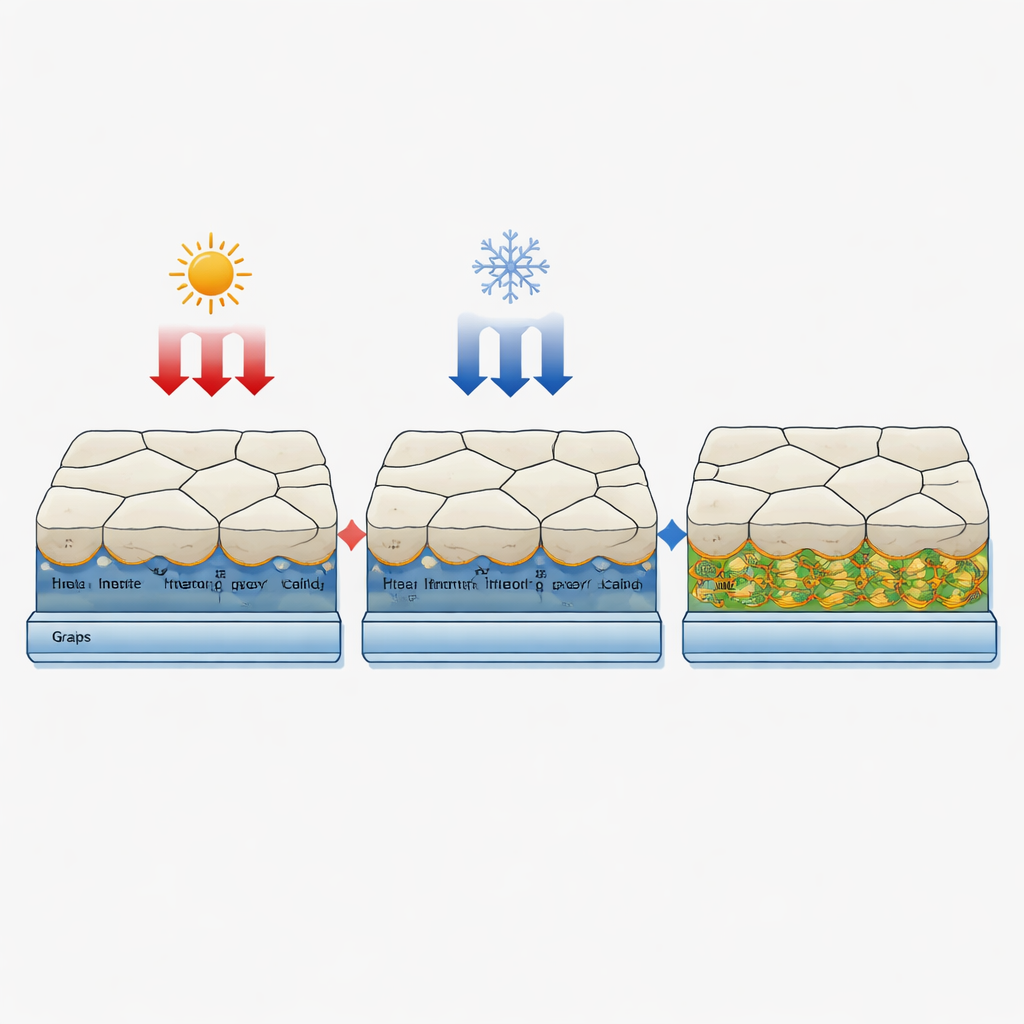
Perovskite solar cells pack impressive power output into thin, low-cost films, making them attractive for portable and space-based energy. Yet their layers expand and contract at very different rates when temperatures change. In tests that drove devices between about −80 °C and +80 °C, these mismatches created strong pulling forces that concentrated at tiny crystal boundaries and at the interface between the active layer and the glass-based electrode. Over time, this "thermal fatigue" led to microscopic cracks, weakened adhesion, and a drop in efficiency, especially in how cleanly electric current could flow through the device.
Microscopic glue between crystal grains
To tackle weak spots inside the perovskite layer, the researchers blended a small molecule called alpha-lipoic acid into the solution from which the crystal film forms. During the normal heating step used to make the film, these molecules link together into polymer chains that collect along the boundaries between microscopic crystal grains. There, they act as flexible bridges: they bond to the perovskite, help heal defects, and connect neighboring grains. Advanced imaging and mechanical mapping showed that these polymer-filled boundaries stick better and distribute stress more evenly, without creating new unwanted crystal phases or disturbing the film’s overall structure.

Stronger bonding where layers meet
The second vulnerability lies where the perovskite touches the transparent conducting layer that collects charges. The team modified this interface using a family of lipoic-acid-based linker molecules combined with a standard self-assembled monolayer already used in high-performance devices. By tuning the sulfur-containing end groups, they created versions that bind especially strongly to both the electrode and the perovskite. One derivative, featuring a positively charged sulfonium group, proved particularly effective. Mechanical pull-off tests showed that this treatment increased the force needed to separate the layers, while computer simulations and spectroscopy revealed stronger electronic coupling and more favorable energy alignment for charge extraction.
High efficiency that lasts through extreme cycling
With both the grain boundaries and the interface reinforced, the researchers built complete perovskite solar cells and pushed them through a custom temperature-cycling protocol from −80 °C to +80 °C. The best devices, combining lipoic acid inside the perovskite with the sulfonium-based linker at the contact, reached stabilized power conversion efficiencies around 26% under standard sunlight—on par with top laboratory results. More importantly, after 16 severe temperature cycles, these cells still delivered 84% of their initial efficiency, outperforming untreated devices and those using less effective additives. The main loss mechanism in all cells was a drop in fill factor, linked to growing resistance and interfacial damage, but the dual-reinforced design slowed this deterioration. Continuous operation tests under strong illumination and elevated temperature further confirmed the improved robustness.
What this means for real-world and space solar power
For non-specialists, the takeaway is that clever chemistry can turn fragile, high-efficiency perovskite films into far tougher energy harvesters. By inserting molecular "springs" and "glue" at their most vulnerable internal joints, the authors show that these solar cells can better withstand the repeated heating and cooling they would experience on satellites, high-altitude platforms, and other demanding environments. The work provides a blueprint for designing future additives that strengthen both internal crystal connections and layer interfaces, bringing lightweight perovskite photovoltaics closer to long-lived use in harsh, rapidly changing climates and in space.
Citation: Yilmaz, C., Buyruk, A., Shi, Y. et al. Perovskite solar cells with enhanced thermal fatigue resistance under extreme temperature cycling. Nat Commun 17, 3669 (2026). https://doi.org/10.1038/s41467-026-70293-7
Keywords: perovskite solar cells, thermal fatigue, temperature cycling, interface engineering, space photovoltaics