Clear Sky Science · en
Electrochemically induced hyperfluorescence based on the formation of charge-transfer excimers
Brighter liquid light for everyday use
Imagine a light source that is not a rigid bulb or panel, but a thin layer of glowing liquid that can be poured into new shapes or printed as artwork and displays. This study shows how to make such “fluid light” much brighter and longer lasting by redesigning the light‑making molecules inside. The researchers introduce a new way to coax extra light out of electrically driven liquids and even use it to write glowing calligraphy.
Why glowing liquids matter
Electrochemiluminescent devices (ECLDs) produce light when an electric voltage drives chemical reactions in a liquid or gel. Because the active layer is a fluid, these devices can be simple, flexible, and cheap to manufacture, and they already play a big role in highly sensitive medical and environmental tests. However, when used for lighting or displays, existing ECLDs have struggled: they are too dim and their brightness fades within minutes. The underlying problem is that the standard light‑making route requires a high density of short‑lived charged molecules that easily break apart, damaging the solution and shortening its life.
Borrowing tricks from efficient LEDs
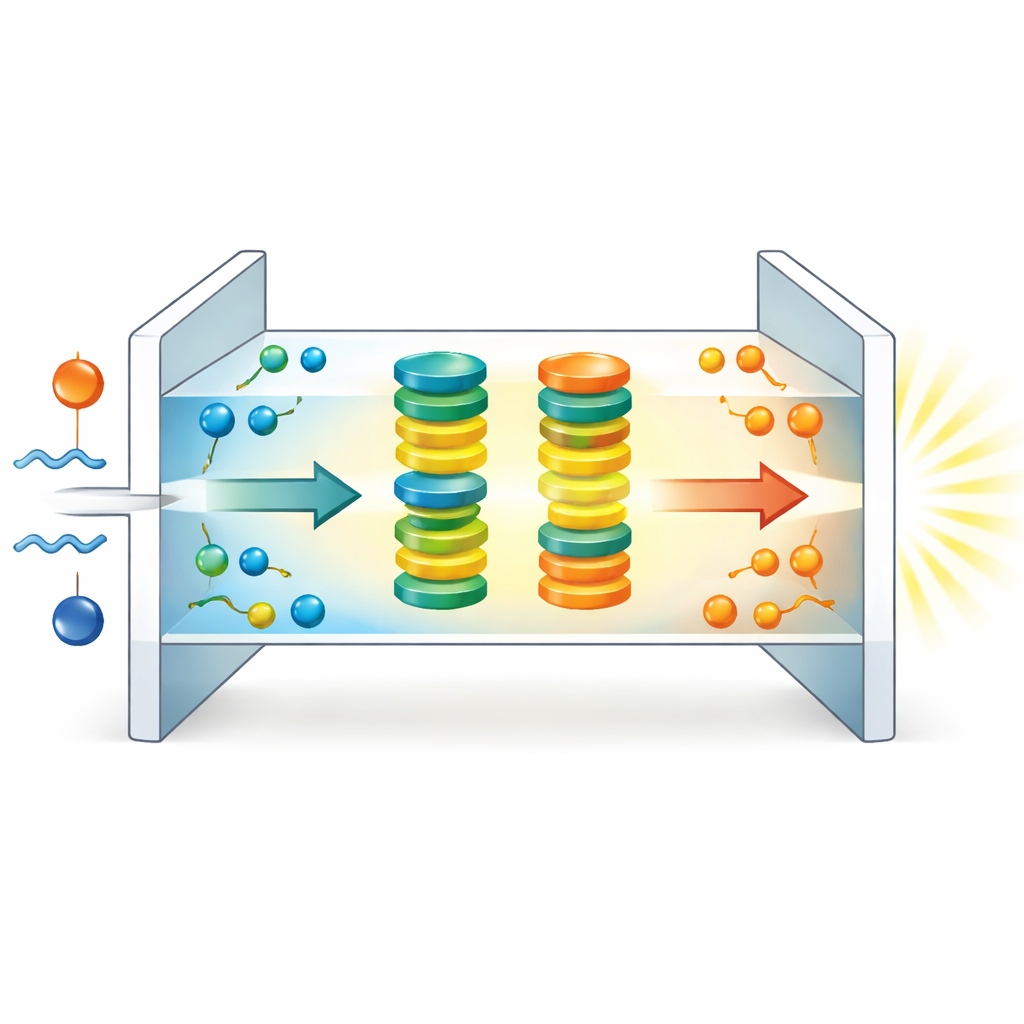
Solid‑state organic LEDs became highly efficient once chemists learned to harvest otherwise “dark” energy states using a process called thermally activated delayed fluorescence. The new work adapts this idea to glowing liquids through a concept the authors call electrochemically induced hyperfluorescence. Instead of depending directly on fragile charged dye molecules to emit light, they add special helper molecules that first gather and convert energy, then hand it off efficiently to a final bright dye. These helpers are designed so that their electron‑donating and electron‑accepting parts sit face‑to‑face, and at high concentration in a mixed solvent they stack into tightly bound pairs that share charge between two molecules.
How double‑deck molecules boost light
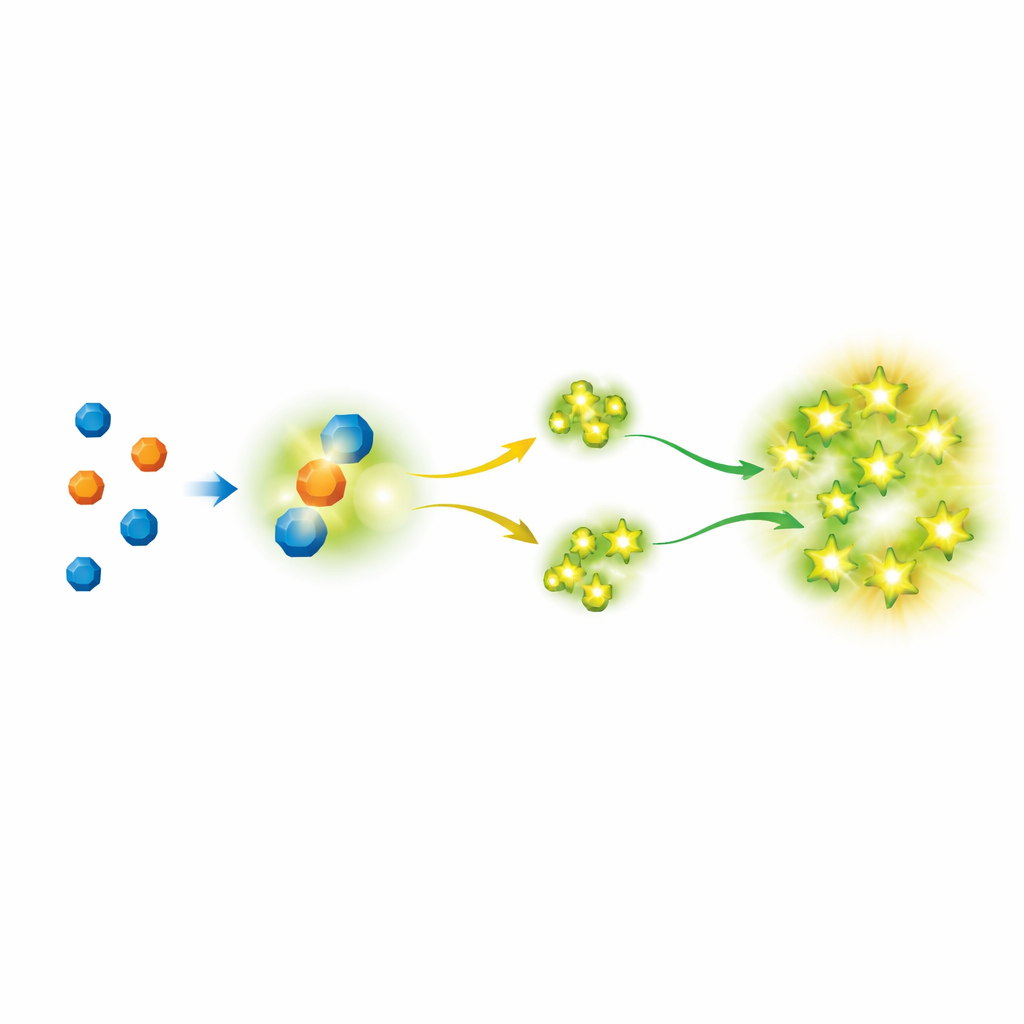
In operation, an alternating voltage creates positively and negatively charged versions of these helper molecules near the electrodes. When they meet, they form what the authors call charge‑transfer excimers—stacked pairs where charge is shared across the two partners. These excimers can rapidly shuffle energy between different internal states and convert nearly all of it into a bright form that can be passed on to the terminal dye through near‑field energy transfer, rather than by direct charge recombination. Measurements of light spectra and timing in solution show that as the helper molecules become more concentrated, their emission shifts from blue to green and becomes strongly delayed, a signature that this indirect pathway is at work and is particularly efficient in the stacked excimer state.
Building brighter, longer‑lived devices
Using these ingredients, the team builds liquid‑based devices from two transparent glass plates coated with electrodes and separated by a hair‑thin gap filled with solution. In a standard configuration, they obtain yellow light entirely from the terminal dye, proving that the excimers successfully act as energy brokers rather than emitters themselves. These devices reach luminance above 3600 candelas per square meter in each direction—already several times brighter than earlier designs. Adding a thin silver mirror behind one side reflects otherwise lost light back through the front, pushing the brightness to more than 6200 candelas per square meter. Importantly, by driving the devices with a controlled current rather than a fixed voltage, they maintain half of their initial brightness for over 20 minutes at practical light levels, more than ten times longer than previous liquid‑based counterparts.
Writing with liquid light
To showcase what this improved performance enables, the researchers pattern ultrathin gold electrodes into fine calligraphic shapes and pair them with simple rectangular transparent contacts. When they fill the gap between them with the glowing liquid and apply an alternating voltage, only the regions where the patterned and transparent electrodes overlap light up. The result is a miniature display where letters and motifs drawn in metal appear as sharp lines of light just 10 micrometers wide—narrow enough to render detailed logos and text. By wiring each region separately, they can even switch individual characters on and off, pointing toward animated or reconfigurable fluid displays.
Design rules for future fluid light
The authors also test a second helper molecule with slightly different energy levels and show that, when those levels are not well aligned with the final dye, the device falls back into a less efficient mixed mode that partly relies on the old, damaging chemistry. Through careful optical and electrical measurements, they derive simple energy‑gap thresholds that favor the desired excimer‑based pathway and minimize wasteful charge transfer. In plain terms, the helper and dye molecules must be tuned so that energy can hop between them, but charges do not easily leak. With the right choices, the new mechanism delivers brighter, more stable liquid light, bringing practical lighting and flexible, patterned displays based on glowing fluids much closer to reality.
Citation: Moon, CK., Yasuda, Y., Kusakabe, Y. et al. Electrochemically induced hyperfluorescence based on the formation of charge-transfer excimers. Nat Commun 17, 3753 (2026). https://doi.org/10.1038/s41467-026-70291-9
Keywords: electrochemiluminescence, hyperfluorescence, fluid light displays, organic emitters, charge-transfer excimers