Clear Sky Science · en
High-accuracy fatigue life prediction and early fracture warning for ferromagnetic metals via spin correlation amplification
Why metal fatigue matters to everyday life
From airplanes and high-speed trains to bridges and elevators, many critical machines we rely on are built from metal parts that are pushed and pulled millions of times during service. These repeated loads gradually weaken the metal in a process called fatigue, which can lead to sudden, catastrophic fractures without obvious warning. The study described here presents a new way to "listen" to the earliest signs of damage inside common magnetic metals, promising more accurate lifetime predictions for parts and a practical early warning system before they break.
Hidden cracks and the limits of today’s tests
Engineers have spent more than 150 years trying to understand and predict metal fatigue, but real structures still often fail unexpectedly. Standard design tools rely on so‑called stress–life curves, which relate how hard you load a metal to how long it will last. These curves are easy to use but notoriously imprecise, often off by a factor of ten or more. High‑magnification imaging methods can see fine defects, and various sensors can monitor sound, heat, or surface strain as a part is cycled, yet all share a major blind spot: the most dangerous early damage happens at the scale of atoms and crystal defects and barely changes the metal’s overall stiffness or shape. By the time conventional methods notice something is wrong, microcracks may already be racing toward failure.
Watching atoms and spins instead of just cracks
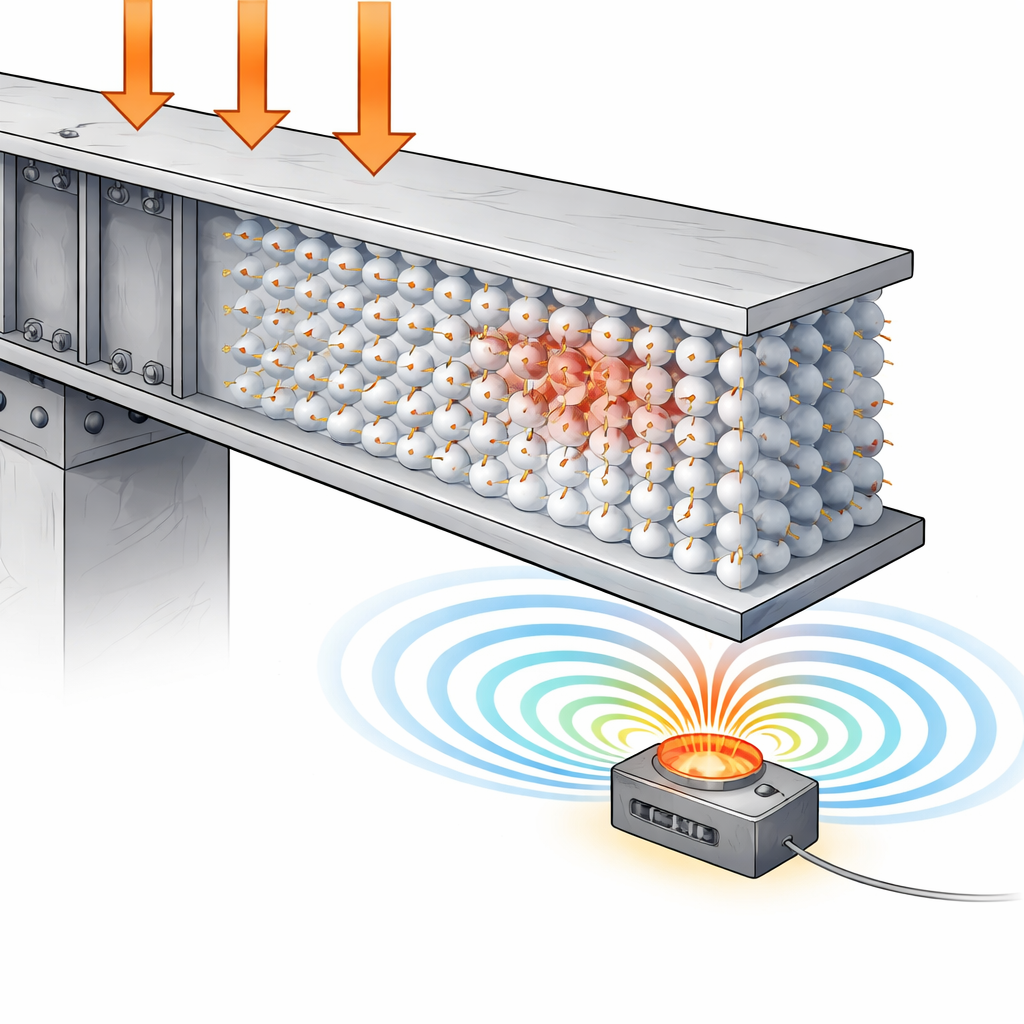
The authors focus on ferromagnetic metals such as iron, steel, and nickel, which are widely used in heavy infrastructure. At the microscopic level, fatigue is driven by the motion and rearrangement of dislocations—line‑like defects where layers of atoms slip past one another. Each loading cycle leaves a tiny residue of irreversible slip, gradually changing the spacing between atoms and weakening the bonds that hold them together. In ferromagnetic materials, those same atoms also carry tiny magnetic moments, or spins, whose interactions give rise to magnetism. The study shows that as atomic bonds weaken during fatigue, the interactions between spins weaken in step, tying mechanical damage directly to small changes in the metal’s internal magnetic behavior.
Amplifying tiny changes into measurable signals
On their own, the magnetic changes caused by sub‑nanometer shifts in atomic spacing are far too small to detect directly. The key idea of the work is to use an external magnetic field to amplify these changes through what the authors call spin correlation conduction. When a strong magnetic field is applied to a fatigued metal sample, the spins in each thin layer of the material influence the next layer along the field direction. As the field passes through a stack of many slightly damaged layers, each one nudges the field a little, and these tiny deflections multiply. The result is that minute weakening of atomic bonds inside a localized damage zone gets turned into a much larger change in the magnetic signal measured at the surface. The team tracks this effect using a quantity they define as MagDrift, the change in peak‑to‑peak magnetic response during each loading cycle, which proves to be dramatically more sensitive than traditional measurements of strain or displacement.

Testing many metals and predicting failure
To see whether this magnetic amplification could reliably track fatigue, the researchers tested 193 samples made from five common ferromagnetic alloys, subjecting them to a total of 3,700 hours of cyclic loading in a controlled magnetic field. For all iron‑based alloys, MagDrift followed a characteristic pattern: a rapid change early on as dislocation structures formed, a long, nearly linear growth phase as microcracks slowly accumulated, and a sharp acceleration shortly before final fracture. Across different stresses and materials, the average rate at which MagDrift changed was closely linked to how many cycles the sample could endure. By analyzing this rate on a logarithmic scale, the authors built a new fatigue‑life equation that ties macroscopic lifetime directly to microscopic magnetic‑flux evolution, achieving prediction accuracies with R² values above 0.9—far better than conventional stress–life curves.
Early warnings before metal parts break
Beyond prediction, the study proposes a practical two‑stage warning system for fracture. In the first stage, early MagDrift data—sometimes from as little as the first 10% of the part’s life—feed into the new model to estimate the total safe operating lifetime and signal when about 90% of that life has been consumed. This gives operators a planning window to schedule inspections or replacements. In the second stage, the system looks for sudden, characteristic jumps or drops in MagDrift that herald the rapid growth of a critical crack. In tests, all 193 samples produced clear warning signals before breaking, often with thousands of cycles of safe margin remaining. Because the method is non‑contact and responds to atomic‑scale changes rather than visible cracks, it offers a route to real‑time monitoring of key structures—such as bridge cables, ship components, and aircraft parts—potentially reducing both tragic accidents and unnecessary early replacement.
Citation: Zhang, B., Zhang, L., Wu, X. et al. High-accuracy fatigue life prediction and early fracture warning for ferromagnetic metals via spin correlation amplification. Nat Commun 17, 4015 (2026). https://doi.org/10.1038/s41467-026-70290-w
Keywords: metal fatigue, ferromagnetic steels, magnetic sensing, structural health monitoring, early fracture warning